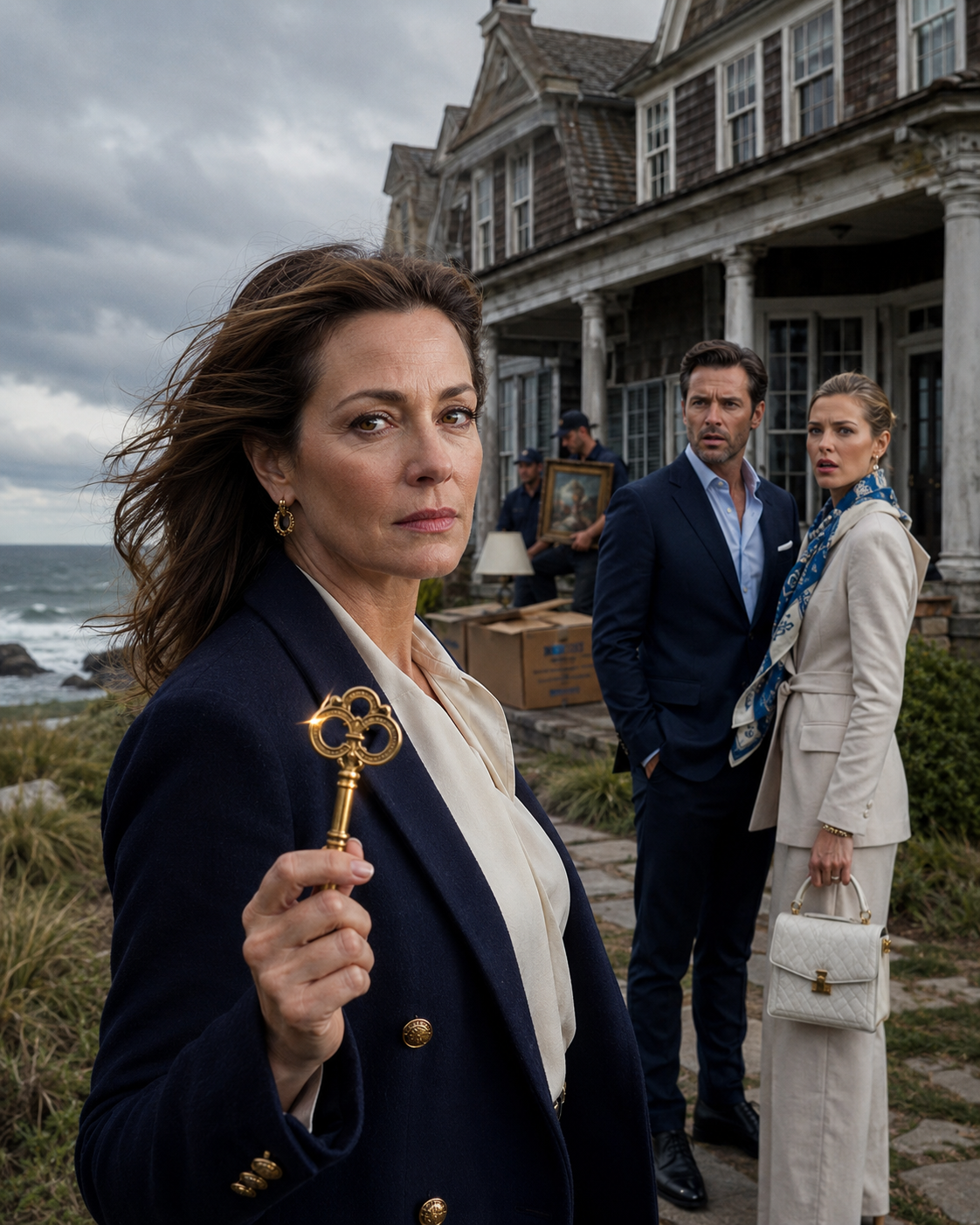
The mechanism resisted, then turned with a deep metallic click.
A shallow door opened.
Behind it sat a steel document case, a bound ledger and a small black device connected to the lodge’s security system.
Adrian stared.
“You knew there was a safe?”
“I knew there was an archive.”
I pressed the security switch.
Outside, the automatic gate began to close.
The moving trucks were still inside the property, but the road behind them was sealed.
At the same moment, every electronic lock Adrian had installed flashed red.
He tried the study door.
It opened.
Then he checked his phone.
“What did you do?”
“I activated the trustee security protocol.”
“The what?”
I removed the document case and placed it on the desk.
“This property is held by the Shaw Coastal Heritage Trust. I am its sole managing trustee. You were allowed to stay here because I gave you written family access while we were married.”
“I am still your husband.”
“You told Bianca I wasn’t your wife.”
“That isn’t legally relevant.”
“No. But the notice revoking your access is.”
I handed him an envelope from the case.
His name was printed across the front.
He did not open it.
Lorraine came into the study.
“What is happening?”
Adrian ignored her.
“You planned this.”
“I prepared for it.”
“You cannot remove me from a house we used together.”
“I can remove an unauthorized guest from protected trust property.”
Bianca’s voice became thin.
“Adrian, you said the lodge belonged to both of you.”
“It does.”
“No,” I said. “It never did.”
A vehicle stopped outside the closed gate.
Through the study window, I saw a county sheriff’s SUV and a second car belonging to my attorney.
Adrian looked at me as though I had changed into someone he had never met.
Perhaps I had.
Or perhaps I had finally stopped hiding the person I had always been.
Before I became Evelyn Cole, I was Evelyn Shaw.
The Shaws had lived along the northern edge of Calder Bay for more than a century.
Gull’s Rest was not a mansion. It had no ballroom, indoor pool or imported marble. The roof groaned during winter storms. The kitchen floor dipped near the pantry. The windows had to be pushed firmly before their latches caught.
But my great-grandfather had built the original cottage with timber salvaged from a shipyard.
My grandfather added the west wing after returning from military service. My father constructed the long porch with his brothers during the summer he turned twenty.
Every generation left something behind.
A crooked doorway.
A carved initial.
A repaired beam.
A story connected to an ordinary object.
My grandmother, Eleanor, tied her blue scarf around her hair whenever she worked in the garden. My mother wore it after Eleanor died. I kept it in the upstairs wardrobe because it still carried the faintest trace of lavender.
My father, Thomas Shaw, repaired boats for a living.
His workshop stood near the public harbor, where fishermen brought him damaged engines, cracked hulls and radios that had stopped working at the worst possible moment.
He charged wealthy yacht owners full price and quietly reduced the bills of families who depended on the water to survive.
People trusted him because he did not perform kindness.
He simply practiced it.
When I was eleven, I watched him replace the lock on the lodge’s side door.
“Why do we need so many keys?” I asked.
He handed me the old brass one.
“A key is a promise,” he said.
“To keep people out?”
“To remember that entering someone’s home is a privilege.”
At eleven, I was more interested in the key’s unusual shape than his answer.
At forty-six, I understood every word.
My younger brother, Daniel, died in a boating accident when he was nineteen.
The loss changed our family without destroying it.
My mother became quieter. My father worked longer hours. I learned to listen for pain hidden inside ordinary conversations.
Gull’s Rest became the place where we could remember Daniel without explaining our grief to anyone.
His model boats remained in the study.
His initials were carved beneath the dock.
Every September, my father placed wild asters beside his photograph.
My mother died twelve years later after a sudden stroke.
My father survived her by six years.
Near the end of his life, he called me to Gull’s Rest on a foggy October morning.
He sat beside the fireplace with a blanket across his knees and the brass key on the table.
“There are things about this place you don’t know,” he said.
I smiled.
“You mean the secret panel?”
“That is one of them.”
He showed me the archive and the first pages of the Shaw Coastal Heritage Trust.
I tried to read the legal language, but my mind was fixed on his trembling hands.
“You’ll have time to explain it when you’re stronger,” I told him.
He studied me for a long moment.