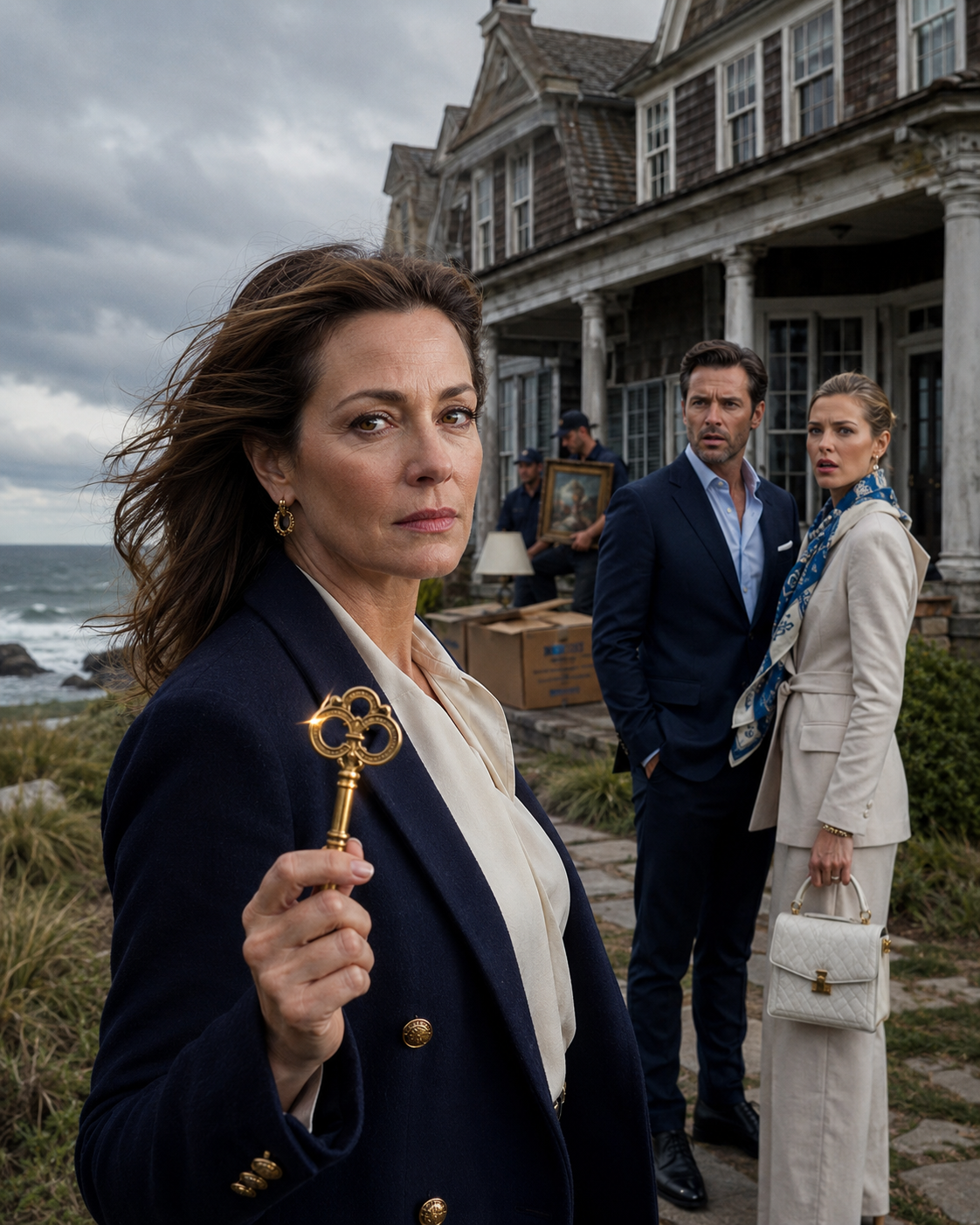
Adrian said it calmly, almost lazily, as though he were reminding me that the grocery store had changed its opening hours.
He stood on the wide cedar porch of Gull’s Rest, my family’s coastal lodge, with one hand resting on the shoulder of the woman he had been sleeping with for nearly a year.
Bianca Hale wore white linen trousers, an expensive cream sweater, and my grandmother’s blue silk scarf around her neck.
Behind them, two moving trucks idled in the circular drive.
Men in gray uniforms were carrying boxes through the front door. A new leather sofa waited beside the hydrangeas. Three cases of imported wine had been stacked beneath the porch window. Adrian’s mother, Lorraine, was directing a pair of workers toward the upstairs bedrooms as if she were supervising the opening of a luxury hotel.
For several seconds, I remained beside my car.
The Atlantic wind pulled strands of hair across my face. The old brass key in my hand pressed into my palm.
Adrian glanced at it and smiled.
“That key won’t help you,” he said. “We changed the locks.”
Bianca’s fingers moved over my grandmother’s scarf.
I looked at her.
“Take that off.”
Her eyebrows rose.
“Excuse me?”
“The scarf. Remove it.”
She gave Adrian an amused glance.
He did not laugh.
“Bianca,” he said quietly, “just take it off.”
Her smile weakened.
She unwrapped the scarf and dropped it onto the porch railing.
Lorraine stepped forward.
“This display is unnecessary, Evelyn. You abandoned your husband, moved into an apartment, and refused every reasonable attempt to discuss the divorce. Adrian is entitled to use a marital residence.”
“Gull’s Rest was never a marital residence.”
“You spent summers here together.”
“I also spent weekends in hotels. That did not make me their owner.”
Adrian exhaled sharply.
“You’re making a scene in front of the movers.”
“I didn’t invite the movers.”
“You weren’t answering your phone.”
“So you brought your girlfriend into my family’s home?”
Bianca straightened.
“I am not his girlfriend.”
I looked at the matching luggage near the door.
“Then you travel very heavily for a colleague.”
Adrian stepped off the porch.
His expression had the polished patience he used with nervous investors and inexperienced employees.
“Evelyn, our marriage has been over for months.”
“Our marriage will be over when the court finalizes it.”
“It is over emotionally.”
“That must be why you brought your mother.”
Lorraine made a sound of disgust.
Adrian lowered his voice.
“You no longer have a place in my life. Accept that with some dignity.”
The movers slowed.
Bianca looked toward the house.
Lorraine folded her arms.
Adrian believed he had arranged the scene perfectly. He had the trucks, the witnesses, the expensive furniture and the woman meant to replace me. He wanted me to see that he had taken control before the divorce papers were signed.
He wanted humiliation to make me obedient.
I opened my hand and studied the old key.
It was dark with age, its round handle scratched by four generations of Shaws.
Adrian shook his head.
“I told you. The locks have been replaced.”
“This key isn’t for the front door.”
For the first time, uncertainty passed across his face.
“What is it for?”
I walked past him.
Bianca moved aside.
Inside, Gull’s Rest smelled of salt, old pine and someone else’s perfume.
The living room had already been disturbed. My grandfather’s reading chair had been pushed toward the hallway. The braided rug my mother made during her final winter had been rolled against the wall. Framed family photographs were stacked facedown on the dining table.
A worker carried a box marked for the attic.
“What’s in there?” I asked.
He stopped.
Adrian entered behind me.
“Nothing important. Old papers and personal effects.”
I took the box from the worker and placed it on the floor.
Inside were my father’s navigation charts, my grandmother’s recipe books, several photo albums and the wooden model boat my brother had built before he died.
Bianca appeared in the doorway.
“We need the shelves for our things.”
Our things.
I turned to Adrian.
“You gave her permission to pack my family’s belongings?”
“They were gathering dust.”
The old anger tried to rise inside me.
It did not succeed.
For years, Adrian had trained me to distrust my own reactions. If I protested, I was emotional. If I remained quiet, I was cold. If I asked questions, I was suspicious. If I discovered the truth, I was vindictive.
That afternoon, his labels no longer mattered.
I carried the box into my father’s study.
A faded maritime painting hung above the fireplace. I lifted it from its hook, revealing a narrow oak panel set into the wall.
Adrian followed me.
“What are you doing?”
I inserted the brass key into the hidden lock.
The mechanism resisted, then turned with a deep metallic click.
A shallow door opened.
Behind it sat a steel document case, a bound ledger and a small black device connected to the lodge’s security system.
Adrian stared.
“You knew there was a safe?”
“I knew there was an archive.”
I pressed the security switch.
Outside, the automatic gate began to close.
The moving trucks were still inside the property, but the road behind them was sealed.
At the same moment, every electronic lock Adrian had installed flashed red.
He tried the study door.
It opened.
Then he checked his phone.
“What did you do?”
“I activated the trustee security protocol.”
“The what?”
I removed the document case and placed it on the desk.
“This property is held by the Shaw Coastal Heritage Trust. I am its sole managing trustee. You were allowed to stay here because I gave you written family access while we were married.”
“I am still your husband.”
“You told Bianca I wasn’t your wife.”
“That isn’t legally relevant.”
“No. But the notice revoking your access is.”
I handed him an envelope from the case.
His name was printed across the front.
He did not open it.
Lorraine came into the study.
“What is happening?”
Adrian ignored her.
“You planned this.”
“I prepared for it.”
“You cannot remove me from a house we used together.”
“I can remove an unauthorized guest from protected trust property.”
Bianca’s voice became thin.
“Adrian, you said the lodge belonged to both of you.”
“It does.”
“No,” I said. “It never did.”
A vehicle stopped outside the closed gate.
Through the study window, I saw a county sheriff’s SUV and a second car belonging to my attorney.
Adrian looked at me as though I had changed into someone he had never met.
Perhaps I had.
Or perhaps I had finally stopped hiding the person I had always been.
Before I became Evelyn Cole, I was Evelyn Shaw.
The Shaws had lived along the northern edge of Calder Bay for more than a century.
Gull’s Rest was not a mansion. It had no ballroom, indoor pool or imported marble. The roof groaned during winter storms. The kitchen floor dipped near the pantry. The windows had to be pushed firmly before their latches caught.
But my great-grandfather had built the original cottage with timber salvaged from a shipyard.
My grandfather added the west wing after returning from military service. My father constructed the long porch with his brothers during the summer he turned twenty.
Every generation left something behind.
A crooked doorway.
A carved initial.
A repaired beam.
A story connected to an ordinary object.
My grandmother, Eleanor, tied her blue scarf around her hair whenever she worked in the garden. My mother wore it after Eleanor died. I kept it in the upstairs wardrobe because it still carried the faintest trace of lavender.
My father, Thomas Shaw, repaired boats for a living.
His workshop stood near the public harbor, where fishermen brought him damaged engines, cracked hulls and radios that had stopped working at the worst possible moment.
He charged wealthy yacht owners full price and quietly reduced the bills of families who depended on the water to survive.
People trusted him because he did not perform kindness.
He simply practiced it.
When I was eleven, I watched him replace the lock on the lodge’s side door.
“Why do we need so many keys?” I asked.
He handed me the old brass one.
“A key is a promise,” he said.
“To keep people out?”
“To remember that entering someone’s home is a privilege.”
At eleven, I was more interested in the key’s unusual shape than his answer.
At forty-six, I understood every word.
My younger brother, Daniel, died in a boating accident when he was nineteen.
The loss changed our family without destroying it.
My mother became quieter. My father worked longer hours. I learned to listen for pain hidden inside ordinary conversations.
Gull’s Rest became the place where we could remember Daniel without explaining our grief to anyone.
His model boats remained in the study.
His initials were carved beneath the dock.
Every September, my father placed wild asters beside his photograph.
My mother died twelve years later after a sudden stroke.
My father survived her by six years.
Near the end of his life, he called me to Gull’s Rest on a foggy October morning.
He sat beside the fireplace with a blanket across his knees and the brass key on the table.
“There are things about this place you don’t know,” he said.
I smiled.
“You mean the secret panel?”
“That is one of them.”
He showed me the archive and the first pages of the Shaw Coastal Heritage Trust.
I tried to read the legal language, but my mind was fixed on his trembling hands.
“You’ll have time to explain it when you’re stronger,” I told him.
He studied me for a long moment.
“People always think there will be a better day for difficult information.”
“Dad—”
“Promise me you won’t let anyone separate the house from the land.”
“I promise.”
“Not even someone you love.”
“I said I promise.”
He touched the brass key.
“The wrong person will see the lodge and imagine what can be taken from it. The right person will want to know what must be protected.”
He died eleven days later.
After the funeral, I could not bring myself to study the trust documents.
I signed the annual forms sent by the family attorney. I approved maintenance expenses and tax payments. I spoke regularly with Owen Pike, the caretaker whose family had lived near the bay almost as long as mine.
But I avoided the archive.
Grief can make a person careful about opening doors, even when she owns the key.
By then, I had already been married to Adrian Cole for nine years.
I met Adrian at a fundraising dinner in Portland.
I was the logistics director for a regional emergency-relief organization. My work involved warehouse contracts, storm preparation, temporary shelters and supply routes to isolated communities.
Adrian worked in commercial development.
He understood money the way some musicians understand rhythm. He could enter a room, identify the most influential person and adjust his entire personality before reaching the other side.
That night, he listened to me describe our hurricane-response program.
“You make complicated systems sound human,” he said.
No one had ever complimented my work that way.
Adrian was handsome without seeming vain, confident without appearing aggressive and ambitious without admitting how much he wanted other people to envy him.
At least, that was what I believed.
He proposed after eighteen months.
We married at Gull’s Rest beneath an arch covered in white roses.
My father stood beside me on the porch before the ceremony.
“Are you nervous?” he asked.
“No.”
“Not even a little?”
“I’m sure about him.”
Dad looked across the lawn.
Adrian was speaking with a property developer near the dock. He pointed toward the opposite shoreline, tracing an invisible line with his hand.
“What are they discussing?” my father asked.
“Probably business. Adrian never really stops working.”
Dad nodded slowly.
Then he took my face between his hands.
“You do not have to earn peace from anyone.”
I laughed because I thought he was being sentimental.
“I’m getting married, not going to war.”
His eyes saddened.
“Sometimes people don’t realize the difference until much later.”
For several years, Adrian was the husband everyone admired.
He sent flowers to my office.
He remembered birthdays.
He helped my father carry firewood.
He told friends that my strength made his success possible.
The changes arrived gradually.
At first, they seemed like the ordinary erosion of a busy marriage.
He interrupted me more often.
He corrected details in stories he had not witnessed.
He began describing my work as “charity administration” whenever important clients asked what I did.
When I disagreed with him privately, he accused me of lacking faith in his judgment.
When I disagreed publicly, he said I had embarrassed him.
After my father died, Adrian began talking about Gull’s Rest as an underperforming asset.
“We could renovate and rent it during summer,” he suggested.
“I don’t want strangers living there.”
“Strangers pay very well for ocean views.”
“It isn’t a rental property.”
“Everything is a property, Evelyn.”
“No. Some places are homes.”
He smiled in the patient way adults smile at children who refuse to understand arithmetic.
“Emotional value and financial value are not enemies.”
“They are when one destroys the other.”
He wanted to remove the original cedar walls, enlarge the windows and replace the workshop with a guesthouse.
I refused every proposal.
Lorraine considered my refusal a personal insult.
Adrian’s mother had inherited very little money and an enormous appetite for status.
She wore designer clothes on credit, exaggerated the importance of distant relatives and spoke about “our family standards” as though the Coles possessed a private dynasty.
At dinner one evening, she placed her wineglass beside her plate and said, “It would have been wiser to put Gull’s Rest into both names after the wedding.”
“My father created the trust before I met Adrian.”
“Marriage should eliminate those divisions.”
“Marriage did not eliminate my family.”
Lorraine smiled.
“You are very defensive about old wood and inconvenient memories.”
Adrian reached beneath the table and pressed his fingers into my knee.
It looked affectionate to everyone else.
It was a warning.
On the drive home, he told me I had been rude.
“Your mother questioned my father’s decisions.”
“She was trying to help.”
“She was trying to establish that anything belonging to me should automatically belong to you.”
“Is that such a terrible idea?”
“Yes, when it only works in one direction.”
He did not speak for the rest of the drive.
By our fifteenth anniversary, I had learned how to prevent his silences.
I apologized quickly.
I changed subjects.
I avoided wearing clothes he considered too plain at business dinners.
I stopped inviting certain friends to our home because Adrian said they brought “small energy” into the room.
I made myself easier to approve of.
Bianca Hale joined Adrian’s company during the autumn after my forty-fifth birthday.
Officially, she was director of strategic partnerships.
Unofficially, she became the person Adrian mentioned in every conversation.
“Bianca found a flaw in the Harbor Point projections.”
“Bianca knows the state permitting system.”
“Bianca understands how to speak to investors.”
“Bianca doesn’t panic when plans change.”
The comparisons were never direct enough to challenge.
They did not need to be.
I met her at a winter reception.
She was thirty-three, elegant and observant. Her attention moved through the room like a camera, recording clothing, jewelry, relationships and weaknesses.
When Adrian introduced us, Bianca kept one hand on his sleeve.
“Evelyn,” she said. “I’ve been fascinated to meet you.”
“Why fascinated?”
“Adrian says you live in a very different world.”
“He means my work involves people who cannot increase his quarterly revenue.”
Adrian’s smile tightened.
Bianca laughed.
“I can see why he calls you serious.”
“I can see why he calls you often.”
That night, Adrian accused me of humiliating him.
“You behaved like a jealous teenager.”
“She touched you throughout dinner.”
“She is physically expressive.”
“She fed you dessert from her fork.”
“That was a joke.”
“It was an intimate joke.”
“You have become suspicious of everyone.”
“Only the woman sleeping with my husband.”
He stared at me.
The silence that followed told me more than a confession would have.
I began noticing what I had previously forced myself not to see.
Receipts from restaurants he claimed to dislike.
A second hotel room charged during a conference.
Messages that disappeared when I entered.
A cashmere coat in his car that was not mine.
Then, on a rainy Tuesday afternoon, I arrived early at a restaurant where Adrian believed he was meeting only an investor.
I saw him through the window.
Bianca sat beside him instead of across the table.
His hand rested over hers.
She leaned close and whispered something.
He kissed her.
I stood beneath the awning while rain ran from its edge in silver sheets.
My body did not collapse.
The street did not tilt.
I simply understood that the life I had spent years protecting no longer existed.
That evening, Adrian came home carrying a bottle of wine.
“We should talk,” I said.
He removed his coat.
“Can it wait?”
“No.”
He looked at my face and knew.
“Where did you see us?”
“Does the location matter?”
“It matters if you were following me.”
The instinct to defend myself almost answered for me.
I stopped it.
“How long?”
Adrian walked to the kitchen, poured water and took several slow drinks.
“Six months.”
“Only six?”
He frowned.
“What is that supposed to mean?”
“You started punishing me for her existence nearly a year ago.”
“I did not punish you.”
“You made me feel defective every time she pleased you.”
“That is your interpretation.”
“Did Lorraine know?”
He said nothing.
Of course she knew.
“Do you love Bianca?”
“I don’t know.”
“Do you love me?”
He placed the glass on the counter.
“I care about you.”
The phrase was worse than hatred.
“Is that how you introduced me to her? As someone you care about?”
“Evelyn, our marriage has been failing for years.”
“You were the only person informed.”
“You disappeared into your grief. Your job. That lodge. Every part of your life is an emergency or a memorial.”
“My parents did not make you unfaithful.”
“No, but your refusal to move forward made it difficult to breathe around you.”
I looked at the man I had married.
For years, I had believed there must be a perfect sentence capable of restoring his empathy.
That night, I understood there was no such sentence.
“You should stay somewhere else,” I said.
“This is my house too.”
“The city house is jointly owned. I’m not arguing about that tonight. I am asking you to leave the room.”
He laughed once.
“Here we go. The dramatic exile.”
“You’re right.”
“About what?”
“This marriage has been failing for years.”
I walked upstairs and locked the bedroom door.
The next morning, I contacted Ruth Mercer.
Ruth had represented our family trust since my father’s final illness. She wore dark suits, kept handwritten notes in neat columns and possessed the unnerving ability to remain silent until people revealed more than they intended.
I told her about the affair.
She listened.
Then she asked, “Where is the brass key?”
“In my desk.”
“Not the house key. The archive key.”
I stared at her.
“How do you know about that?”
“Your father gave me a duplicate. Evelyn, we need to discuss what you inherited.”
The next day, we drove to Gull’s Rest.
Ruth opened the archive and removed the steel case.
Inside were property maps, deeds, environmental covenants, shellfish rights, tidal-access agreements and records dating back to the nineteen-fifties.
The lodge was only the visible center of the Shaw Coastal Heritage Trust.
Over several decades, my grandfather and father had quietly purchased strips of shoreline, marshland, sections of an abandoned ferry road, freshwater access points and woodland behind Calder Bay.
Some parcels were barely wider than a driveway.
Others included protected dunes or paths local fishing families had used for generations.
My father had never talked about himself as a landowner.
He considered the trust a shield.
As wealthy developers bought coastal properties, they closed old footpaths, restricted harbor access and priced working families out of communities their grandparents had built.
My father could not stop every sale.
He could preserve strategic pieces of land that kept the bay accessible.
Ruth pointed to a section of the trust agreement.
“No spouse, creditor, partner or commercial entity can use the property as security, establish an occupancy claim or negotiate development rights without the managing trustee’s written authorization.”
“My authorization.”
“Exactly.”
“Adrian knows the lodge is protected.”
“He may know part of it.”
“Why would he care about the rest?”
Ruth folded her hands.
“Does his company have any projects near Calder Bay?”
I remembered the maps Adrian had studied at our wedding.
The renovation proposals.
The questions about neighboring parcels.
The sudden interest in replacing the old ferry road.
“I don’t know.”
“Find out before he realizes you are looking.”
Adrian filed for divorce three weeks later.
His petition described me as emotionally unavailable, financially secretive and unreasonably attached to inherited property.
He requested the city house, a large share of our investments and temporary use of Gull’s Rest until the marital assets could be evaluated.
Ruth read the request twice.
“He does not need a summer home during a divorce.”
“What does he need?”
“That is what we are going to discover.”
I moved into a small apartment near my office.
Adrian remained in the city house.
Within a month, Bianca was attending dinners beside him. Lorraine moved into the guest room and began telling mutual friends that I had driven Adrian away by choosing dead relatives over a living husband.
I said nothing publicly.
Adrian mistook silence for paralysis.
He had always assumed that if I was not arguing, I was losing.
In reality, Ruth and I were tracing corporate registrations, property options and planning applications.
Adrian’s company had formed a development partnership called Northstar Coastal Ventures.
Northstar proposed a private marina, luxury cottages, a waterfront restaurant and an exclusive wellness club near Calder Bay.
The promotional material showed sailboats, polished decks and smiling couples drinking champagne.
The maps did not show the families who repaired nets beside the harbor.
They did not show the public path children used to reach the beach.
They did not show the marsh that absorbed storm surges before they reached the lower homes.
Most importantly, they did not clearly show that Northstar’s development could not function without land controlled by the Shaw trust.
The old ferry road was the only practical route wide enough for construction vehicles.
The freshwater pumping agreement crossed one of our parcels.
The proposed marina entrance depended on tidal rights my grandfather had acquired decades earlier.
Adrian’s project was surrounded by land he could not use without me.
Suddenly, his years of pressure made sense.
He had not wanted Gull’s Rest because he loved the view.
He wanted the lodge treated as shared marital property so he could claim influence over the wider trust.
The affair was personal.
The attempted occupation was strategic.
The call from Owen Pike arrived on a Thursday morning in June.
“Evelyn,” he said, “Adrian is at Gull’s Rest.”
“Inside?”
“He arrived with Bianca, Lorraine and two moving companies. He told them he has authority to occupy the lodge during the divorce.”
“How did he get through the gate?”
“He had the access code.”
“And the house?”
“He replaced two exterior locks. Claims one of your old permissions gives him the right.”
My chair rolled backward as I stood.
“Do not confront him.”
“I can call the sheriff.”
“Ruth is already doing that. I’m coming.”
The drive to Calder Bay took nearly four hours.
During the first hour, I cried.
During the second, I remembered every time Adrian had dismissed my instincts.
During the third, I stopped wondering whether I was allowed to be angry.
By the time I reached the coastal road, I felt calm.
Not peaceful.
Precise.
That was the calm I carried when Adrian told me I no longer lived there.
That was the calm with which I opened the archive, activated the security system and handed him the notice revoking his access.
Sheriff Dana Reeves entered the study with Ruth behind her.
Reeves was a compact woman with silver hair and a patient expression.
She examined the notice, the trust certificate and the moving company’s paperwork.
Then she faced Adrian.
“Mr. Cole, who authorized the move?”
“I am the owner’s husband.”
“Estranged husband,” Ruth said.
Adrian ignored her.
“This lodge functioned as a shared residence.”
Sheriff Reeves looked at the trust certificate.
“Not according to these records.”
“My attorneys dispute that.”
“They can dispute it in court. Today, the trustee has revoked your permission to enter.”
Lorraine stepped forward.
“Do you understand who my son is?”
The sheriff looked at Adrian.
“Yes. He is the man named on the notice.”
One mover covered a smile with his hand.
Bianca turned toward Adrian.
“You promised there was no legal risk.”
“This is temporary.”
“You said Evelyn couldn’t remove us.”
“She is creating a performance.”
I walked to the porch railing and picked up my grandmother’s scarf.
“You brought an audience,” I said. “The performance was yours.”
Adrian followed me outside.
“You are damaging yourself.”
“How?”
“Judges dislike vindictive behavior.”
“Then it is fortunate that the trust documents, the security record and the sheriff’s report have nothing to do with revenge.”
“You are enjoying this.”
“No. I am ending it.”
He lowered his voice.
“Let us stay through the weekend. We’ll remove everything Monday.”
“No.”
“Bianca has nowhere else arranged.”
“She has a home.”
“We have investors arriving tomorrow.”
There it was.
Not a romantic weekend.
Not a desperate attempt to establish a new life.
Investors.
Ruth heard him too.
“What investors?” she asked.
Adrian’s face hardened.
“That is private business.”
“Not when the meeting is being held on trust property.”
Bianca looked from Adrian to Ruth.
“You said the Northstar meeting was approved.”
Adrian turned on her.
“Stop talking.”
The sheriff stepped between them without touching either person.
“Everyone will remain calm. The movers may remove whatever they brought today. Any disputed item already belonging to the lodge stays inside.”
Lorraine pointed at the new sofa.
“We paid for that.”
“Then you are welcome to take it.”
The workers began carrying furniture back toward the trucks.
Adrian stood in the drive as the life he had arranged reversed direction around him.
Before leaving, he stopped beside my car.
“You think an old trust makes you untouchable?”
“No.”
“Then why are you smiling?”
“Because you still think this is about the house.”
His eyes changed.
Only for a moment.
But I saw fear.
He left without answering.
The morning after the lockout, I woke in my childhood bedroom.
Ocean light moved across the walls.
For the first time in years, I did not begin the day by anticipating someone else’s disappointment.
I returned my father’s charts to the study.
I placed Daniel’s model boat on the shelf.
I washed my grandmother’s scarf by hand and hung it beside the window.
Adrian called repeatedly.
I did not answer.
Bianca sent one message.
You humiliated us over an empty old lodge.
I replied:
Then you should have chosen somewhere empty.
I blocked her.
Northstar’s investors were not pleased that their coastal meeting had ended under sheriff supervision.
Several began asking why Adrian had represented Gull’s Rest as available for company use.
Ruth obtained internal planning records during the divorce discovery process.
They revealed that Adrian had repeatedly assured his partners he could secure the necessary access from the Shaw trust.
In one email, he described the matter as “a domestic issue that will be resolved through settlement leverage.”
In another, he claimed that my emotional attachment to the lodge could be used to encourage cooperation.
He had reduced my family, my grief and our marriage to negotiating variables.
I expected the discovery to devastate me.
Instead, it clarified everything.
Adrian had not suddenly become dishonest.
He had simply become confident enough to record it.
The county planning hearing was scheduled for September.
Northstar filled the chamber with architectural renderings.
The proposed marina gleamed beneath imaginary sunlight. The cottages had glass walls and private decks. The restaurant appeared to float above clean blue water.
No storms existed in those images.
No working harbor existed.
No elderly residents.
No children carrying fishing buckets down the public path.
Only customers.
Adrian entered with Bianca beside him.
Their relationship had already begun to fracture, but they still performed unity in public.
Lorraine sat behind them wearing pearls and a look of injured dignity.
Adrian noticed me beside Ruth.
His confidence slipped.
The hearing lasted three hours.
Northstar’s consultants promised employment, tourism and revitalization.
A construction executive described the undeveloped shoreline as “underutilized.”
Then the residents of Calder Bay spoke.
A retired teacher described evacuating children along the old ferry road during a hurricane.
A fisherman explained how the proposed marina traffic would disrupt the shallow breeding grounds.
A mother spoke about generations of local families using the beach path.
Owen Pike carried photographs showing winter flooding across land Northstar’s renderings presented as dry lawn.
Then Ruth called my name.
I walked to the microphone with the brass key in my pocket.
“My name is Evelyn Shaw,” I said. “I am the managing trustee of the Shaw Coastal Heritage Trust.”
Adrian stared down at the table.
“The Northstar proposal depends on an access road, water agreement, tidal passage and several shoreline easements controlled by our trust. Northstar does not have permission to use them.”
A murmur moved through the room.
One of Adrian’s investors leaned toward another.
I continued.
“Our trust is not opposed to responsible business. Calder Bay needs jobs, safe infrastructure and investment. But this project would close historic access routes, increase storm risks and transform a working community into scenery for people wealthy enough to purchase privacy.”
Adrian stood.
The board chair raised her hand.
“You will have an opportunity to respond, Mr. Cole.”
I looked directly at him.
“For years, I was told that refusing to sell meant I was trapped in the past. I understand now that memory and progress are not enemies. Progress becomes dangerous when it requires everyone without money to disappear.”
The room remained silent.
“The Shaw Coastal Heritage Trust will not grant Northstar access to the ferry road. It will not transfer the tidal rights. It will not authorize construction across the freshwater corridor or remove the public-path covenant.”
I returned to my seat.
Bianca’s face had gone pale.
Lorraine whispered angrily into Adrian’s ear.
One of the investors closed his folder.
The project did not collapse that afternoon.
Large failures rarely occur in a single dramatic moment.
They spread through conference calls, delayed signatures and revised risk calculations.
The county ordered a new environmental assessment.
The state questioned Northstar’s storm-water projections.
Two investors withdrew.
A bank suspended financing until the access dispute could be resolved.
Without the trust property, the marina entrance had to be redesigned at enormous cost.
Without the ferry road, construction became nearly impossible.
Northstar’s promised paradise turned into a collection of expensive drawings.
After the hearing, Adrian followed me into the corridor.
“You made your point.”
“I gave the board information.”
“You turned my private life into a public weapon.”
“I did not mention the affair.”
“Everyone knows.”
“Because you moved Bianca into my family’s lodge with two trucks.”
Bianca stood several steps behind him.
Her expression sharpened.
Adrian lowered his voice.
“Grant the road easement. We can negotiate protections for the rest.”
“No.”
“You have no idea how much money is involved.”
“That is precisely why my father created the trust.”
“This could secure your future.”
“My future is already secure.”
“You are punishing hundreds of people because our marriage failed.”
“The company has not hired hundreds of people. It created projections.”
“You always think you are morally superior.”
“No. I think your project depends on property you do not control.”
One of Northstar’s senior partners approached.
“We need to speak,” he told Adrian.
“Not now.”
“Now.”
Adrian looked at me.
“This is not finished.”
“For the first time,” I said, “you are correct.”
Northstar removed him from the project six weeks later.
The company called it an internal restructuring.
Local reporters obtained portions of the development records and learned that Adrian had attempted to establish occupancy at Gull’s Rest while negotiating access connected to the trust.
Bianca resigned shortly afterward.
She moved to another state and ended her relationship with Adrian before our divorce was finalized.
Lorraine stopped calling our mutual friends after one of them asked why she had helped move her son’s mistress into property he was trying to use as business leverage.
The city house was sold.
Our joint accounts were divided.
Adrian fought for several paintings, two investment accounts and a wine collection he had once claimed was ours.
He did not receive any interest in Gull’s Rest or the coastal trust.
The following February, he came to the gate alone.
Snow remained in the shadowed sections of the road. The bay beyond the lodge was gray and restless.
Owen called from his cottage.
“Should I send him away?”
“No,” I said. “I’ll speak to him.”
Adrian waited outside the gate in a dark coat.
Without Bianca, Lorraine, investors or attorneys, he looked smaller.
Not physically.
Honestly.
“I lost my position,” he said when I approached.
“I heard.”
“Northstar may sue me.”
“I heard that too.”
He looked toward the lodge.
“I need you to reconsider the road easement.”
“No.”
“The redesigned access is impossible.”
“Then the project is impossible.”
“You could save it.”
“I could surrender to it.”
He tightened his hands around the iron bars.
“I didn’t believe you would take this so far.”
“You believed I would protect your reputation more fiercely than my own family.”
“I believed we could negotiate.”
“You believed I would become frightened.”
He looked down.
“I was wrong.”
“Yes.”
The wind moved through the bare trees.
“I hated Gull’s Rest,” he said.
“I know.”
“It always felt like a part of your life I could not enter.”
“You entered it many times.”
“I mean truly enter. Your father, your brother, your mother—everything there existed before me. I always felt temporary.”
“You could have become part of it.”
“How?”
“By respecting what was already there.”
His eyes shifted toward the lodge.
“I wanted something that belonged to both of us.”
“No, Adrian. You wanted everything belonging to me to prove that I belonged to you.”
He did not argue.
Perhaps losing his position had removed his energy for pretending.
Perhaps, for one minute, he finally understood.
“Did you ever love me?” he asked.
“Yes.”
The answer came easily.
“How can you say that after everything?”
“Love does not become imaginary because it ended badly.”
“What changed?”
“You required me to trade pieces of myself for temporary peace. My work. My friends. My judgment. My memories. Every time I surrendered something, you called the marriage stronger.”
His eyes reddened.
“One day,” I continued, “you asked for the last place where I still recognized myself.”
“I am sorry.”
I believed he felt something.
Regret.
Shame.
Fear.
Loss.
Perhaps even love, distorted by years of entitlement.
But an apology offered after the consequences arrive does not erase the choices that invited them.
“I hope you learn what being sorry requires,” I said.
I turned away.
“Evelyn.”
I stopped.
“I should never have brought Bianca here.”
“No.”
“I wanted you to see that I had moved on.”
“You wanted me to feel replaced.”
He closed his eyes.
“Yes.”
I touched the brass key inside my coat pocket.
“You didn’t replace me, Adrian. You released me.”
I walked back toward the lodge.
The gate remained locked.
Our divorce became final in March.
I returned legally to the name Evelyn Shaw.
That spring, the trust partnered with Calder Bay residents to restore the public beach path and reinforce the marsh against storm damage.
We renovated my father’s old workshop and turned it into a marine-skills center where local teenagers could learn engine repair, navigation, coastal ecology and emergency response.
We named it the Thomas and Daniel Shaw Harbor House.
On opening day, fishing boats sounded their horns from the bay.
Children ran between the workshop and the dock.
Owen wore a new jacket and spent the entire ceremony pretending the wind was responsible for his wet eyes.
I hung my grandmother’s blue scarf in a glass cabinet beside a photograph of my parents.
The brass key remained with me.
Not because I feared another invasion.
Because I finally understood my father’s lesson.
A key is not proof of ownership.
It is proof of responsibility.
Adrian had believed the lodge was the valuable part of my inheritance.
He had been wrong.
The true inheritance was the ability to decide what would remain untouched by people who measured everything in profit.
It was the road that allowed families to reach the harbor.
The marsh that protected houses during storms.
The path where children carried buckets to the beach.
The workshop where my father repaired boats for neighbors who could not pay immediately.
The memories that had survived because no one had been allowed to renovate them into something more fashionable.
One evening, after the last volunteers left the Harbor House, I sat alone on the porch of Gull’s Rest.
The sunset turned the bay copper.
Wind moved beneath the eaves.
Somewhere inside, the old floorboards creaked.
Adrian used to complain about that sound.
He said it made the lodge feel tired.
To me, it sounded alive.
I thought about the afternoon he had stood on the porch with Bianca and told me I no longer lived there.
He had wanted those words to make me feel homeless.
Instead, they reminded me where home had always been.
He believed changing two locks would make the house his.
He never understood that the most important lock was hidden behind my father’s painting.
He never understood that the brass key did not merely open a document archive.
It opened the truth about the land.
About the development.
About our marriage.
And about me.
For years, I had waited for Adrian to return the woman I had been before I began shrinking around him.
She had never been his to return.
She had been waiting inside an old coastal lodge, beside a steel case and a stack of maps, holding the one key he had never bothered to understand.
I slipped it into the porch-door lock.
The mechanism turned smoothly.
Behind me, the Harbor House lights glowed beside the water.
Ahead of me, Gull’s Rest was warm and quiet.
I stepped inside.
Then I closed the door—not because I was afraid of who might enter, but because I had finally learned that peace was worth protecting.
THE END

