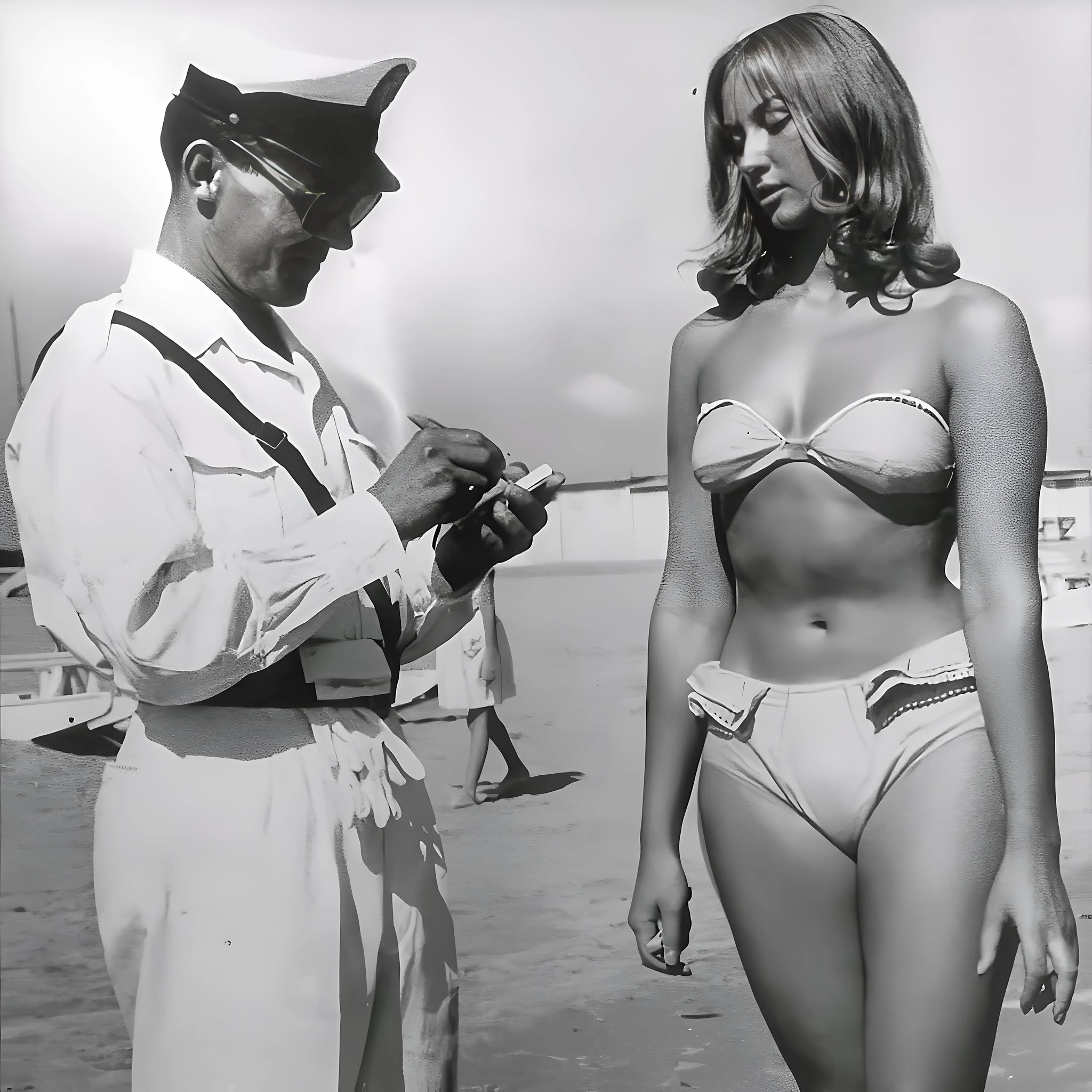
One tiny article of clothing. That’s all it took to spark outrage, bans and even arrests around the world.
In the decades-long war between modesty and freedom, the bikini proved to be both the villain and the winner. Popes have called it sinful. Governments outlawed it.
But women continued to wear it – and rewrote the rules with each daring appearance.
Tailors on the beaches
At the dawn of the 20th century, swimwear was a far cry from the sleek and stylish designs we know today. Back then it was a bulky garment made of wool, designed to protect you from the sun. It was not about fashion, but about modesty.
A strict dress code was commonplace on beaches across the United States. As Kathleen Morgan Drown and Patrick Huber write in their book on 1920s pop culture, places like Chicago’s Clarendon Beach even hired tailors to adjust swimming costumes deemed too revealing on the spot.
Similar rules appeared across the country – for example, Coney Island in 1915 banned bathing socks if they exposed ‘knee dimples.’ In Washington, D.C., beach police were known to enforce these rules with a tape measure in hand.
Arrested for a one-piece swimming costume?
In the early 1900s, everyone was eager to cover up. Both men and women had to wear suits from neck to knee – no exceptions. If skin was exposed? It was considered scandalous.
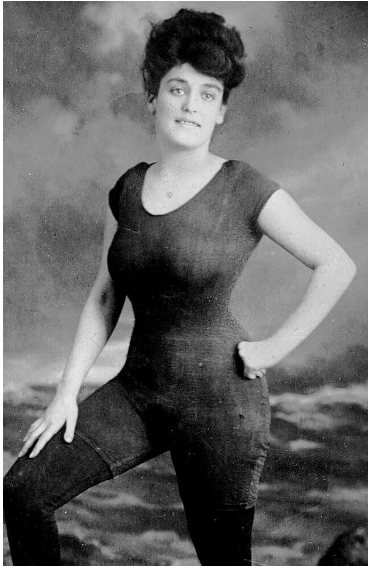
But change was on the horizon. In 1907, Australian swimmer Annette Kellerman became one of the first to challenge these norms by wearing a one-piece suit that exposed her arms, legs and neck instead of the then-standard knickers.
Nicknamed the ‘Australian Mermaid’ for her outstanding swimming skills, Kellerman spent much of her life challenging societal norms and redefining ideals.
According to Kellerman herself, she was arrested by police for her ‘indecent’ attire, although there are no official reports confirming this. Nevertheless, it caused an uproar at the time – a woman was swimming in such an outfit. The incident made headlines and sparked a movement.
Kellerman’s bold swimming costume choice caught the public’s attention, and soon her one-piece suits became a popular trend.
Demand grew so much that she eventually launched her own swimwear line, and ‘Annette Kellerman,’ as they became known, was the first step in the evolution of modern women’s swimwear.

The Roaring 20s: The New Wave of Fashion
In the 1920s, flapper style began to gain momentum not only in evening wear, but also on the beach.
It all started when a group of rebellious women from California rebelled against tradition. Known as the ‘girls in skirts,’ their revolutionary goal was simple: swimming costumes that women could actually swim in.
Thus, swimwear began to change, becoming more practical and form-fitting. ‘Girls’ skirts’ symbolised a nationwide shift that was not only about fashion, but also about functionality and freedom of movement.
Although still modest by today’s standards, women gradually showed more skin and swimwear was designed for freedom of movement. But the real revolution was yet to come.
The Bikini: A Scandalous Step Forward
The year was 1946, and with it came the birth of the bikini. Invented by French engineer Louis Reard, this two-piece swimming costume exposed the navel and exposed more skin than anyone thought appropriate for public places.
Just days before the bikini was introduced in 1946, the US conducted the first peacetime nuclear test at Bikini Atoll, which caught the world’s attention.
Although designer Louis Réard never explained why he named the swimming costume ‘bikini,’ many believe it was an allusion to the explosive effect he hoped it would produce – both commercially and culturally – like the bomb itself. Others suggest the name conjured up thoughts of the exotic appeal of the Pacific, or compared the shock of a revealing swimming costume to the power of an atomic explosion.
The reaction in the US was swift: many beaches banned bikinis and it was seen as outright rebellion. In Europe, things were not much simpler. France banned bikinis on its beaches in 1949, and in Germany they were banned in public swimming pools until the 1970s. At the same time, some communist groups condemned bikinis as a sign of capitalist decadence and moral decay.
Pope Pius XII declared the bikini sinful, and several countries, including Belgium, Italy, Portugal, and Spain, imposed nationwide bans on swimwear.
A famous case occurred in 1952 when Australian model Anne Ferguson was asked to leave the beach at Surfers Paradise because her Paula Stafford bikini was deemed too revealing.
The truth about the famous photo
One photo has come to symbolise the whole debate about whether or not bikinis can be worn on public beaches. And it comes from Italy.