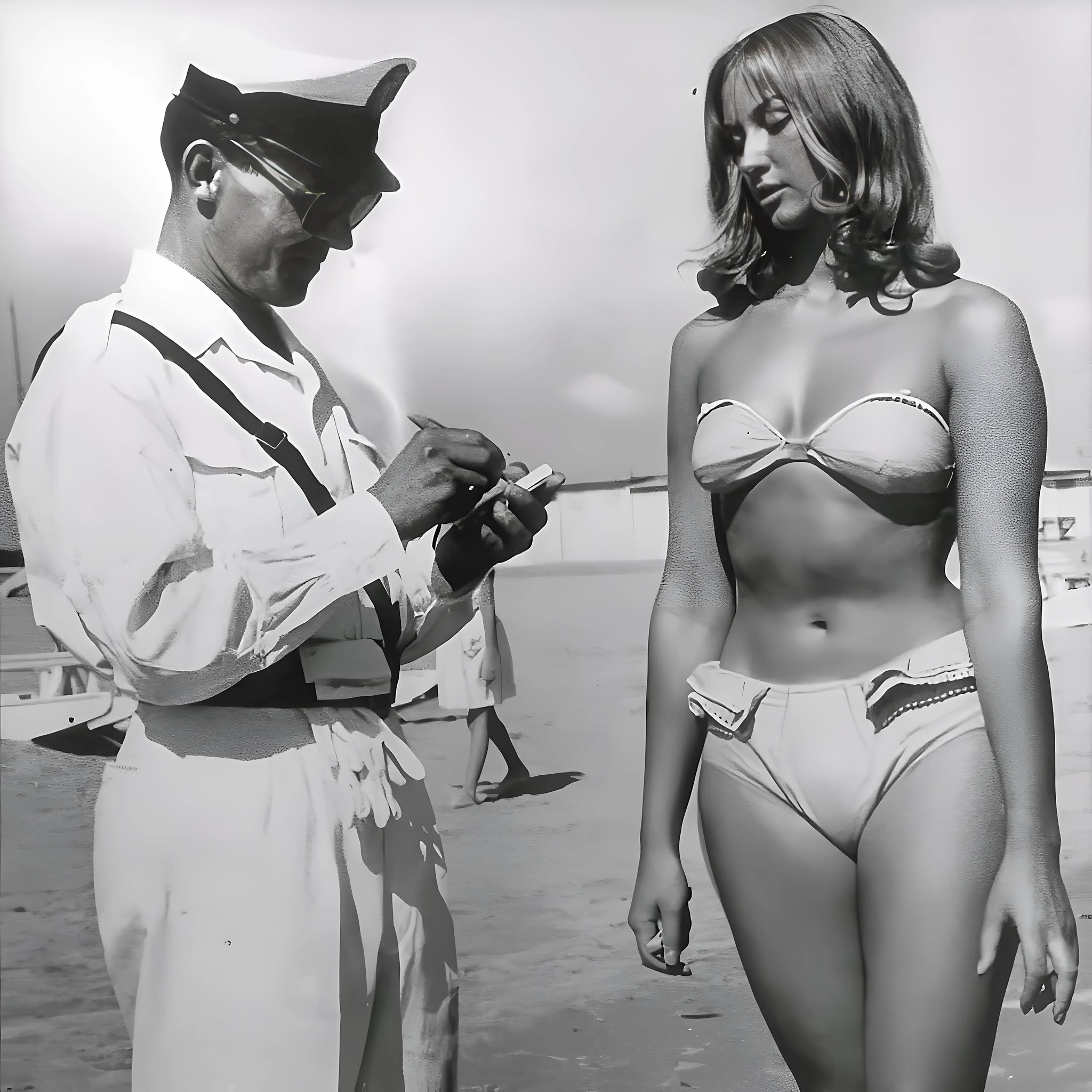
The black and white photo, which has gone viral in recent years, shows a man in a white uniform standing next to a young woman in a bikini on a beach. Social media users often claim that the moment was captured in Rimini, Italy in 1957. The most common version of the story says that the man is a police officer writing the woman a ticket for simply wearing a bikini.
In 2023, a post with this image appeared on Reddit, garnering over 31,000 votes and 1,400 comments. The caption read: ‘Police officer writing a ticket to a woman for wearing a bikini, 1957.’
But was it real?
The photo itself is genuine – it shows no signs of digital processing – but the backstory remains a mystery. There is no hard evidence that the woman was fined for the swimming costume. Some suspect it may have been a staged scene involving models or actors, while others believe the police officer may have ticketed her for an entirely different reason.
Nevertheless, the photo has struck a nerve.
Gianluca Braschi, director of the Rimini State Archives, confirmed to Snopes in an email that Italy did indeed have swimming costume laws at the time, though the story behind the photo remains unclear.
As Braschi explained, a 1932 law prohibited ‘bathing in public in a state of total nudity and in obscene swimwear.’ That law technically remained in effect until 2000, though enforcement was inconsistent.
So while we may never know the full story behind this viral moment, it reflects the very real tensions of that era, when bikinis didn’t just attract attention… they could also get you in trouble.
Hollywood’s Influence
It wasn’t until the 1960s that the bikini became truly popular. Cultural shifts opened the door to bolder swimming costume styles.
But even then, public opinion was divided. More conservative neighbourhoods opposed the tiny two-parter.
One example is the U.S. Motion Picture Code, better known as the Hayes Code, which was enacted in 1934. It allowed two-piece outfits in films, but strictly forbade showing the navel. The National Legion of Decency, a Roman Catholic group, urged Hollywood and international filmmakers to completely reject bikinis on the big screen.
The emergence of Hollywood stars like Marilyn Monroe, Ursula Andress and Brigitte Bardot helped redefine standards of beauty and self-confidence. These icons didn’t just wear swimming costumes – they became synonymous with them.
Bikini Girl
Perhaps no one did more to make the bikini gain worldwide popularity than French-born actress Brigitte Bardot.
It wasn’t just the fact that she wore a bikini, it was the way she wielded it. In her breakthrough role in The Bikini Girl, Bardot didn’t just wear a swimming costume, she turned it into a cultural statement. Her figure, clad in a strapless diamond-shaped bikini that looked like it could come undone at any moment, became the centrepiece of the film.
With her long, wispy hair and carefree appearance, Bardot wasn’t just acting – she was rewriting the rules for how women were seen on screen.
The film tried to show her in harmony with the ocean and the sun, but let’s be honest: it was her body that the camera adored. She appeared in the film in classic pin-up style, but Bardot wasn’t just a treat for the eyes – she was the first actress to star in a bikini in a leading role and gave it a storyline.
Brigitte Bardot in a white bikini stands on a rocky beach in footage from the film The Girl in the Bikini, directed by Willy Rosier, 1958. (Photo: Atlantis Films/Pictorial Parade/Courtesy of Getty Images)
While Bardot wasn’t the first woman to wear a bikini, she was the first to make the bikini iconic thanks to the story, and thanks to this film in the US, she gained instant worldwide fame.
Ursula Andress’ white bikini from the film Dr No (1962) instantly became an icon because it combined sex appeal, power and cinematic impact that audiences had never seen before.
As she emerged from the sea with a knife strapped to her hip, Andress wasn’t just eye-catching – she was strong, confident and unforgettable. This moment defined her as the ultimate Bond girl and cemented the bikini as a symbol of bold femininity in pop culture.
In the 1970s, bikinis were everywhere. Swimwear became even more revealing, with thong bikinis and thong panties entering the scene. Men’s swimwear also shrank as the ‘modesty’ of the early 20th century became a thing of the past.

Swimming costumes Today: Bodypositive and Diversity
In the 21st century, swimwear no longer just conforms to societal norms. The swimwear market has become a world of choice.
From modest one-piece swimming costumes to bikini thongs and daring thongs, there is something for everyone. What’s more, the conversation about body types has changed dramatically. Today, it’s about comfort, confidence and body positivity, and people of all shapes, sizes and backgrounds are free to express themselves on the beach or in the pool.
Gone are the days when ‘decent’ swimwear was regulated. Now it’s all about personal choice and self-expression. Whether it’s a full-zip swimming costume or the most revealing bikini, America’s changing views on modesty reflect a much more inclusive and accepting society.
What started as a fight for modesty has turned into a celebration of diversity, individuality and freedom. So the next time you head to the beach, remember: it’s not just about the swimming costume – it’s about the path to self-expression it represents.