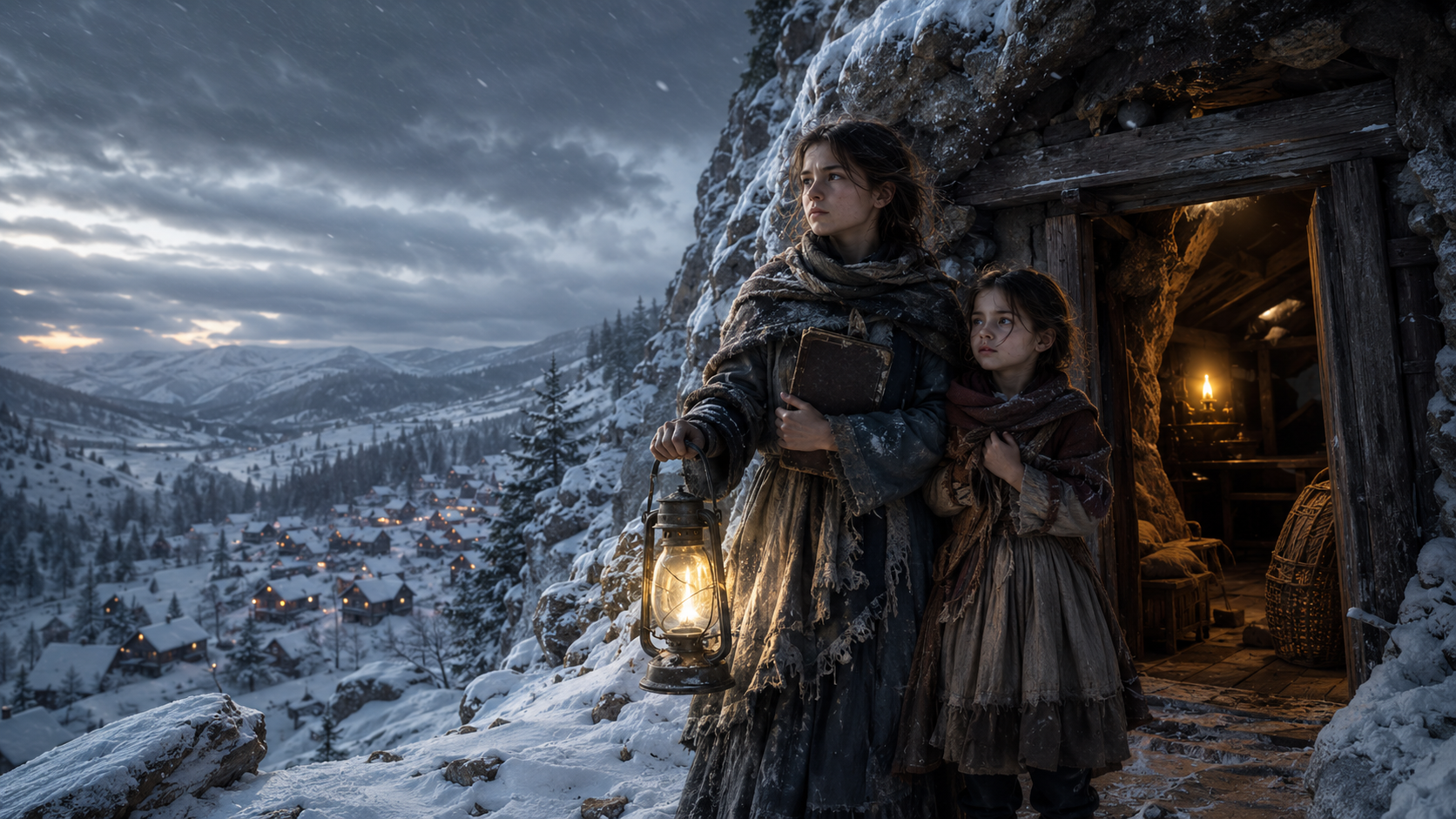
People slept beyond the finished room, deeper in the raw cave where the air was cooler but still merciful compared with the killing dark outside. Mara rationed food. Bea managed blankets like a commander. Elsie soothed children. Jonah tended the fire and never let the coal bed drop too low. Hiram sat near the hearth, pale but alert, correcting anyone who tried to block airflow with stacked baggage.
On the fourth night, Otto Reese came to Mara holding a folded bill.
She was adding wood to the fire.
“What is that?” she asked.
“My bet,” he said.
She stared at him.
He looked at the floor. “I said this place would crush you before New Year’s.”
Behind him, his little brother slept under Elsie’s quilt, alive because the cave had held.
Mara turned back to the fire.
“Keep it.”
“You should take it.”
“Buy your brother gloves.”
Otto’s mouth trembled once.
“If you were like me, he’d be dead.”
Mara placed another log on the coals.
“If the door had stayed closed, he’d be dead,” she said. “That’s the only thing that matters.”
The storm ended on the fifth morning.
The silence woke them.
Mara opened the door and found a world remade in white.
Snow lay in huge drifts against the slope. Fences had vanished. Trees had snapped halfway up their trunks. Roofs sagged or split across the valley. Smoke rose from some chimneys. From others, nothing rose at all.
Briar Glen survived.
But not untouched.
The Crowe house had collapsed over the kitchen. The Mercer barn was gone. Mrs. Blythe’s back wall had blown inward. A shepherd named Alden Frost was found near his woodpile, one hand still gripping a split log. Two children on the lower road lived only because their mother tied them together with apron strings and crawled with them beneath an overturned wagon until morning.
Three people died.
Not because they were foolish.
Not because they were weak.
Because they had built the way everyone built, and everyone had mistaken repetition for wisdom.
The funeral filled the church a week later.
People stood shoulder to shoulder in damp wool and bandages. Frostburned hands rested in laps. Children leaned against parents who had not stopped touching them since the storm, as if warmth might vanish if they forgot to guard it.
Before Reverend Callum spoke, Caleb Crowe stood.
A hush moved through the room.
He turned toward Mara and Elsie.
“I owe words,” he said.
His voice shook, but he did not sit.
“I called Mara Vale proud. I called Elsie foolish. I called their home a hole, a den, and a grave. I said those things in the street, in the store, and to their faces because I was certain that what I knew was the same thing as truth.”
No one moved.
Caleb looked down once, then forced himself to continue.
“On the second night of the storm, my roof came down. My mother was freezing in my arms. The only shelter left to us was the door I had mocked. Mara opened it before I apologized. Before I deserved mercy. She opened it because she had built a real shelter, and real shelter does not ask whether pride is worth saving.”
His mother, sitting in the front pew, began to cry silently.
Caleb looked back at the congregation.
“If Briar Glen has any sense left, we will stop laughing at what saved us and start learning from it.”
For a long moment, no one spoke.
Then Hiram Pike stood with the help of his cane.
“Learning is allowed,” he said. “But foolish building is not. A cave with a stove is not a house. A hole is not a miracle. You will measure. You will drain. You will vent. You will build with humility or you will build another coffin.”
That time, a few people laughed softly.
Not in mockery.
In relief.
By spring, seven families had asked Mara to inspect their land.
By summer, Jonah had become her best student.
By autumn, three new earth-sheltered homes were rising into the hillsides around Briar Glen. From the road, they looked almost shy: timber fronts tucked beneath stone, small windows facing morning sun, smoke rising from chimneys that followed the mountain’s own lines. Men who once laughed now argued over drainage angles. Women who once pitied the Vale sisters now came with notebooks. Children carried stones in buckets and boasted that their houses would be warmer than anyone’s.
One evening in October, Jonah walked with Mara above South-Face Hollow.
Below them, the valley glowed gold and brown beneath the last light of day. Smoke rose from the new homes. Elsie’s laughter drifted from the cave entrance, where she and Bea were arguing about whether bread could be improved with dried apples. Finch slept in a patch of sun like an old king.
Jonah stopped beside Mara.
“I came here first because my mother was cold,” he said.
“I remember.”
“I kept coming because of you.”
Mara looked at the valley. “That sounds dangerous.”
“It is.”
She turned to him then.
Jonah’s expression was open, frightened, and steady all at once.