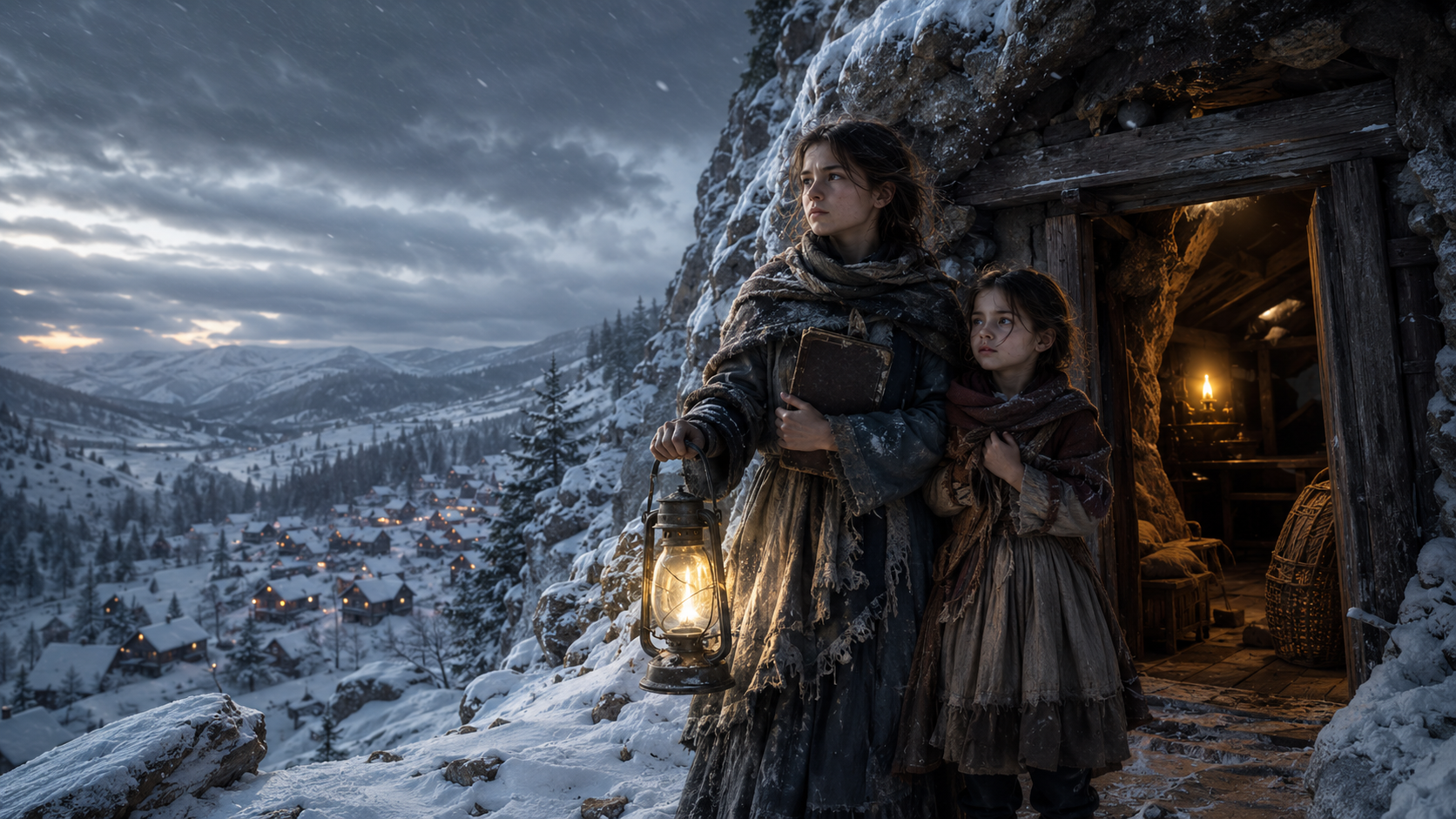
“I love you, Mara Vale,” he said. “Not because you proved everyone wrong. Not because you survived a storm. I love you because when the world tried to make you hard, you became useful instead. You built a door wide enough for even your enemies to enter.”
Mara, who could explain chimney draw, floor insulation, drainage, mortar, and thermal mass under pressure, found herself without one sensible sentence.
Jonah smiled faintly.
“I did not think silence was possible from you.”
“Enjoy it,” she said. “It will not last.”
He took her hand.
“Will you marry me?”
Mara looked toward the cave that had begun as desperation and become a lesson the whole valley could no longer ignore.
“Yes,” she said. “But I will not live in a foolish house.”
Jonah laughed.
“I would never ask you to.”
They married the next spring in the meadow above the cave.
Elsie wore green and cried before the vows even began. Bea stood beside Mara like a soldier guarding a bridge. Caleb Crowe brought a cedar chest he had built himself, every joint clean, every edge smoothed by hand. He did not call it an apology.
He did not need to.
Years passed.
The notebook grew thicker.
Mara added what Orson Vale had never lived to write: how to turn seepage before it reached the floor, how to size a fireplace for six people instead of two frightened sisters, how to brace a snow shed against crosswind, how to test a vent with candle smoke, how to teach proud people without wasting breath on their pride.
Elsie eventually built her own earth-sheltered home on the east slope and made several improvements Mara pretended not to envy. When Mara finally admitted the pantry design was better, Elsie smiled and said, “Of course it is. I had a good teacher and fewer people laughing in my ear.”
Bea built a small stone-fronted place near the creek and filled it with tools, jars, and the kind of peace that made visitors lower their voices without knowing why.
Hiram died in his sleep beside a stove he had rebuilt three times because “almost right” offended him. At his funeral, half the valley brought stones instead of flowers and set them around his grave.
Caleb Crowe became one of the method’s loudest defenders. Whenever someone mocked a new idea too quickly, he would say, “Careful. I once laughed at the only door that saved my mother.”
People listened.
Not because he had been wise.
Because he had been wrong and had learned the cost of it.
Many years later, a reporter came from Helena to write about the strange hillside homes of Briar Glen. By then Mara’s hair had gone silver, Elsie had grandchildren, and the original cave house had been repaired, improved, and copied so many times that strangers assumed it had always been respected.
The reporter sat beside the old fireplace and asked Mara, “What made you keep going when everyone said you were foolish?”
Mara looked at the first page of her grandfather’s drawing, framed above the mantel.
“The laughing people were not the mountain,” she said. “They were only noise. The mountain was the one I had to answer to.”
The reporter wrote that down.
Mara continued.
“People think courage means not hearing them laugh. That is not true. I heard every word. I remembered most of them. But a house does not stand because someone approves of it. It stands because it was built correctly.”
The article traveled farther than anyone expected.
Letters came from Wyoming, Colorado, Maine, and the Dakotas. Some asked for drawings. Some asked for advice. Some asked whether a woman could really build such a house without a husband directing her.
Elsie answered those letters herself.
“Yes,” she wrote on one, “provided she can read, measure, listen, and ignore fools.”
When Mara died, the church could not hold everyone.
People stood outside in falling snow, wrapped in coats, breathing white into the cold. Many had been born in houses the Vale sisters’ work had helped build. Many had survived winters they had once believed were simply meant to be endured.
They buried Mara beside Jonah, not far from the pine where Finch slept beneath the roots.
Her stone read:
MARA VALE REED
1874–1943
SHE BUILT WHAT WINTER COULD NOT BREAK.
Below it, Elsie had one more line carved:
AND WHEN THE VALLEY KNOCKED, SHE OPENED THE DOOR.
South-Face Hollow still stands.
The timber front has been rebuilt. The floor has been replaced. The fireplace stones are blackened by generations of flame. But on winter mornings, when visitors step inside from the cutting wind, they still feel the same impossible change Mara felt the first day she entered: the cold losing its teeth, the air growing still, the mountain keeping the promise it had always offered to anyone humble enough to learn its terms.
Near the old doorway hangs a framed note in faded ink.
No one knows whether Orson wrote it first, or Mara, or Elsie, or one of the many hands that carried the knowledge forward.
But the words remain:
Build for the weather that comes, not the pride that hopes it will not. Stone does not flatter. Winter does not forgive. But if you listen before you build, the mountain may yet become a home.