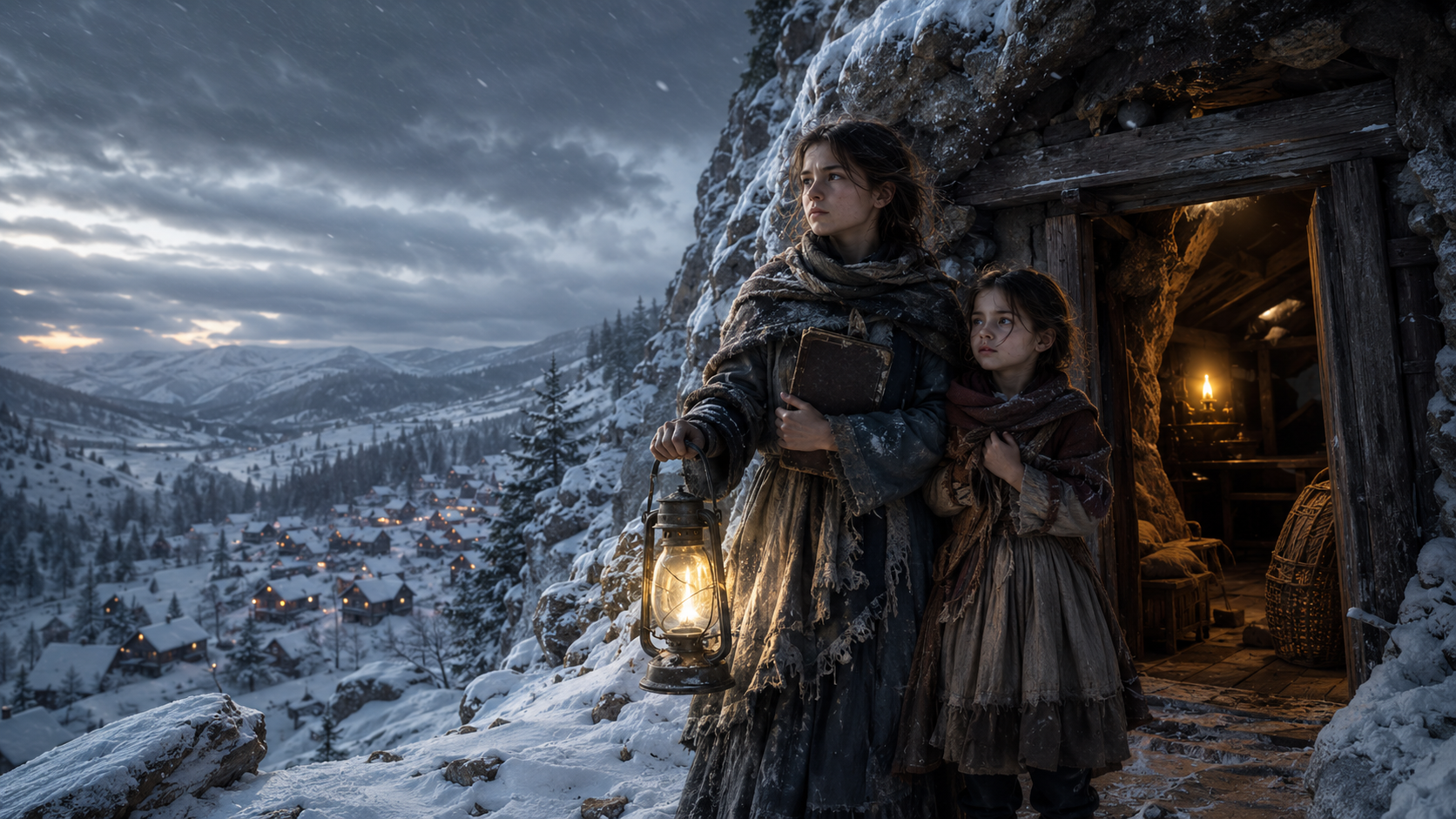
“Tell me honestly,” Elsie whispered, staring at the black mouth of the cave, “are we surviving… or have we finally lost our minds?”
Mara Vale did not answer at once.
The wind moved through the pines above them with a long, warning sound, like someone dragging a hand across a closed coffin. Below the ridge, the town of Briar Glen sat in a basin of white fields and crooked roofs, every chimney puffing smoke into the December-gray sky. From up here, it looked peaceful. Gentle. Safe.
Mara knew better.
Safety was what people called a thing after it had failed someone else.
She tucked a loose strand of dark hair beneath her wool cap and held up the leather-bound notebook in her hand. Its cover had gone soft with age. The corners were chewed by damp. The pages smelled of smoke, oil, dust, and the careful patience of a man who had spent his life noticing what other people ignored.
“Our grandfather didn’t draw this place because he was mad,” Mara said. “He drew it because he understood the mountain.”
Elsie hugged herself tighter. She was seventeen, thin from grief and winter, her cheeks hollowed by the months since fever took their mother and a logging accident took their father before the year had even finished burying itself. She looked too young to be standing in front of a cave with a shovel in her hands, deciding whether stone could become a home.
But then again, Mara thought, nobody ever looked ready for the life that arrived.
“He wrote a hundred things in that book,” Elsie said. “Root cellars. Smokehouses. Drainage pits. Spring shelves. Storm walls. That doesn’t mean he meant for his granddaughters to sleep under a cliff.”
Mara opened the notebook to the page she had studied until the lines appeared behind her eyelids at night.
There it was.
A drawing of the ridge above Briar Glen. The creek bend. The split pine. The sloping pasture behind their ruined cabin. The stone shelf hidden behind blackberry canes. And beneath that, in their grandfather Orson Vale’s square, stubborn handwriting:
SOUTH-FACE HOLLOW. IF THE HOUSE FAILS, BUILD HERE.
Beneath the words was a careful drawing of the cave mouth. A timber wall fitted under the overhang. A door set slightly to the left to break the north wind. Two small windows facing morning light. A raised plank floor with air beneath it. Drainage trenches carved along both sides. A stone fireplace built deep into the back wall, not for beauty, but for heat storage. A vent line through a natural crack overhead.
Not a den.
Not a grave.
A plan.
Mara stepped forward into the cave and held out her bare hand. Outside, the wind bit through gloves. Inside, after twenty paces, it changed. The air did not warm, exactly, but it steadied. It stopped attacking. It wrapped itself around the skin with the stillness of earth that had not cared about yesterday’s weather and would not care about tomorrow’s.
Elsie followed her in, boots scraping stone.
“It feels strange,” she murmured.
“It feels honest,” Mara said.
Elsie glanced at her. “Honest?”
“A regular house lies to you. It stands there looking proud and upright, but if the wind finds every crack and snow piles on the roof, pride won’t keep anyone alive.” Mara touched the cave wall. “This doesn’t pretend. It says, ‘I am stone. Learn my rules or leave.’”
Elsie looked back toward the valley, where a faint line of smoke rose from the church chimney.
“They’ll laugh.”
“They already laugh.”
“They’ll call us cave rats.”
“They called us poor before that. Orphans before that. Stubborn before that.” Mara turned a page in the notebook. “Let them choose a new word. We still need a place to live.”
Their cabin below the ridge had become unfit before winter even arrived. The roof sagged where wet snow had collected too many years in a row. Wind slipped through the plank walls no matter how much rags and clay Mara pushed into the gaps. The chimney smoked in bad weather. The floor froze so hard some mornings that Elsie’s wash water formed ice in the basin before sunrise.
The townspeople had offered advice.
Advice, Mara had learned, was what people gave when they wanted to feel generous without giving anything useful.
Mrs. Blythe from the mercantile said the sisters should hire a man to repair the cabin, though everyone knew they had no money.
Reverend Callum said hardship was a test and humility a virtue, which was easy to say beside a church stove fed by other people’s wood.
Nathan Crowe, the largest landowner in the valley, said the Vale girls should sell their useless upper acres before taxes swallowed them whole.
His son Caleb laughed in front of the blacksmith shop and said, “Maybe the mountain will take them in. It’s got more room than sense.”
Mara had been there buying nails with the last of her mother’s egg money.
She had said nothing.
Silence, she had discovered, frightened certain men more than argument.