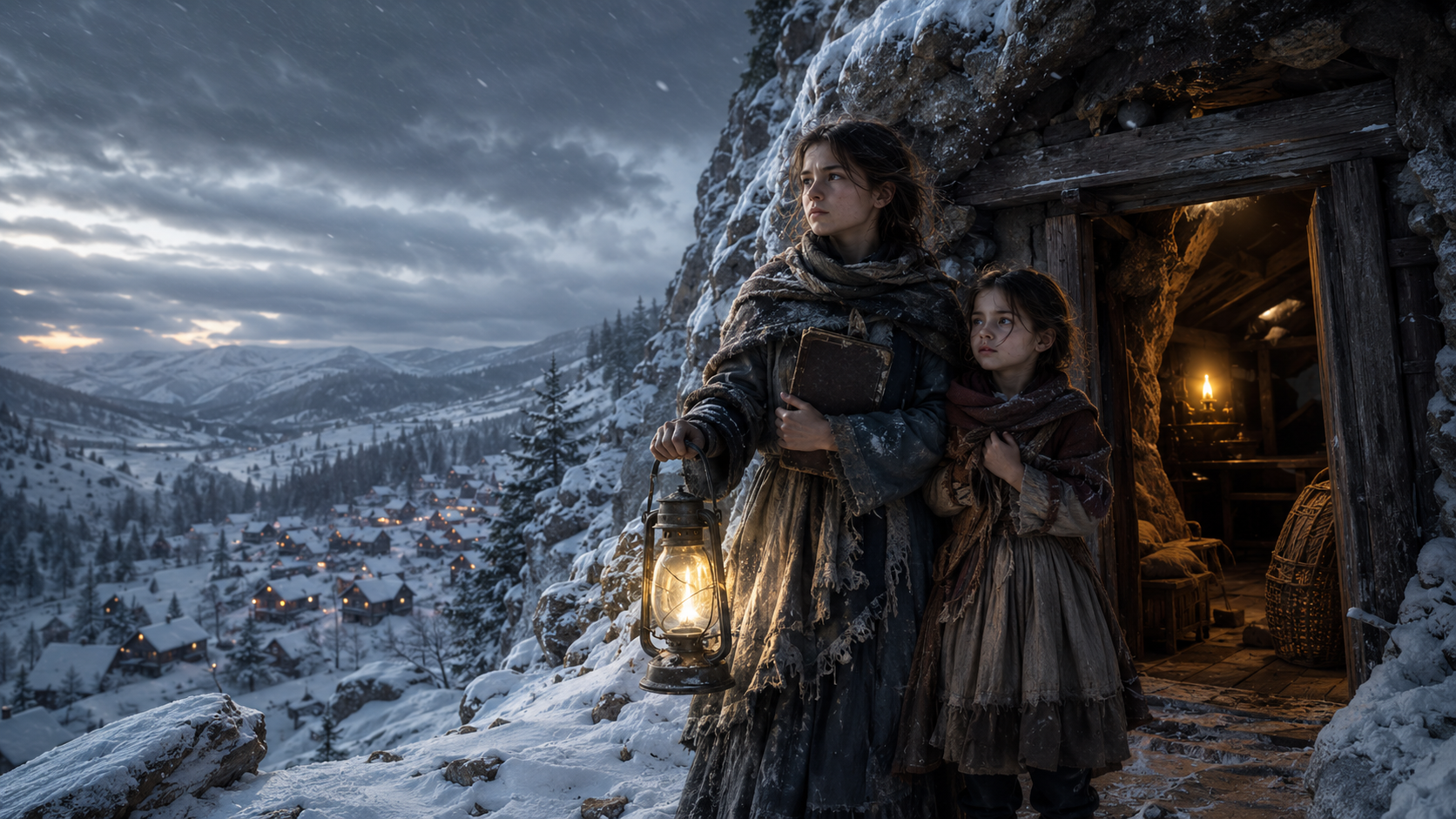
Now, standing in the cave, she looked at the place her grandfather had marked and felt something inside her shift from grief into purpose.
“Tomorrow we clear the entrance,” she said.
Elsie stared. “Tomorrow?”
“Before the next snow.”
“We don’t know how to build this.”
“No,” Mara said. “But we know how to learn.”
Word reached Briar Glen by the end of the week.
By Sunday, the whole valley had decided the Vale sisters were either touched by sorrow or ruined by pride.
By Monday, people began climbing the ridge just to see the foolishness for themselves.
They came in twos and threes, stamping snow from their boots, pretending concern while their eyes shone with entertainment.
Mrs. Blythe stood outside the cave with her hands tucked into a fur muff and declared that grief had made the girls “unsuitable for their own decisions.”
A cattleman named Otto Reese bet half the general store that the cave wall would collapse before New Year’s.
Reverend Callum said, “The Lord gave mankind timber for homes.”
Mara, carrying a basket of stones from the cave floor, replied, “He gave us mountains too.”
The reverend frowned as if scripture had been used without permission.
Caleb Crowe came on the coldest afternoon of the month. He arrived on horseback, wearing a black coat too fine for a man who claimed to work harder than anyone else. His father owned the best meadowland, the sawmill share, and most of the debt in Briar Glen. Caleb had inherited the family gift for standing in a place as if he had already bought it.
He dismounted and looked at the half-cleared cave.
“So it’s true,” he said. “You’re moving into a hole.”
Mara leaned on her shovel. “A dry hole.”
Elsie, behind her, tried not to smile.
Caleb stepped inside. He examined the ceiling, the side walls, the natural overhang, and the rough stakes Mara had placed where the front wall would stand. He tried to look amused, but the cave’s steadiness unsettled him. Mara could see it.
“This is animal shelter,” he said.
“Then animals may be wiser than we are.”
His jaw tightened. “A storm will bury that entrance.”
“We’ll build a snow shed and drainage lip.”
“The smoke will choke you.”
“Not if the throat is built correctly.”
“Spring melt will flood you out.”
“The floor will be raised. Water moves lower than people if people are smart enough to let it.”
He looked at the old notebook resting on a crate near the wall.
“You think a dead mason’s scribbles make you builders?”
Mara picked up another stone and dropped it into the basket.
“No. I think a dead mason’s scribbles are still more useful than a living fool’s laughter.”
Elsie made a small choking sound behind her.
Caleb’s face darkened. “When this ridge becomes your tomb, don’t expect the valley to risk men digging you out.”
Mara lifted the basket.
“If you come,” she said, “bring someone who knows how to use a shovel.”
After he rode away, Elsie sat on an overturned bucket and laughed until tears came.
“I thought he was going to burst.”
“I almost hoped he would,” Mara said.
Then she bent and went back to work.
The first month nearly broke them.
The cave had held years of windblown dirt, fallen branches, nests, animal bones, and stone loosened by freeze and thaw. Every bucket they carried out revealed another job beneath it. Their hands cracked. Their backs ached. Elsie fell asleep sitting upright beside the stove in the old cabin, still wearing her boots. Mara woke each morning feeling as if someone had filled her shoulders with gravel.
But the cave changed.
Slowly, stubbornly, it began to answer them.
The floor became level enough to measure. The walls showed where they could cut storage alcoves. The overhang proved broader than it looked once the brush was cleared. The natural vent crack above the rear wall drew a candle flame upward when Mara held it beneath the opening.
That discovery sent her running back to Elsie like a girl instead of a woman who had forgotten how to be young.
“It draws,” she said, breathless.
Elsie blinked from where she was sorting salvage nails. “What does?”
“The chimney crack. Grandfather was right. It pulls.”
For the first time in weeks, Elsie smiled without effort.
Help arrived in March from a man nobody expected.
Hiram Pike was seventy-nine years old, half deaf, one-eyed, and said to have been born disagreeing with weather. He had worked mines in Colorado, cut stone in Missouri, and built icehouses before most of Briar Glen’s men knew which end of a hammer to hold. He came limping up the ridge with a cane, a tobacco pouch, and a face like dried leather.
Mara saw him at the entrance and braced for mockery.
Instead, he studied the notebook, spat neatly into the snow, and said, “Your grandfather had a brain.”
Mara stared at him.
“You knew this kind of building?”