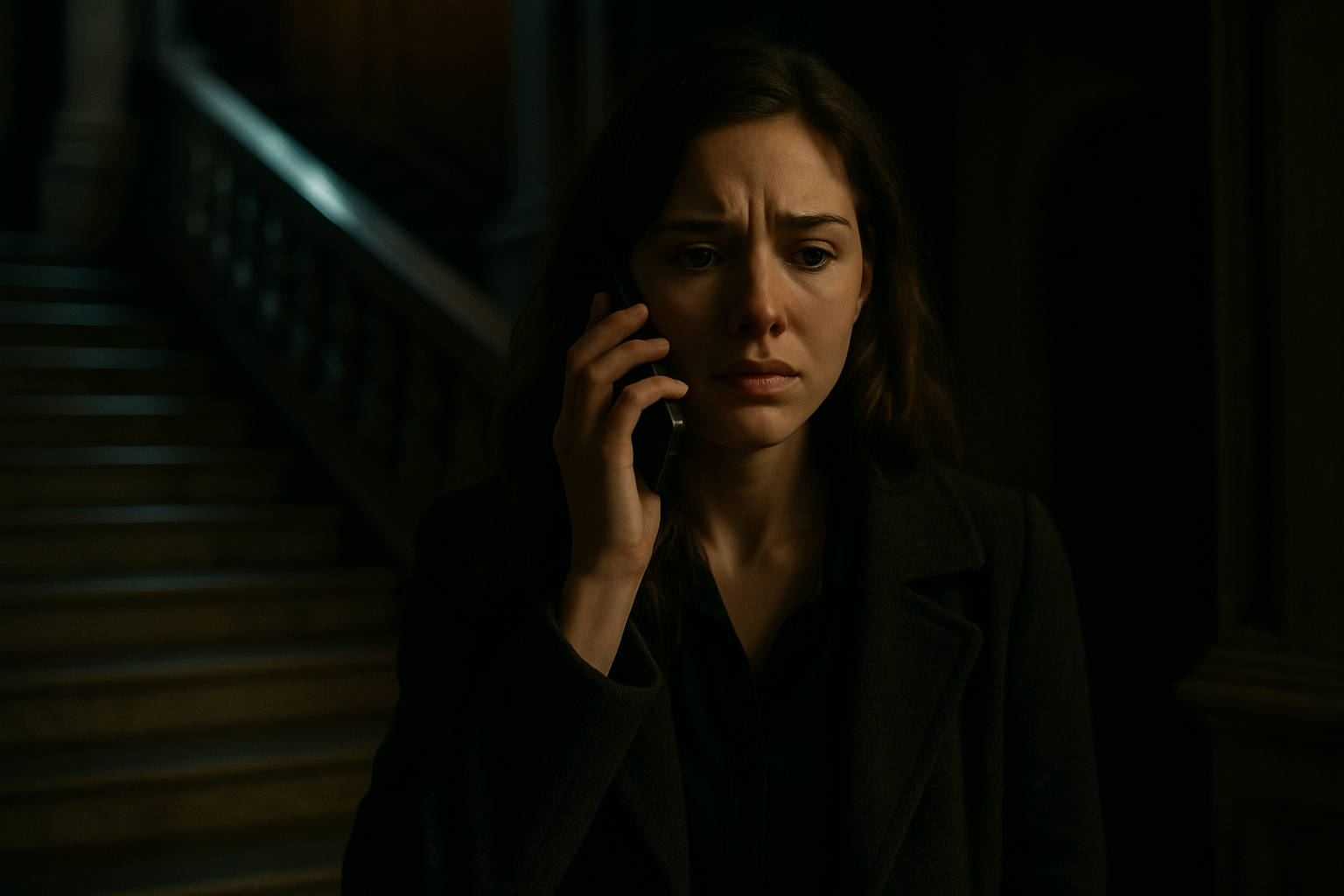
“I’m Dr. Sanjani,” she said, though she wore no white coat, only scrubs and an expression trained to remain steady in rooms where families might shatter. “Ms. Mercer has regained consciousness briefly. She confirmed you as her medical decision-maker. We have the directive.”
Grant pushed away from the wall. “I’m her husband.”
Dr. Sanjani looked at him. “And she has explicitly requested that you not be involved in her care decisions at this time.”
“She’s injured. She doesn’t know what she’s saying.”
Nathan’s voice cut through the air. “Stop.”
But the doctor did not need him. “Mr. Mercer, your wife is alert enough to state her preference. It is documented.”
Grant’s jaw worked. “What about the baby?”
Dr. Sanjani turned back to Nathan. “We are concerned about placental abruption. The fetal tracing is unstable. There’s also maternal trauma—possible rib fractures, head injury, and internal bleeding. We need to proceed with an emergency cesarean section.”
Nathan felt the room recede.
“Will they live?”
Dr. Sanjani’s expression softened, which frightened him more than severity would have.
“We are moving quickly because that gives both of them the best chance.”
The pen she handed him was blue.
Nathan stared at it for a second as if it were an instrument from a foreign country. Consent. Surgery. Blood products. Anesthesia. Neonatal intervention. Each page had neat little lines where a person was meant to place certainty.
There was none.
There was only his sister’s whispered plea.
Don’t let him decide.
Nathan signed.
Grant made a sound behind him.
“You have no right.”
Nathan turned with the pen still in his hand. “I have every right she gave me when she finally understood who you were.”
Grant’s face changed then. The grief he had been performing drained away, and something uglier looked out through the cracks.
“If anything happens to my daughter because of this—”
Nathan stepped close enough that Paul Wexler grabbed Grant’s sleeve.
“Finish that sentence,” Nathan said.
Wexler murmured, “Grant. Don’t.”
For once, Grant listened.
The doors opened again, and through the gap Nathan saw Evelyn for half a second as they rolled her past toward surgery. Her face was ashen. Her hair was matted dark near the temple. A clear mask covered her mouth and nose.
Her eyes found him.
He did not know whether she could see him clearly. Still, he lifted his hand.
“I’m here,” he said.
The doors closed.
And Nathan was left with the men who had reasons to fear a woman surviving.
The next hour belonged to machines.
Nathan had spent his professional life making time obey calendars. Filing deadlines. Hearing dates. Market openings. Contract expirations. He understood time as a thing divided into billable parts, negotiated in conference rooms, measured by people who charged for precision.
Hospital time had no respect for him.
It stretched and collapsed. Ten minutes lasted an entire childhood. Forty minutes vanished while he stared at the same scuff mark on the floor. Somewhere a child cried. Somewhere a vending machine hummed. Somewhere behind walls, surgeons worked with gloved hands inside his sister’s body while a baby who had not yet seen the world was forced to fight for her place in it.
Margaret arrived in black wool and pearls, her hair pinned too perfectly, her face held together by will. When she saw Nathan, she did not ask for composure. She crossed the waiting room and took his face in both hands.
“My girl?” she whispered.
“In surgery.”
Margaret closed her eyes. The tremor passed through her fingers into his jaw.
Grant rose as if she might come to him. “Margaret—”
She turned.
The temperature of the room seemed to drop.
“You,” she said.
It was not loud. It did not need to be.
Grant stopped moving.
Margaret Beaumont had built philanthropy boards, ruined predatory executives with polite questions, and survived a husband who died too early without ever allowing grief to make her less formidable. She had accepted Grant Mercer into her family because Evelyn loved him. Now that love had been revealed as evidence of Evelyn’s goodness, not Grant’s worth.
“You will not speak to me,” Margaret said. “You will not stand near my son. You will not use the word family in my presence. If my daughter dies, there will not be a locked door in this country strong enough to make you feel safe.”
Paul Wexler went pale.
Grant swallowed. “I didn’t push her.”
“No,” Margaret said. “You only brought the hand that did.”
She sat beside Nathan after that and took his bloody hand in hers.
No one said anything for a long time.
At 2:36 p.m., a neonatal nurse emerged.
Nathan stood.
Margaret stood.
Grant stood too, but no one looked at him.
“Baby girl delivered at 2:31,” the nurse said. “She’s alive.”
The sound that came out of Margaret was half sob, half prayer.
Nathan gripped the back of the chair.
Alive.
The word did not fix the world, but it put a floor beneath it.
“She needed respiratory support,” the nurse continued. “She’s premature and had some distress, but the NICU team is with her now. She’s small, but she’s fighting.”