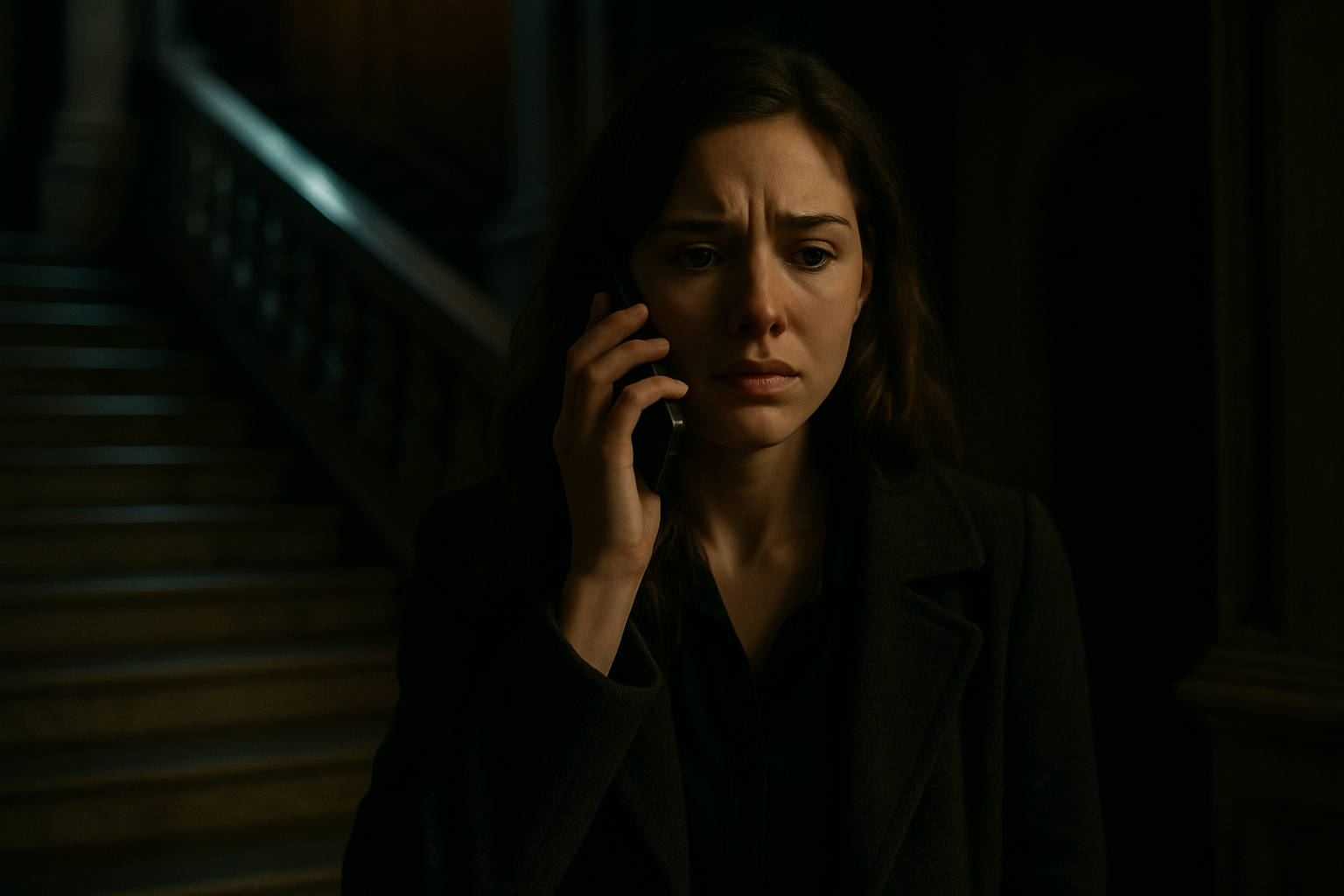
Nathan’s throat closed.
“Can we see her?”
“Soon. We need to stabilize her first.”
“And Evelyn?” Margaret asked.
The nurse’s face grew more careful.
“Dr. Sanjani will come speak with you.”
Alive became not enough.
Nathan heard himself ask, “Is my sister alive?”
“Yes,” the nurse said quickly. “She is alive. But there were complications.”
Complications.
Another clean hospital word for terror.
Dr. Sanjani arrived twelve minutes later with a surgical cap still on her head and fatigue around her eyes.
“Evelyn survived the delivery,” she said.
Margaret’s knees weakened. Nathan caught her elbow.
The doctor continued. “She had a significant placental abruption and internal bleeding from the fall. We controlled the hemorrhage. She required transfusions. There are two cracked ribs, a concussion, extensive bruising, and a laceration at her scalp that has been closed. She is being transferred to recovery, then likely the ICU for monitoring.”
Nathan nodded because his body remembered how even when his mind did not.
“Will she wake up?”
“We expect her to, yes. She was under general anesthesia. Given the concussion and blood loss, it may take time.”
“Can she have more children?” Grant asked.
The question landed wrong.
Not with grief. With calculation. With ownership.
Dr. Sanjani looked at him, then at Nathan, clearly measuring what she was allowed to say.
Nathan’s voice was sharp. “He is not entitled to her medical details.”
Grant’s face darkened. “I’m the father of her child.”
“You are not her proxy,” Dr. Sanjani said evenly. “Mr. Beaumont is correct.”
Grant looked as if he might argue, but Paul Wexler touched his arm again.
It was astonishing, Nathan thought, how often Grant needed to be stopped from making himself worse.
Dr. Sanjani led Nathan and Margaret down the hall to a smaller consultation room where Grant could not follow. There, she explained what she had not said in the waiting area. Evelyn had nearly bled out. The placenta had separated too quickly. The baby had been deprived of oxygen for a dangerous stretch, though not long enough yet to predict the outcome. The next twenty-four hours mattered. The next forty-eight mattered more.
“There may be no long-term effects,” the doctor said. “There may be some. We won’t know immediately.”
Margaret listened without blinking, but Nathan felt her nails press crescents into his palm.
“Can Evelyn see her?” Nathan asked.
“When she is awake and stable.”
“And if Grant tries to access the NICU?”
“We can restrict visitors with proper legal documentation.”
“You’ll have it,” Nathan said.
Dr. Sanjani studied him. “I believe you.”
By late afternoon, the courthouse video had already found its way into the hands of the county prosecutor.
Not the press. Not yet.
Nathan made sure of that.
He wanted legal containment before public spectacle. He wanted Marissa processed before she could transform herself online into a sobbing victim in silk. He wanted Grant’s phone subpoenaed, his messages preserved, his assets frozen harder than they already were. Rage sharpened him into efficiency. Grief would come later. Fear would come at night. For now, there were forms to file and orders to obtain, and Nathan knew how to build a wall out of paper strong enough to stop a man.
By 5:00 p.m., an emergency protective order was in place barring Marissa Vale from contact with Evelyn, the child, Nathan, and Margaret.
By 5:40, Nathan’s associate had filed for a temporary order restricting Grant’s access to Evelyn’s medical information and the infant’s location pending a custody hearing.
By 6:15, the first reporter called.
Nathan did not answer.
In the NICU, the baby lay beneath blue-white light, impossibly small under a web of tubes and wires.
Nathan saw her through the glass before he was allowed inside. She had Evelyn’s mouth. That was the first thing he noticed, and it nearly undid him. A tiny bow of a mouth, stubborn even in sleep, moving now and then as if practicing protests for a life that had already demanded too much of her.
Margaret pressed her hand to the window.
“Oh,” she whispered. “Oh, Evelyn.”
The nurse beside them spoke gently. “She’s doing better than she was when she arrived. Still critical, but stable.”
Stable.
Nathan had never loved a word so fiercely.
“What is her name?” the nurse asked.
Nathan looked at Margaret.
Margaret looked at the child.
“Evelyn hadn’t told us,” she said. “She kept saying she wanted to meet her first.”
The nurse nodded. “Then Baby Girl Mercer for now.”
Nathan’s head turned.
“No,” he said.
The nurse blinked.
Margaret wiped her eyes and straightened.
Nathan’s voice was quiet but absolute. “Not Mercer.”
“Legally, we have to use the mother’s registered surname until paperwork—”
“Then use her mother’s legal name.”
The nurse checked the chart. “Evelyn Mercer.”
Nathan felt the old anger rise again, but Margaret placed a hand on his arm.
“Not tonight,” she said softly. “We will fix what can be fixed when both our girls are breathing without machines.”
Both our girls.