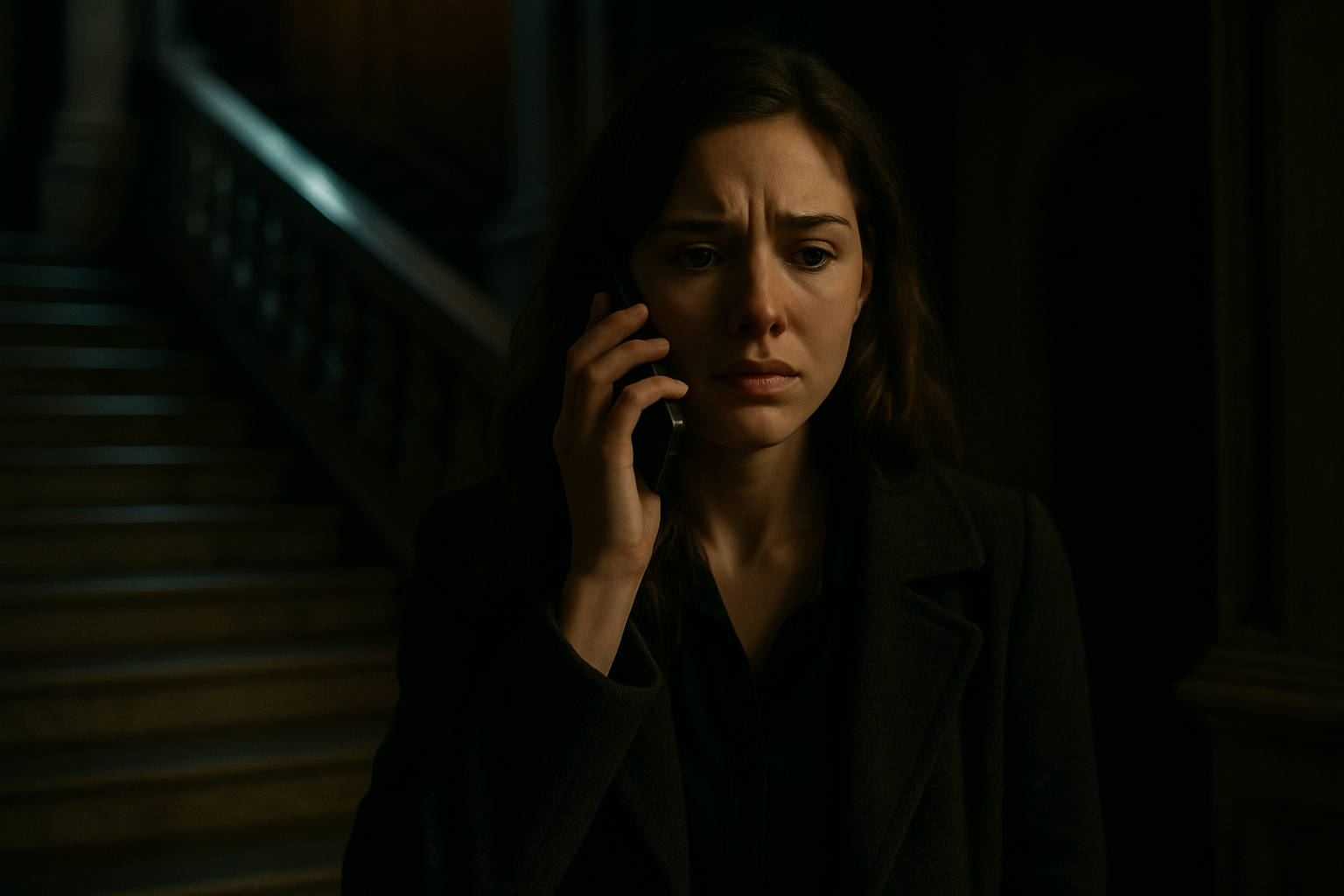
At the emergency entrance, the world became movement.
Doors flew open. Cold air rushed in. White lights. Rolling wheels. A woman in blue scrubs asking gestational age. Another calling for obstetrics and trauma. Someone cut Evelyn’s coat up the sleeve. Someone else shouted for an ultrasound. Nathan followed until a nurse planted both hands on his chest.
“Sir, you have to wait here.”
“I’m her brother.”
“You still have to wait here.”
“She doesn’t want her husband making medical decisions,” Nathan said. “It’s in her file. Her attorney filed a medical directive. My name is Nathan Beaumont.”
The nurse’s expression changed by a fraction. Not softness. Recognition of danger.
“Do you have documentation?”
“My office does. I can have it sent in sixty seconds.”
“Send it.”
Nathan already had his phone out. His hands, which had held courtroom binders steady through hostile hearings and billion-dollar disputes, shook so badly he mistyped his own password twice.
Behind the swinging doors, Evelyn disappeared.
The doors kept moving after she was gone.
Nathan stood there, staring at them, with blood on the cuff of his shirt and courthouse dust on his knees.
Then Grant arrived.
He came through the ambulance entrance pale and breathing hard, his tie loosened, one side of his coat hanging open. He looked less like a husband than a man who had run after the consequences of his own life and still expected them to stop when he commanded.
“Where is she?” Grant demanded.
Nathan turned slowly.
For a moment neither man spoke. The fluorescent lights made Grant look older, emptied out. There had been a time when Nathan had let him stand at family tables, pour wine beside his mother’s silver candlesticks, call Evelyn sweetheart in a voice that seemed gentle if no one listened closely enough.
Now Nathan saw him as he was: a man who had used charm the way other men used knives.
“You don’t get to go back there,” Nathan said.
“She is my wife.”
“She is my client. She is my sister. And if the directive she signed is on file, I am her medical proxy.”
Grant’s eyes sharpened. “She was coerced.”
Nathan gave a laugh so low it barely sounded human. “Choose your next lie carefully. There are deputies ten feet away.”
Grant looked past him toward the trauma doors. “My child is in there.”
Nathan stepped into his line of sight.
“Your child is in there because your mistress pushed her mother down courthouse steps.”
Grant flinched, but only for a moment. “Marissa was upset.”
“Marissa committed assault in front of witnesses.”
“It was an accident.”
Nathan moved closer. “If you say that again, I will forget we are in a hospital.”
A sheriff’s deputy entered through the same doors then, followed by another. Nathan recognized the first one from the courthouse steps. His uniform was damp at the collar from the cold outside, and his mouth was pressed into a grim line.
“Mr. Beaumont,” the deputy said. “We’ll need a statement when you’re able.”
“Is Marissa Vale in custody?”
“She’s being transported for booking.”
Grant’s head snapped toward him. “Booking?”
The deputy looked at him without warmth. “Ms. Vale was seen shoving a pregnant woman down a flight of stone steps, Mr. Mercer.”
“She didn’t mean—”
“Mr. Mercer,” Nathan said softly.
Grant stopped.
The deputy’s gaze moved between them, registering everything and promising to remember it later.
“I’ll wait outside the family area,” the deputy said. “Doctors first. Statement after.”
Doctors first.
It became the only law Nathan could obey.
He sent the medical directive. He called his assistant and told her to get Judge Halperin’s clerk on the phone, to notify Evelyn’s family counsel, to preserve every scrap of footage from the courthouse, every 911 call, every cell phone video. His voice sounded composed. He could hear it and almost admire the impersonation.
Then he called his mother.
Margaret Beaumont answered on the second ring.
“Nathan?”
For one merciful second, he was nine years old again, standing at the bottom of a staircase after dropping a glass, waiting for someone older to tell him accidents could be fixed.
“It’s Evelyn,” he said.
There was silence.
“What happened?”
He looked down at the blood drying brown across his cuff.
“She fell.”
His mother inhaled sharply. “The baby?”
“We don’t know yet.”
“I’m coming.”
“Mom—”
“I am coming,” Margaret said, and hung up.
Grant hovered near the wall, making calls no one answered. His lawyer arrived twenty minutes later, coat buttoned wrong, forehead shining. Paul Wexler took one look at Nathan and seemed to understand that the case had changed shape while he drove. It was no longer divorce litigation. It was no longer financial misconduct tucked under civil pleadings and urgent motions.
Blood made everything simpler.
Blood made people choose sides.
A nurse came out at 1:07 p.m.
“Nathan Beaumont?”
He was on his feet before she finished saying his name.