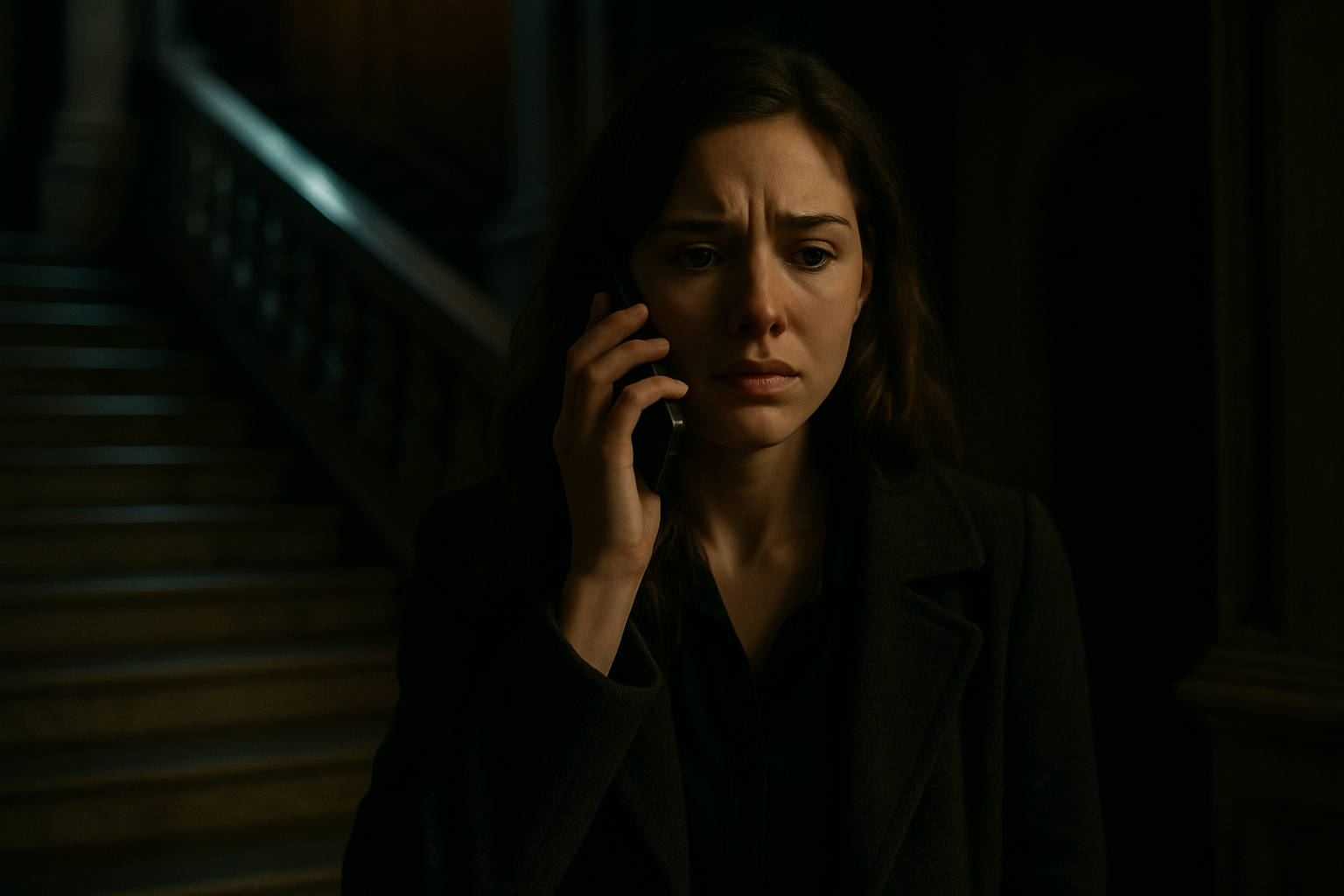
“Then move fast enough that I don’t have to.”
For once, Caroline Shaw did not rebuke him.
“I’ll get Romero assigned,” she said. “And I’ll have someone pull courthouse surveillance immediately.”
“Good.”
“Nathan?”
“What?”
“I’m sorry.”
He looked at his sister’s blood drying beneath his fingernails.
“Be useful instead.”
Then he hung up.
Inside the operating room, Evelyn was dying by inches.
The fall had done what Marissa Vale’s hands alone could not have managed: it had turned marble and gravity into accomplices. Evelyn’s ribs had cracked against the courthouse steps. Her clavicle had broken beneath the force of impact. A concussion clouded the brain that had once remembered birthdays, recipes, arguments, and every cruel thing Grant Mercer had said after midnight when he thought no one would ever hear of it.
But the worst damage was hidden.
The placenta had partially torn from the uterine wall. Blood pooled where it should not. Oxygen faltered. The baby’s heart, small and furious and frightened, dipped on the monitor while the obstetric surgeon called for instruments and the anesthesiologist watched Evelyn’s blood pressure slide downward with merciless speed.
“Prep for emergency C-section.”
“She’s unstable.”
“The baby’s not tolerating this.”
“We don’t have time.”
They cut through her body to save the life inside it.
At 1:47 p.m., Evelyn Mercer’s daughter was delivered into a room filled not with celebration but alarms.
She did not cry.
For a moment—one suspended, breathless, unbearable moment—there was only the wet hush of surgical movement and the flat urgency of machines.
Then the NICU team took her.
She weighed four pounds and two ounces.
Tiny.
Too early.
Not gone.
Silent, but not surrendered.
A nurse wrapped her in sterile warmth while another slipped a tube between impossibly delicate lips. Two fingers pressed against her chest, compressing a heart that had not yet learned the world could be so cruel. Someone adjusted oxygen. Someone called out numbers. Someone murmured, again and again, “Come on, little one. Come on. Come on.”
It was not a prayer, not exactly.
It was command.
Invitation.
Defiance.
The baby’s chest rose because a machine insisted. Her limbs trembled faintly. Her skin was flushed, translucent, furious with the effort of being alive.
Then, at last, sound broke from her.
Thin.
Reedy.
Almost offended.
It was not the triumphant cry people imagined when they spoke about birth. It was not a movie moment, not a swelling of music, not a mother weeping and a father laughing as the world became new.
It was fragile and uncertain.
But it was a cry.
It was breath.
It was life, offended by death’s presumption, insisting on itself.
Ten minutes later, Evelyn’s heart stopped.
The bleeding had not slowed. It came and came, a red tide no surgeon could politely reason with. Her pressure crashed. The room shifted from urgency into war.
“Massive transfusion protocol.”
“More suction.”
“Clamp.”
“We need control now.”
Her uterus, the place that had held June, had become the thing killing her.
There are choices medicine makes that are not choices at all. There are doors that close because the alternative is a grave.
The surgeons performed an emergency hysterectomy to save Evelyn’s life.
Her heart faltered once more. Stopped.
Returned.
Nathan knew none of this as it happened.
He knew only the hallway.
The closed doors.
The scuffed floor.
The clock that moved with obscene indifference.
At some point, a security guard brought him a plastic bag for his ruined suit jacket. Nathan ignored it. At some point, an orderly wiped a small smear of blood from the wall near where he stood; Nathan watched the red vanish and felt something inside him harden permanently. At some point, Caroline texted: Detectives en route. Courthouse secured.
He did not answer.
Then the surgical doors opened.
A man in blue scrubs stepped out, mask tugged down beneath his chin. He looked exhausted in the way only surgeons looked exhausted—body tired, eyes still terribly awake. His badge read: Dr. Adrian Cole.
“Nathan Reed?”
Nathan stepped forward.
“Yes.”
Dr. Cole’s expression did not soften with false hope. Nathan appreciated that, even as he hated him for everything he was about to say.
“Your sister is alive.”
Nathan closed his eyes.
For a moment, all of him went silent.
Alive.
The word entered him like air after drowning.
“She is in critical condition,” Dr. Cole continued. “She sustained multiple traumatic injuries—fractured ribs, a broken clavicle, concussion, significant internal bleeding. The most immediate crisis was a severe placental abruption. We delivered the baby by emergency C-section.”
Nathan’s throat tightened.
“The baby?”
“In the NICU. She’s ventilated. Premature, but alive. Oxygen deprivation is a concern. The next forty-eight hours are going to be important.”
Nathan nodded once, but his mind snagged on every word.
Premature.
Ventilated.
Oxygen deprivation.
Forty-eight hours.
Dr. Cole went on, and Nathan braced himself before he knew why.