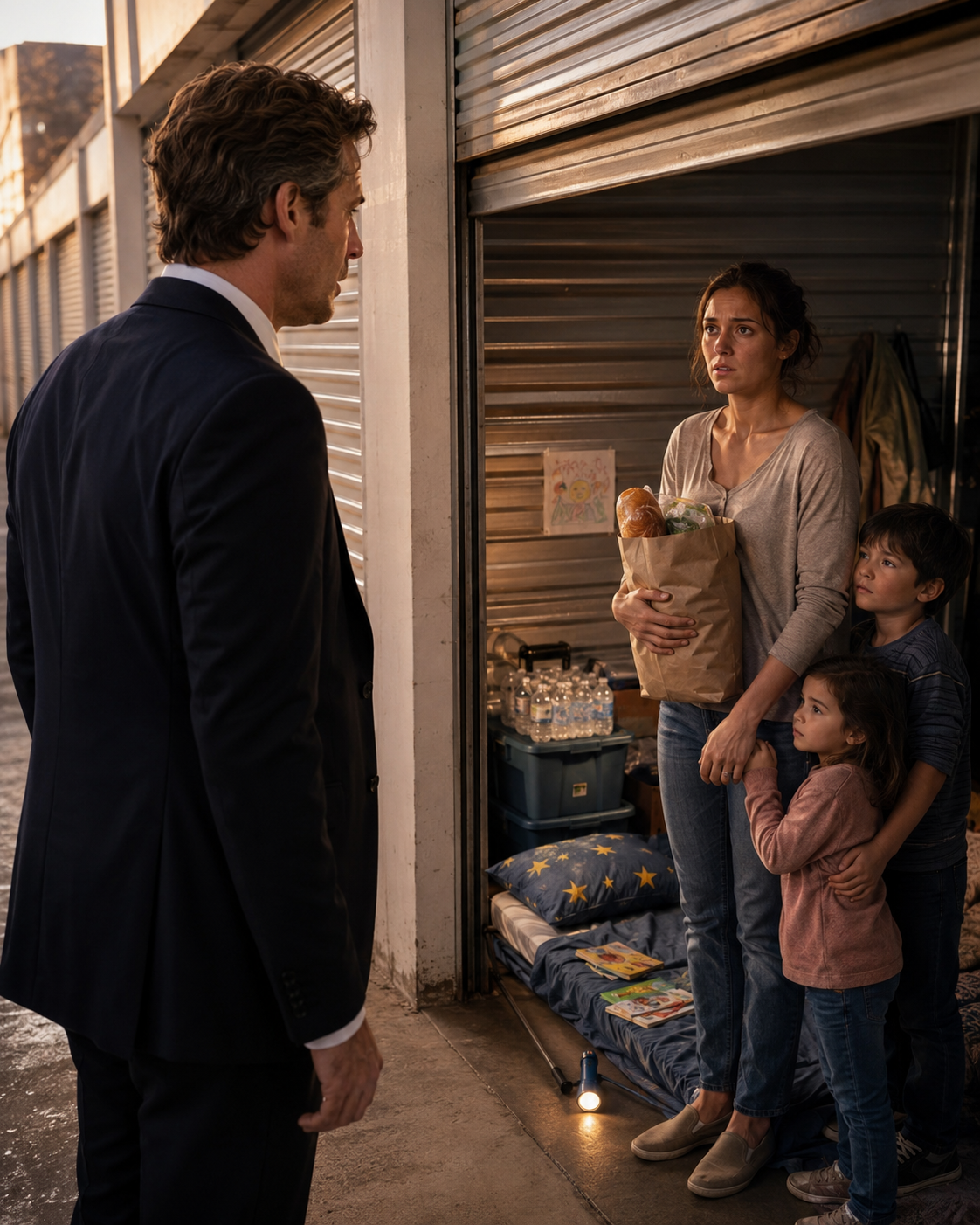
The answer was in his silence.
Adrian held out his hand. “Open it.”
Walter removed a folded slip of paper from his pocket. His fingers trembled as he turned the lock. The metal clicked. He gripped the handle and rolled the door upward.
The sound was violent in the quiet row.
Adrian stepped forward.
Then he stopped.
The unit did not look like storage.
It looked like someone had tried to turn a concrete box into a home without allowing it to admit what it was.
A thin mattress was folded against the left wall. Two pillows sat on top of it, one plain gray, one covered in faded yellow stars. A small cooler stood beside a stack of bottled water. There were crackers, apples, peanut butter, a dented kettle, paper plates, a flashlight, a battery fan, and three plastic bins arranged with a precision that made the place more heartbreaking, not less.
A row of children’s books leaned against the back wall.
A little pair of pink sneakers sat beneath them.
There were drawings taped to the concrete, but the tape was curling in the heat. A blue toothbrush lay in a plastic cup. Beside it sat a tiny hairbrush with glitter trapped in the handle.
Adrian smelled laundry soap, bleach, canned soup, and warm air that had nowhere to go.
He had seen poverty before. He had donated to it. He had sat at fundraising tables while people gave speeches about it. He had approved corporate grants with numbers large enough to make newspaper captions.
But this was not a speech.
This was not a statistic.
This was a child’s hairbrush in a windowless storage unit on land he was about to sell.
Walter spoke behind him, his voice low.
“She pays every month.”
Adrian turned slowly.
“What?”
“On time,” Walter said. “Cash. Never late.”
Adrian looked back into the unit.
On a piece of cardboard near the mattress, a child had drawn a map. It showed a square labeled with a house shape, though the house had no roof. A dotted path ran from the square to a school, then to a bus stop, then back again. The lines were careful. Too careful for a child who should have been drawing monsters, superheroes, or suns in the corners of pages.
“How long?” Adrian asked.
Walter closed his eyes.
“Eight months.”
The words entered Adrian like cold water.
Eight months.
A mother and children had been living in a storage unit owned by his company for eight months, and every report he had received had reduced them to one harmless word.
Current.
The account was current.
The rent had been paid.
The property was underperforming.
The tenant was compliant.
The system had seen everything except the people.
Footsteps sounded at the end of the row.
Quick footsteps. Familiar footsteps.
A woman stopped ten feet away, holding a grocery bag against her hip. She was in her early thirties, with dark hair tied at the back of her neck and a work uniform partly hidden under a denim jacket. Her face was thin with exhaustion, but not weakness.
She saw Walter first.
Then Adrian.
Then the open door.
Something crossed her face so quickly most people would have missed it. Not fear exactly. Calculation. She measured the distance to the door, the position of the men, the grocery bag, the time, the fact that her children were not with her.
Then she lifted her chin.
“I’ll clear it out,” she said. “Give me until tonight.”
Walter looked away.
Adrian stepped out of the unit. “Are your children with you?”
The woman’s eyes hardened. “Why?”
“I need to know if they’re safe.”
Her hand tightened on the grocery bag. “They’re at school.”
“What are their names?”
“That is not your business.”
“No,” Adrian said quietly. “Maybe it should have been.”
She let out a humorless breath. “You opened my door without asking. Don’t pretend you’re worried about boundaries now.”
The words struck harder than he expected because they were accurate.
He owned the facility. He owned the land. He owned the door. He owned the contract that said no one could sleep inside a unit. But the pink shoes, the books, the careful bins, the little map — none of those belonged to him.
“I’m Adrian Vale,” he said.
“I know.”
“Then you know I can’t ignore this.”
“I’m not asking you to ignore it,” she said. “I’m asking you to let me tell my children before you make them watch strangers throw their things away.”
Walter made a quiet sound behind Adrian.
“What’s your name?” Adrian asked, though he already had it.
“Marissa Cole.”
“Why here?”
She stared at him as if the question itself proved how little he understood.
“Because it is close to their school.”
“That’s all?”
“That is everything.”
Adrian waited.
Marissa hated that he waited. He could see it. She had the expression of someone who had spent too much of her life answering questions from people who had already made up their minds.