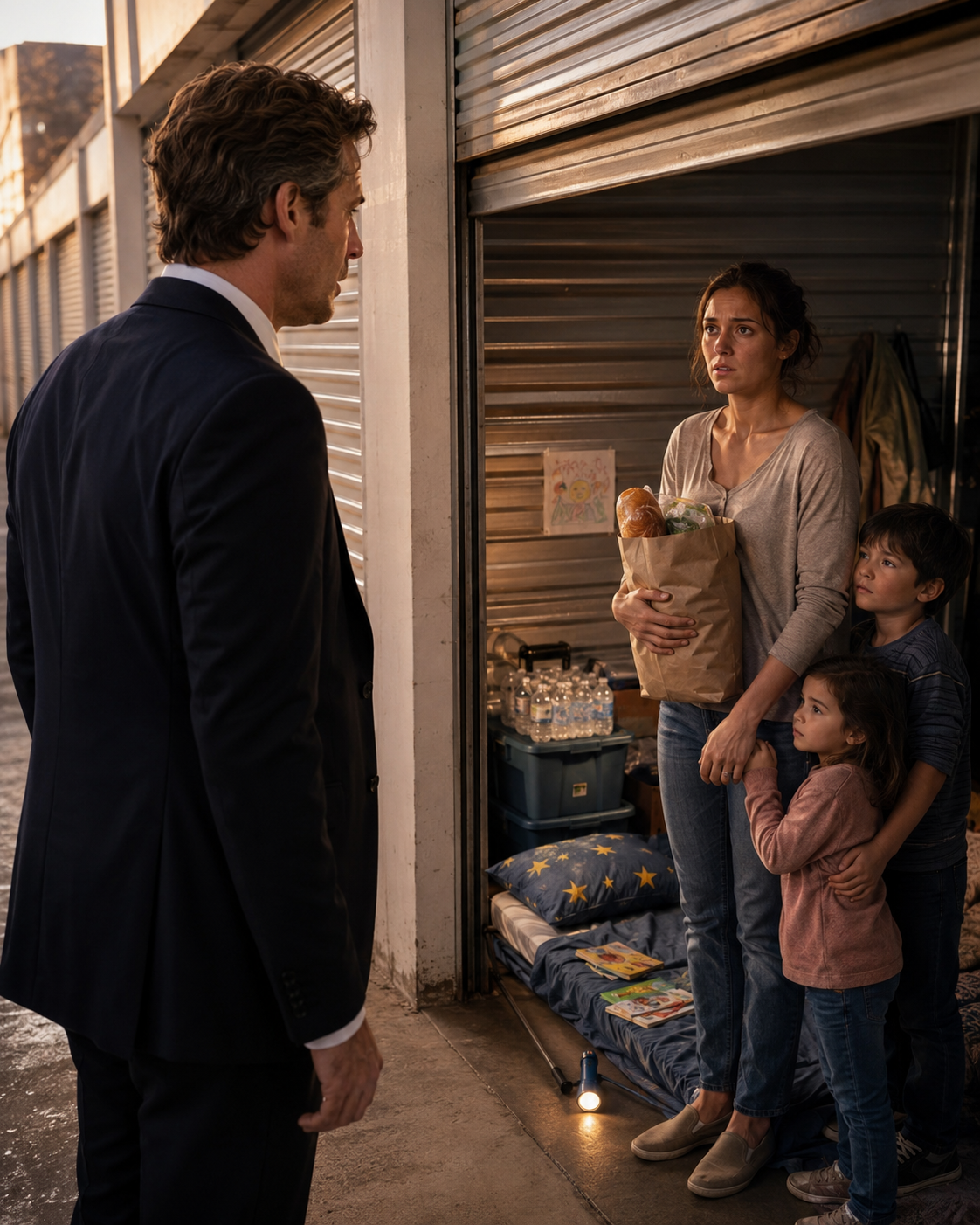
“My son, Ben, gets reading support at that school,” she said at last. “He lost a year moving around. He is finally catching up. My daughter, Ava, has asthma. I work mornings at a diner and evenings cleaning offices. This unit was near the school, near the bus line, and cheap enough that I could keep paying it. That’s the explanation. Not the whole story. Just the part I’m willing to give you.”
Before Adrian could answer, two children appeared at the far end of Row B.
The boy was about ten. Thin, serious, carrying a backpack that looked too heavy. The little girl beside him was maybe six, with two uneven ponytails and a drawing clutched in her hand.
The boy saw the open door.
He stopped.
The little girl bumped into him, then followed his gaze.
“Mom?” the boy called.
Marissa turned, and for the first time her composure cracked.
“It’s okay,” she said immediately.
The boy did not believe her. Children who have been forced to understand adult problems learn the sound of false comfort.
He looked at Adrian’s suit.
Then at Walter.
Then at the open unit.
“Are we getting kicked out?”
Marissa crossed the distance quickly and crouched in front of them. “Listen to me. We are together. We are going to figure this out.”
Ava’s lower lip trembled. “Do we sleep outside now?”
“No, baby.”
Marissa said it too fast.
Everyone heard it.
Adrian had spoken to senators, investors, judges, and executives. He had negotiated deals worth more than entire towns. He had answered impossible questions with a calm face.
But he could not answer a six-year-old girl asking if the sky would be her ceiling.
He looked at the storage unit, then at the children, then at Walter.
The correct corporate procedure unfolded in his mind.
Violation notice.
Immediate removal.
Incident report.
Legal review.
Liability mitigation.
Proceed with sale.
That was the machine he had built. That was how a company stayed clean. Move the problem out of sight, document that you moved it, and call the emptiness order.
But Ava had a yellow-star pillow.
Ben had a map.
And Marissa Cole was standing between her children and ruin with a grocery bag of bruised apples in her hand.
“I’m not removing anyone today,” Adrian said.
Marissa looked at him sharply. “What does that mean?”
“It means no one touches your things tonight. No police. No lock change. No disposal crew.”
“And tomorrow?”
“I come back.”
“For what?”
“To ask better questions.”
Her expression did not soften. “People like you ask questions after you already know the answer.”
“Then don’t trust me.”
“I don’t.”
“I understand.”
“No,” Marissa said. “You don’t.”
Adrian had no defense.
That night, he did not return to his house on Bayshore Boulevard. He went to his downtown office and sat alone in a glass conference room while the city glittered beneath him.
His phone kept lighting up.
The developer wanted confirmation.
His general counsel wanted to discuss liability.
His chief operating officer wanted to know why the sale had paused.
Adrian answered none of them.
Instead, he opened the Harborline file.
Unit 14B.
Tenant: Marissa Cole.
Monthly rent: one hundred eighty-nine dollars.
Status: current.
He stared at the word until it seemed less like an accounting term and more like an accusation.
Current.
As if money arriving on time meant life was in order.
As if a paid bill could prove a child was safe.
Near midnight, Adrian walked into the private bathroom and looked at himself in the mirror. He saw the handmade shirt, the expensive watch, the controlled face, the gray beginning at his temples. He saw a man who had spent decades building distance and calling it achievement.
Then, without warning, he remembered the motel vending machine.
He was nine again, standing barefoot on cold tile while his mother counted coins in her palm. They had lived in a motel for three weeks after his father disappeared with the rent money. Then in a car for eleven nights after that. His mother had brushed his hair in gas station bathrooms, washed his socks in sinks, and told him every morning, “Walk in like you belong somewhere.”
He had built a life so high above that memory that he thought he had escaped it.
He had not.
He had only purchased better walls.
The next morning, Adrian returned to Harborline alone.
Marissa was waiting outside the office, not inside it. Walter had told him she chose the bench by the gate because she could see the exit, the road, and Row B at the same time.
Adrian understood more than he wanted to.
He sat on the other end of the bench, leaving space between them.
For a minute, neither spoke.
Finally, Marissa said, “If you’re here to feel noble, please do it somewhere else.”
Adrian nodded. “Fair.”
“I’ve met men with money before. They love rescuing people long enough to admire themselves.”
“I’m not offering rescue.”