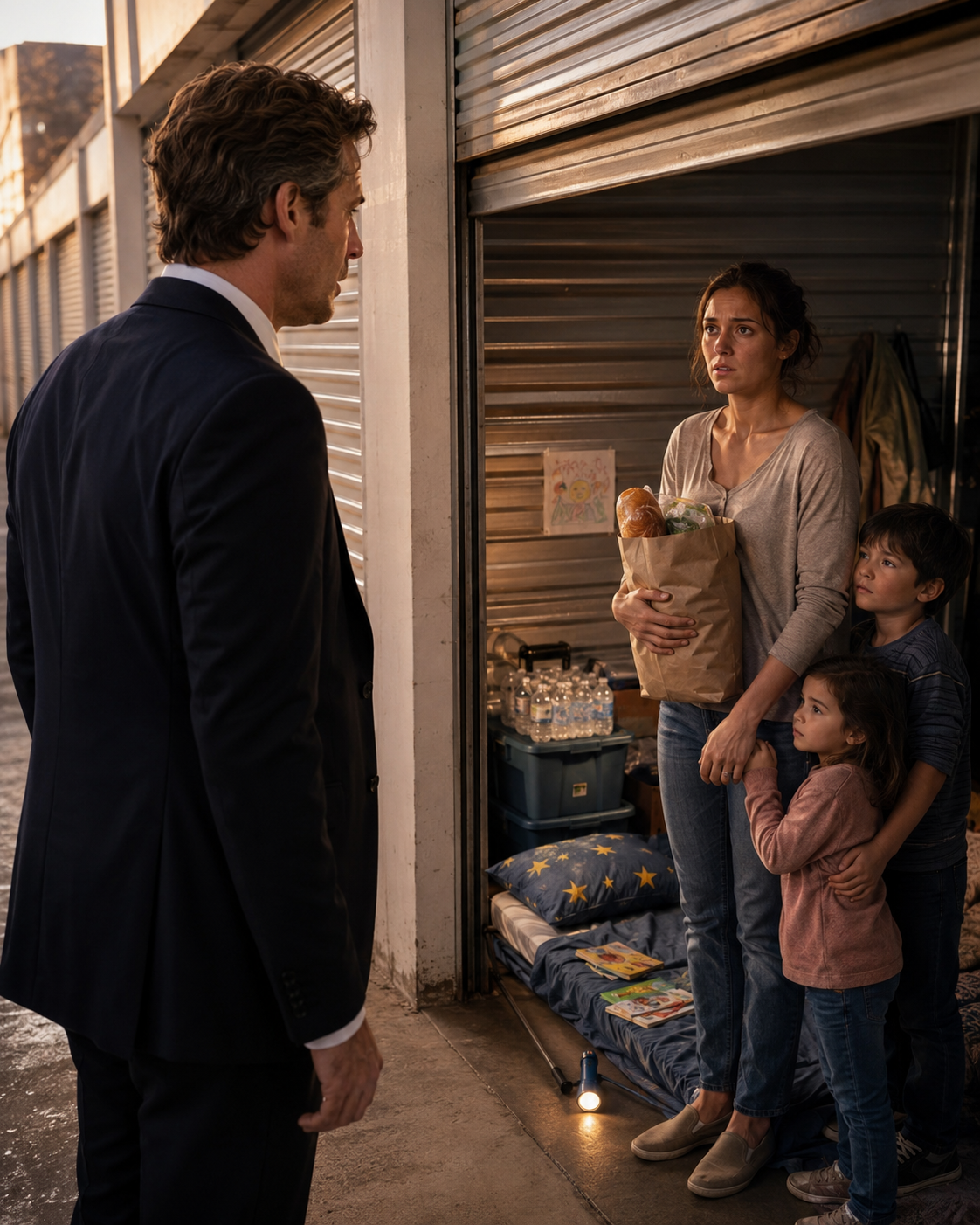
Adrian Vale had built his fortune by knowing the exact value of empty space.
An empty parking lot could become a luxury tower. An old factory could become lofts. A strip of forgotten land by the highway could become a logistics hub before anyone else saw its worth. He had made billions by looking at neglected properties and seeing not what they were, but what they could be sold for.
That was why Harborline Storage should have been an easy decision.
The facility sat on six tired acres near the riverfront in Tampa, between a closed auto shop and a row of warehouses that had once smelled of machine oil and salt. The place had been profitable years ago, before newer storage companies came in with climate control, bright gates, and cheerful signs promising security and convenience. Harborline still had rust on the doors, patched asphalt, and cameras so old they looked more decorative than useful.
Adrian’s advisors had already told him what to do.
Sell it.
A regional developer wanted the land for a distribution center. The numbers were clean. The offer was generous. The closing could happen before the quarter ended. Everyone in his office agreed that Harborline was no longer an asset. It was dead weight.
Adrian agreed with them.
Mostly.
There was one rule he had never abandoned, not even after his company became too large for him to know every property by name. Before selling a site, he visited it once. He walked it himself. He looked at the fences, the gates, the doors, the office, the cracks in the concrete. He told people this was discipline.
The truth was older than discipline.
He had started with one small storage yard and a borrowed truck. Back then, he had fixed locks, swept units, argued with tenants, and slept in his office more than once. Walking a property reminded him that money was supposed to come from something real.
So on a humid Tuesday afternoon, Adrian Vale arrived at Harborline Storage in a black sedan with tinted windows, an unsigned sale approval in his briefcase, and no intention of staying longer than twenty minutes.
Walter Finch, the site manager, was waiting outside the office.
He was sixty-two, narrow-shouldered, sun-browned, and wearing a faded Harborline cap that looked older than some of the buildings. His shirt was clean but frayed at the collar. His hands were clasped in front of him the way people stand when they are ready to be blamed for things they did not cause.
“Mr. Vale,” Walter said.
Adrian shook his hand. “Let’s make it efficient.”
“Yes, sir.”
They began with the gate motor. Then the office. Then the security monitors. Adrian asked direct questions. Walter answered carefully.
How many active tenants?
How many delinquent?
How many units unusable?
Any major incidents?
Any code problems?
Walter answered every question, but his eyes kept moving toward Row B.
Adrian noticed.
He had made a career out of noticing what people avoided.
“What’s on Row B?” he asked.
Walter adjusted his cap. “Standard ten-by-twelves. Mostly household overflow.”
“Mostly?”
“Some contractor equipment. Some long-term tenants.”
Adrian stopped walking. “Show me.”
Walter hesitated for half a second.
It was enough.
They crossed the lot under the hard white sun. Row B was quieter than the rest of the facility. Metal doors lined both sides like closed mouths. Most had dust along the bottom edges, dead leaves stuck against the thresholds, spiderwebs in the corners.
Unit 14B did not.
Its concrete pad was clean. Not freshly cleaned. Maintained. The handle had been wiped so often that the paint around it was lighter. A small strip of weather seal had been neatly repaired. The padlock was not the standard company lock. It was a heavy combination lock, scratched from use.
Adrian looked at Walter.
“Why does this one look different?”
Walter’s jaw tightened. “Tenant takes care of it.”
“Tenant name?”
Walter did not answer quickly enough.
Adrian’s voice changed. “Walter.”
“Marissa Cole,” he said.
“How often does she come here?”
Walter looked down the row before answering. “Often.”
“That is not an answer.”
“No, sir.”
Adrian stepped closer to the door. “Open it.”
Walter’s face lost color. “I don’t think that’s wise.”
“I didn’t ask if it was wise.”
“There are tenant privacy rules.”
“I own the facility.”
Walter lifted his eyes. For the first time, he looked less like a nervous employee and more like a tired man at the end of his patience.
“Ownership doesn’t make every choice decent.”
Adrian stared at him.
People argued with Adrian Vale all the time, but usually from polished conference rooms with lawyers present. He was not used to being morally challenged by a storage manager whose office coffee probably came from a machine older than the company’s website.
“What is inside 14B?” Adrian asked.
Walter swallowed.