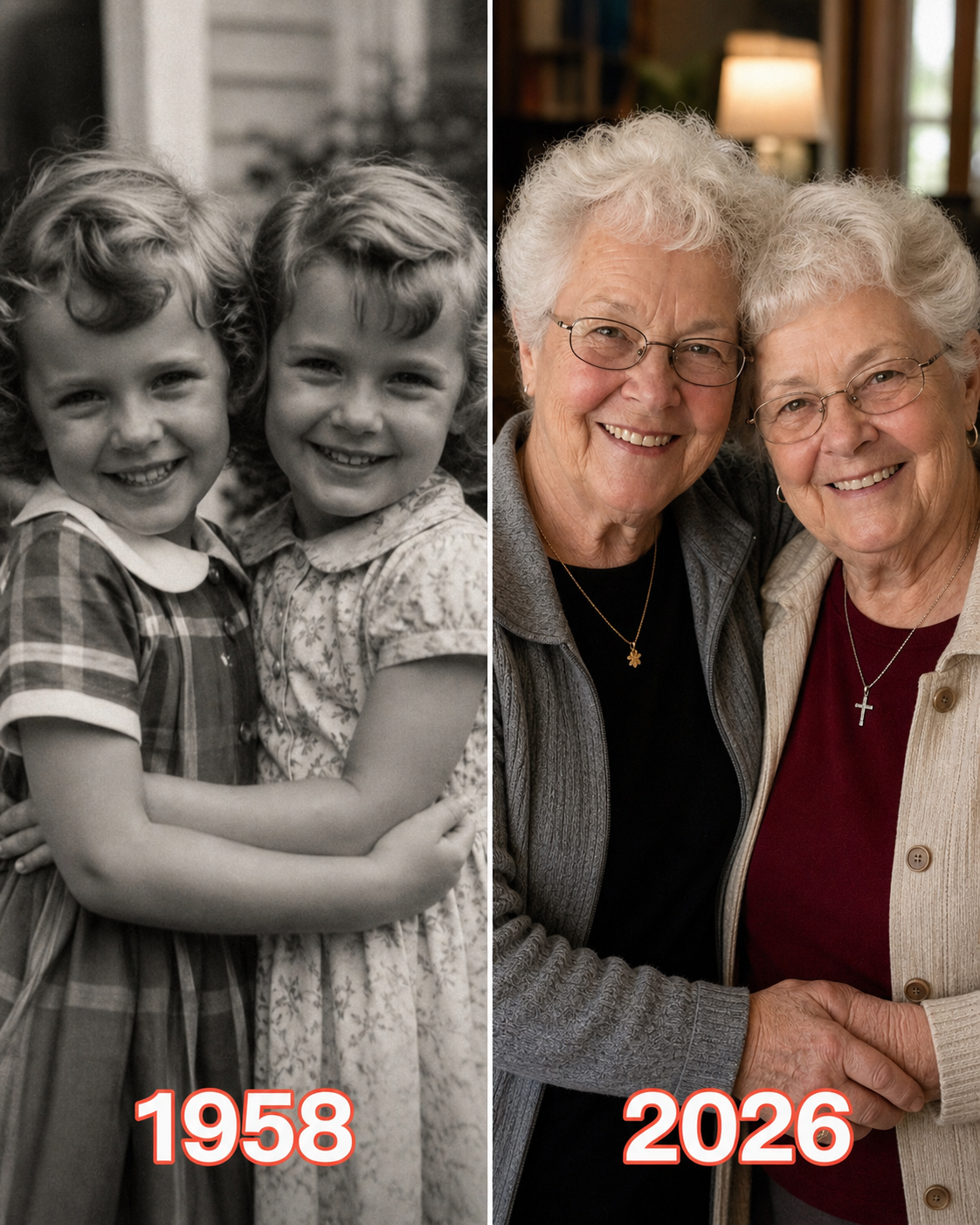
When I was just five years old, my twin sister vanished into the woods behind our home and never returned. Authorities later informed my parents that her body had supposedly been discovered, yet I never saw a funeral, never stood beside a grave, and never looked into a coffin. What remained instead was a lifetime of unanswered questions, silence, and the constant feeling that the truth had never fully surfaced.
My name is Dorothy, I’m 73 years old, and for my entire life I’ve carried an emptiness shaped exactly like a little girl named Ella.
Ella was my twin sister. We were only five when she disappeared.
That afternoon, Ella sat in the corner of the room bouncing her red rubber ball against the wall.
We weren’t merely twins because we shared a birthday. We were inseparable in every possible way — sharing thoughts, emotions, even fears. If she laughed, I laughed harder. If she cried, tears came to my eyes too. Ella was fearless, adventurous. I was the quieter shadow following behind her.
The day she vanished, our parents were both at work, leaving us in the care of our grandmother.
I had fallen ill with a terrible fever. My throat burned, my body ached, and Grandma sat beside me pressing a cool damp cloth against my forehead.
“Close your eyes and rest, sweetheart,” she whispered gently. “Ella will stay quiet.”
Across the room, Ella continued bouncing her red ball against the wall, humming softly to herself. I can still remember the rhythm of that sound and the rain beginning to tap against the windows outside.
At some point, I drifted asleep.
When I woke up, something felt terribly wrong.
The house was unnaturally silent.
No bouncing ball. No humming voice.
“Grandma?” I called weakly.
No response came.
A moment later she hurried into the room, her hair disheveled and panic written across her face.
“Where’s Ella?” I asked immediately.
“She’s probably outside,” Grandma replied too quickly. “You stay in bed, okay?”
Her voice trembled.
Then I heard the back door slam open.
“Ella!” Grandma shouted into the rain.
Her voice rose higher and higher with every call. Soon there were frantic footsteps rushing through the house.
I climbed out of bed despite my fever. The hallway felt icy beneath my feet. By the time I reached the living room, neighbors had gathered near the front entrance. Mr. Frank crouched down in front of me.
“Have you seen your sister, sweetheart?” he asked softly.
I shook my head.
“Did she go somewhere? Did she speak to anyone?”
Then the police arrived.
Blue jackets soaked with rainwater. Muddy boots. Radios crackling with static. Adults everywhere asking questions I was too young to answer.
“What was she wearing?”
“Where did she usually play?”
“Did she ever talk to strangers?”
Late that night they found her red ball.

Behind our house stretched a narrow strip of woods everyone dramatically called “the forest.” To a child, it felt endless — dark trees, tangled shadows, endless places to hide. Flashlights moved between the trunks while men shouted Ella’s name through the storm.
The only clear detail anyone ever truly gave me was this:
They found her ball.
The search continued for days. Then weeks. Time became blurred and confusing. Adults whispered constantly but explained nothing.
I remember Grandma crying quietly beside the kitchen sink, repeating the same words over and over:
“I’m so sorry… I’m so sorry…”
Once, I asked my mother, “When is Ella coming home?”
She stopped drying dishes instantly.
“She isn’t,” my mother answered flatly.
“Why not?”
Before she could continue, my father interrupted sharply.
“That’s enough, Dorothy. Go to your room.”
Later that evening, they sat me down in the living room. My father stared at the carpet while my mother focused on her trembling hands.
“The police found Ella,” my mother whispered.
“Where?”
“In the woods.”
“Is she coming back?”
My father rubbed his forehead tiredly before finally speaking.
“She died,” he said coldly. “Ella died. That’s all you need to know.”
But nothing about it made sense.
I never saw a funeral.
I never saw a burial.
No grave. No flowers. No goodbye.
One day I had a twin sister.
The next day she simply no longer existed.
Her toys disappeared first. Then our matching clothes. Eventually even her name vanished from conversation completely.
Still, I kept asking questions.
“Where did they find her?”
“What happened to her?”
“Did she suffer?”
Every time I asked, my mother’s expression hardened instantly.
“Stop talking about this, Dorothy,” she would say. “You’re hurting me.”
What I wanted to scream back was:
“I’m hurting too.”
But eventually I learned silence was safer.
As the years passed, I became an expert at pretending everything was normal. I went to school, made friends, stayed out of trouble. From the outside I looked like any ordinary girl growing up.
Inside, though, there was always a hollow ache where Ella should have been.

When I turned sixteen, I finally tried confronting the mystery myself.
One afternoon I walked alone into the local police station, hands trembling nervously.
The officer behind the desk looked up.
“Can I help you?”
“My twin sister disappeared when we were five,” I said carefully. “Her name was Ella. I want to see the case records.”
He frowned sympathetically.
“How old are you, honey?”
“Sixteen.”
The officer sighed deeply.
“I’m sorry,” he replied. “Those records aren’t available publicly. Your parents would need to request them.”
“They won’t even say her name anymore,” I admitted quietly. “They only told me she died.”
His face softened.
“Sometimes old pain is better left buried,” he told me gently.
I left feeling more alone than ever.
Years later, in my twenties, I made one final attempt with my mother.
We sat folding laundry together when I finally asked:
“Mom, please… tell me what really happened to Ella.”
She froze completely.
“What good would that do now?” she whispered. “You have your own life. Why reopen all that pain?”
“Because I’m still living inside it,” I answered. “I don’t even know where she’s buried.”
My mother flinched like I’d struck her.
“Please,” she whispered. “Don’t ask me again. I can’t talk about it.”
So I stopped asking.
Life carried me forward whether I wanted it to or not. I graduated school, married, raised children, paid bills, became a mother and eventually a grandmother.
Outwardly, my life appeared full and complete.
But deep inside remained that same quiet empty space shaped like Ella.
Sometimes I’d accidentally place two plates on the table before realizing what I’d done.
Sometimes I’d wake in the middle of the night certain I’d heard a little girl calling my name.
Sometimes I’d stare into the mirror and wonder:
Is this what Ella would look like today?
Both my parents eventually died without ever revealing more. Two funerals. Two gravestones. Their secrets buried with them.
For years, I convinced myself the mystery would die there too.
Then my granddaughter left for college in another state.
“Grandma, you have to visit,” she insisted excitedly. “You’ll love it here.”
A few months later, I flew out to see her. We spent the day organizing her dorm room, debating over storage boxes and blankets like families always do.
The following morning she left for class.
“Go explore the town,” she told me. “There’s a little café nearby with amazing coffee and terrible music.”
So I went.
The café was crowded, warm, noisy. The smell of coffee beans and pastries filled the air. I stood near the counter pretending to study the menu.
Then I heard a woman’s voice.
She was ordering a latte.
Something about her voice froze me instantly — the rhythm, the raspiness, the tone.
It sounded exactly like me.
I looked up.
The woman standing at the counter had gray hair pinned loosely up. Same height. Same posture.
Then she turned around.
And I felt the world stop.
It was like staring directly into my own reflection.
Older, yes. Softer somehow. But unmistakably familiar.
My hands went cold.
I walked slowly toward her.
Her eyes widened with shock.
“Oh my God,” she whispered.
Before I could stop myself, the name escaped my lips.
“Ella?”
Tears instantly filled her eyes.
“No,” she answered shakily. “My name is Margaret.”
I stepped back, embarrassed.

“I’m sorry,” I said quickly. “My twin sister disappeared when we were children. I’ve just… never seen anyone who looked so much like me.”
“No,” she replied immediately. “You don’t sound crazy. Because I’m looking at you thinking exactly the same thing.”
The resemblance was overwhelming.
Same eyes.
Same nose.
Same crease between the eyebrows.
Even our hands looked alike.
We sat together at a small table, both visibly shaken.
Finally she spoke quietly.
“I don’t want to make this stranger,” she said, “but… I was adopted.”
My heart tightened painfully.
“Do you know anything about your birth family?” I asked.
“Almost nothing,” Margaret admitted. “Every time I asked, my parents shut the conversation down.”
I swallowed hard.
“My twin sister disappeared from a small town in the Midwest,” I explained slowly. “The police later claimed they found her body, but I never saw proof.”
We stared silently at one another.
Then she asked:
“What year were you born?”
I told her.
She told me hers.
Five years apart.
“We aren’t twins,” I whispered.
“No,” she agreed softly. “But maybe we’re still connected somehow.”
She exhaled shakily.
“My whole life,” she admitted, “I’ve felt like part of my story was hidden from me.”
“My whole life has felt like that too,” I replied.
Before leaving, we exchanged phone numbers.
Back home, I couldn’t stop thinking about her.
Then I remembered an old dusty box in my closet filled with my parents’ belongings — papers I’d avoided opening for years.
Maybe the truth had been hidden there all along.
I dragged the box onto my kitchen table and began sorting through old documents: tax forms, medical records, letters, certificates.
At the very bottom lay a thin manila folder.
Inside was an adoption document.
Female infant.
No name listed.
The year matched exactly — five years before my birth.
Birth mother: my mother.
My knees nearly buckled beneath me.
Behind the document was a folded handwritten note from my mother.
I unfolded it carefully.
The words shattered me.
She wrote that she had been young and unmarried. Her own parents forced her to surrender the baby in shame. She wasn’t even allowed to hold her daughter before they took the child away forever.
But she never forgot.
Not for a single day.
I cried until my chest physically hurt.
For the frightened young woman my mother once was.
For the child she lost.
For Ella.
And for myself — the daughter left behind inside decades of silence.
When I finally regained composure, I photographed everything and sent it to Margaret.
She called almost immediately.
“Is this real?” she whispered through tears.
“Yes,” I answered quietly. “It’s real.”
Later, a DNA test confirmed what our hearts already knew.
We were full sisters.
People often ask whether our reunion felt joyful or magical.
Honestly, it didn’t.
It felt like uncovering the wreckage left behind by generations of grief, fear, and silence.

We’re not pretending seventy lost years can suddenly disappear.
But now we talk.
We compare old photographs, childhood memories, habits, expressions.
And together we slowly untangle the painful truth:
My mother had three daughters.
One she was forced to surrender.
One she lost in the woods.
And one she kept close while burying the truth beneath silence.
None of it was fair.
But sometimes pain explains what words never could.

