She paid for it honestly after her shift. It simply had not had time to cool by the time she left.
That winter, Ethan repaired the gate, which had not latched properly in five years. He cleaned the chimney, replaced the faucet at the outdoor washstand, and learned how to tend the woodstove without filling the kitchen with smoke.
He rode the school bus to the county high school.
After classes, he carried water, split firewood, cleared snow from the porch to the gate, and then shoveled a narrow path all the way to the road.
Lily started first grade at the same elementary school where her mother cleaned the hallways.
She named a hen with an injured wing Buttercup and constantly carried pieces of bread out to her.
The other hens, apparently, regarded Buttercup’s special treatment with deep disapproval.
And the house grew noisy.
Margaret noticed it sometime in the middle of January.
One morning, she forgot to turn on the radio.
She simply forgot.
There was no need for it anymore. Someone was always talking.
Marina offered to pay for their room and board three times.
The first time, Margaret said, “Don’t be ridiculous.”
The second time, she said, “Do I look like a hotel?”
The third time, she became genuinely angry.
After that, Marina never mentioned money again.
Instead, she began buying things.
First came a new pair of glasses. Margaret’s old ones were cracked across the bridge and held together with tape. She had been reading through them for nearly two years.
Then Marina bought the heart medication from the pharmacy in town—the very medicine Margaret kept postponing until “next month.”
After that came a used washing machine she found through a local advertisement.
Marina simply could not stand watching a woman in her late seventies scrub clothes by hand in a plastic tub.
In the spring, Ethan and their neighbor, George Miller, replaced the damaged shingles on the roof.
The ceiling above the entryway had leaked for two years, and there had always been a bucket beneath the hole.
“Roof repairs,” Margaret said, tilting her head back. “I was saving for that even when my husband was alive.”
“Then keep your money,” Ethan called from above. “Mr. Miller gave us the shingles. He had extras left from his garage.”
Behind the glass doors of the china cabinet stood two framed photographs.
The first showed Olivia.
Margaret’s daughter.
She had a dark bob, a gray jacket, large earrings, and a broad, confident smile.
The picture had been taken in Chicago nearly eight years earlier. Every morning, Margaret wiped the glass and polished the cabinet around it.
The second photograph showed a ten-year-old girl in a school uniform.
Her granddaughter, Sophie.
Sophie was sixteen now, and Margaret had no idea what she looked like anymore.
Olivia had not visited in four years.
Every few months, money appeared on Margaret’s bank card—usually a few dozen dollars, sometimes a little more.
There was never a message.
Never a call.
Margaret did not withdraw it. The money simply remained in the account, like things in an old drawer that were too painful to throw away and too useless to touch.
Six months earlier, Olivia had stopped calling altogether.
A calendar hung on the wall beside the woodstove. Each evening, Margaret crossed out the day with a careful diagonal line.
She had begun the habit during her second year alone, and for some reason, it had stayed.
“Grandma, who is that?” Lily asked one morning, pointing at the photograph.
“My daughter. Olivia.”
“Why doesn’t she come visit?”
“She’s busy,” Margaret replied. “Everyone in Chicago is busy.”
Her neighbor, Helen Foster, caught her beside the well in early April.
“Margaret, tell me you’ve hidden your papers.”
“What papers?”
“The house papers.” Helen set down her bucket and glanced nervously along the empty road. “These people move in, confuse an old woman, take her to a lawyer, and talk her into signing the property over. Then you’ll end up with nothing. Something just like that happened in Fairview. I’m telling you, I know what I heard.”
“The lawyer’s office is in the county seat, above the pharmacy,” Margaret said calmly. “Would you like to go there with me? I’ll show you exactly how it works. We can have something put in your name while we’re there.”
Helen grabbed her bucket and marched away, her rubber boots slapping angrily against the mud.
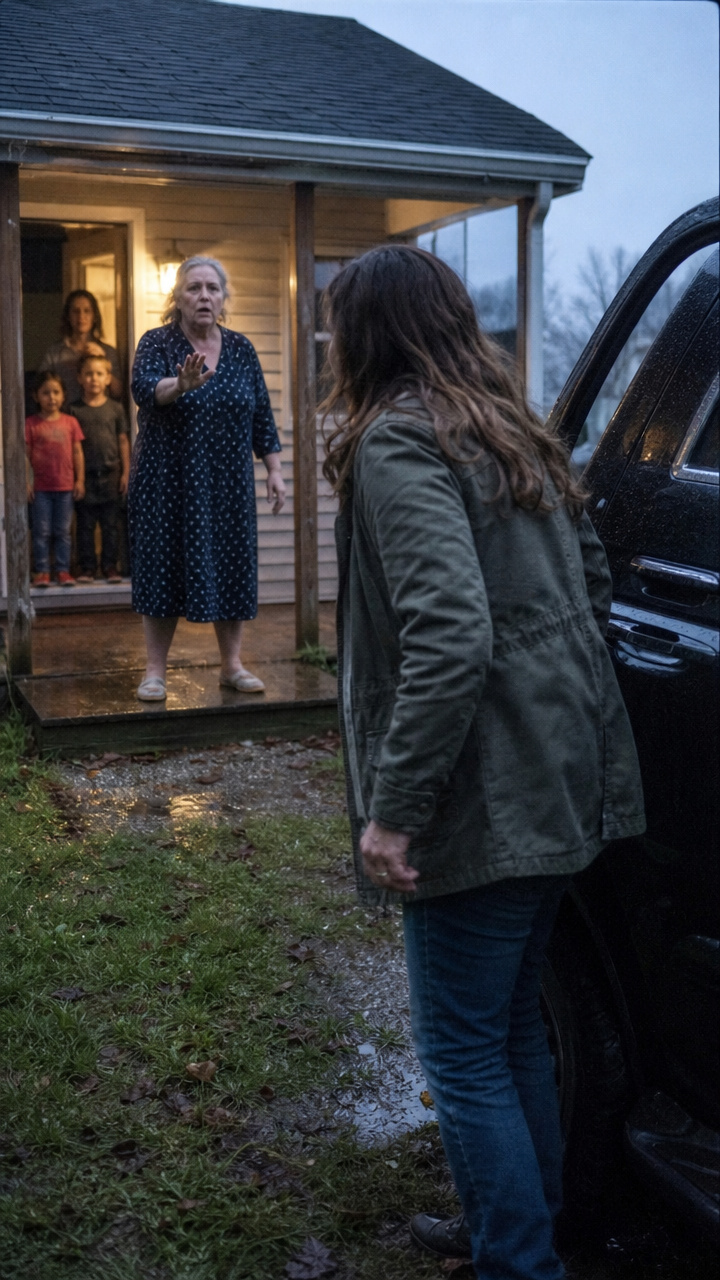
Five days later, a dark SUV pulled into Margaret’s yard.
It was Saturday.
Marina was hanging laundry, clothespins held between her teeth.
Ethan sat on the roof of the summer kitchen, hammering in the last shingle.
Lily was kneeling beside the flower bed, planting marigolds she had grown from seeds on the windowsill.
Olivia stepped out of the vehicle.
She did not even say hello.
“What is going on here?” she demanded, surveying the yard. “Who are these people?”
“Good afternoon,” Marina said, removing the clothespins from her mouth.
“I wasn’t speaking to you. Mom! Mom!”
Margaret came onto the porch, wiping her hands on her apron.