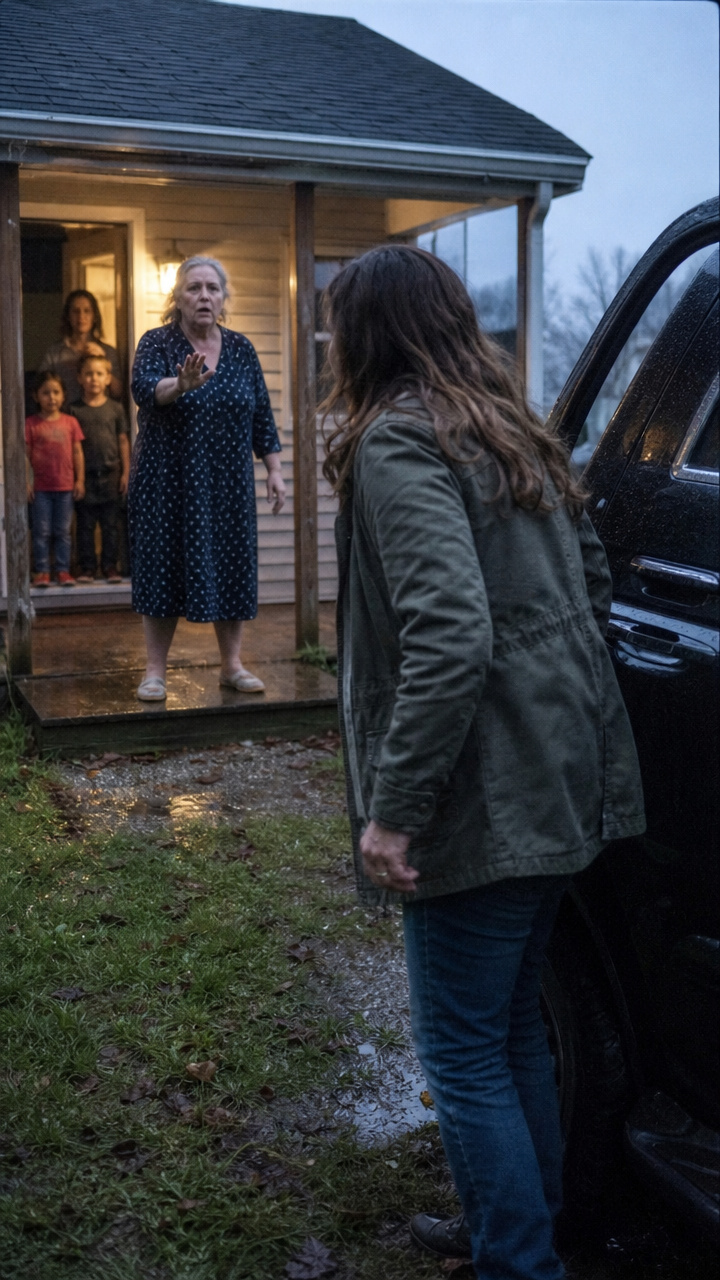
“Why are you shouting? The whole neighborhood can hear you.”
“Let them hear!” Olivia slammed the car door. “Helen called me yesterday. She said you’ve let complete strangers move into the house. I didn’t sleep all night. I drove here from Chicago—”
“You drove for four hours,” her mother corrected. “You didn’t fly.”
“Mom, do you understand what could be happening? They could be scammers. They’ll manipulate you, transfer the house into their names, and leave you homeless! I know an attorney. I’m calling him now.”
“Call him.”
Olivia stopped.
“What?”
“I said call him. Let your attorney come out. He can inspect the roof while he’s here. It leaked for two years until Ethan replaced the shingles. Perhaps your attorney knows roofing, too.”
Olivia turned sharply toward Marina.
“How much are you paying her? Or is she paying you?”
“Nothing,” Marina answered evenly. “I offered. She refused. If you want, I can write a statement saying I have no claim on the house.”
“Of course you can write one.”
“There will be no statements written in my house,” Margaret said.
Lily cautiously peeked out from behind her grandmother’s skirt.
Her knees were muddy, and she still held the small garden shovel. She clutched the fabric tightly and watched the unfamiliar woman with suspicion.
Olivia fell silent.
Only her expression changed. A flicker of unease crossed her face.
“And there’s a child,” she said more quietly.
“Sit down,” Margaret ordered. “Sit on the bench. Your hands are shaking.”
Olivia remained standing.
“Then stand there and listen. When was the last time you came here?”
“Mom, I…”
“I’ll tell you. Four years ago, in May. You brought a cake, stayed for two hours, and left because someone from work called. I gave the cake to Helen afterward. I couldn’t have eaten it by myself in a week.”
“I work!” Olivia raised her voice. “I’m not lazy, Mom. I have two jobs!”
“I know. Everyone works. Everyone also carries a phone in their pocket.”
The yard grew strangely quiet.
Ethan froze on the roof, hammer raised above his head.
“Six months, Olivia,” Margaret said. “You didn’t call me for six months. I stopped counting…”
She paused.
“No,” she corrected herself. “That’s a lie. I didn’t stop.”
“Mom…”
“In February, I slipped beside the well. I fell and couldn’t get up. I lay on the ice wondering when someone would find me. Helen goes into town for bread every Tuesday, so I thought she would notice me on Tuesday. But it was Thursday.”
Olivia said nothing.
“Ethan ran outside wearing only a T-shirt. No coat. He lifted me and carried me into the house. Mrs. Reynolds, the nurse from town, came and said I was lucky not to have been alone. Marina sat beside my bed on a stool for three nights. She bought my medicine with her own money. I scolded her for a week afterward.”
“Why didn’t you call me?” Olivia cried.
“Who was I supposed to call? The dial tone?”
Marina silently led Lily toward the summer kitchen.
Olivia did not even notice.
“You aren’t a stranger to me,” Margaret continued, her voice calmer now. “You’re my daughter. I love you, even if you no longer believe that. But I haven’t had a daughter for four years. I had people here. Strangers, yes—but people who brought me water, baked bread, adjusted my blankets, and bought me glasses because mine were held together with tape.”
She stepped closer.
“If my own daughter doesn’t need me, then I’ll accept help from strangers. At my age, you don’t get to choose whose hand brings you a glass of water.”
“I sent you money!” Olivia’s voice broke. “Every other month!”
“You did. Every penny is still on the card. You can take it back and buy yourself some peace.”
Margaret sighed.
“I didn’t need money, Olivia. I needed someone to ask whether I had eaten lunch.”
Olivia entered the house without another word.
Perhaps she did not want to cry in front of strangers. Perhaps she simply had nowhere else to put herself.
She stopped in the middle of the kitchen.
Then she saw the wall beside the stove.
Lily’s drawings were pinned there.
Chickens.
A cat named Whiskers with enormous crooked whiskers.
A house with yellow smoke rising from the chimney.
And on a separate sheet, a carefully drawn woman.
Dark bob.
Gray jacket.
Large earrings.
The child had pressed so hard with the pencil that the paper was dented in places.
At the bottom, in uneven block letters, were the words:
“GRANDMA OLIVIA.”
“Who is that?” Olivia asked, though she already knew.
Lily appeared around the doorframe.
“That’s you,” the girl whispered. “Grandma showed me your picture. She said you would come for the holidays. I drew you early so it would already be on the wall when you arrived.”
Olivia stood with her back to the door for a long time.
Then she lowered herself onto the bench.
And began to cry.
Not gracefully.
Not quietly.
Like a child.
She covered her mouth with one hand so Lily would not hear.
Margaret came to her and placed a palm on her head.
She had done the same thing years ago, when Olivia was in third grade, had received a failing grade in mathematics, and was terrified to go home.