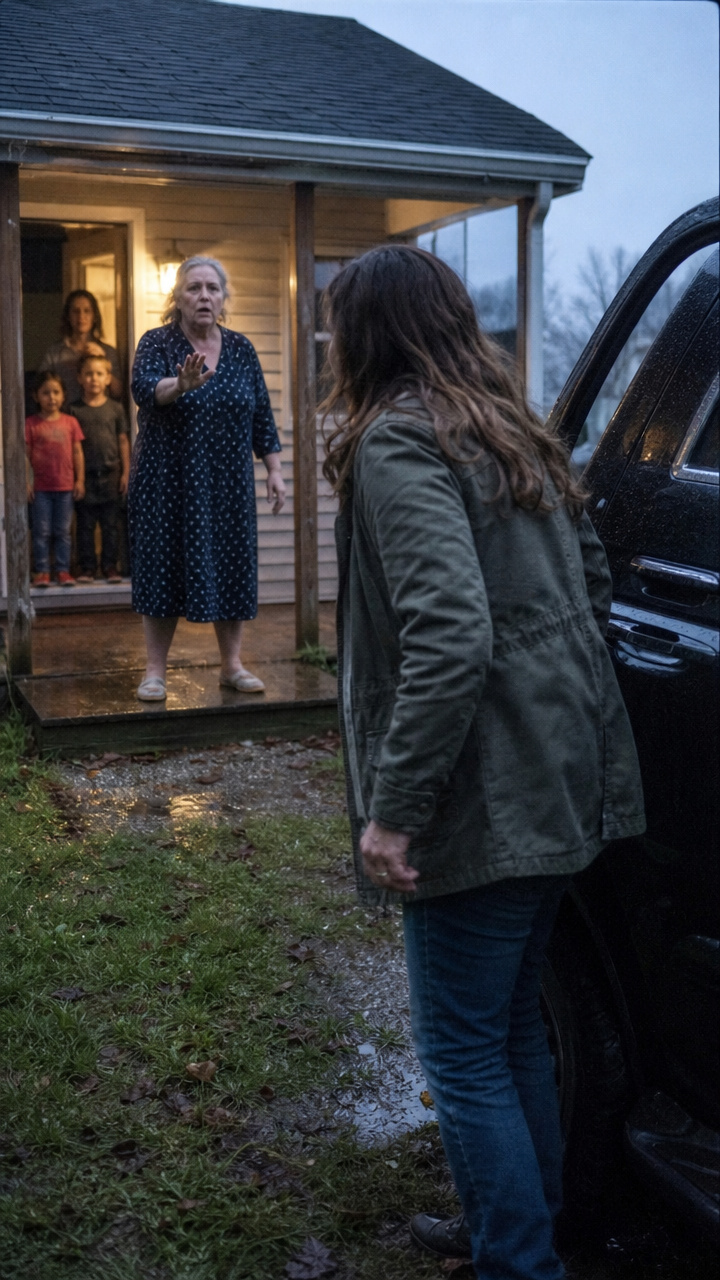
Margaret Carter had just stepped onto the porch to fasten the storm shutter when she froze, one hand still wrapped around the iron hook.
Across the road, where only the blackened frame of Iris Bell’s house remained among heaps of broken brick, three figures stood in the rain: a woman, a teenage boy, and a little girl. Two battered suitcases and a plaid travel bag, pulled tight with rope, lay at their feet on the soaked grass.
It was November. Though the clock had barely reached half past five, darkness had already settled over the village like midnight. Rain had been falling for three straight days. By now it seemed less like drops coming from the sky and more like a fine, icy mist suspended in the air, creeping beneath collars and sleeves and clinging there for hours.
Margaret picked up the flashlight from the windowsill and crossed the yard.
“Who are you looking for?” she called before reaching the gate.
The woman turned sharply and instinctively moved in front of the little girl.
“I’m sorry. We… we came to this house. My grandmother lived here. Iris Bell.”
“Iris?” Margaret came closer, lowering the beam so it would not shine into their faces. “And you are?”
“Her granddaughter. Marina. I spent every summer here when I was little. You had a goat, too. A red one with one broken horn.”
For several seconds, Margaret said nothing.
“Maisie,” she murmured at last. “That was about thirty years ago.”
Marina looked once more at the charred remains across the road, as if she were still hoping she had somehow mistaken the address.
“What happened to the house?”
“It burned down the winter before last. No one had replaced the wiring in forty years. By the time the fire crew came from the county, there was nothing left to save.”
Marina did not answer. She only pulled the strap of her bag higher onto her shoulder, though it was already secure.
“Mom,” the boy said quietly, “maybe we should go back to the highway.”
“What highway, sweetheart?” Margaret directed the flashlight toward him.
He looked about sixteen. His jacket was too thin for the weather, and his sneakers were soaked through.
“There’s one bus in the morning, at six. The highway is three miles away across the fields. You’d break your ankles crossing them in daylight, and right now the water is probably up to your knees.”
The little girl sneezed.
Then she sneezed again.
“All right,” Margaret said in the firm voice she had used for forty years whenever she announced a test to her third-grade students. “Pick up your things and come inside. You’ll spend the night, and in the morning we’ll decide what happens next.”
“But you don’t know us,” Marina said softly.
“I knew your grandmother. Come along. That child is drenched.”
The kitchen smelled of reheated beef stew.
Margaret had cooked it on Sunday and had been eating it a little at a time ever since. No matter how carefully she tried to plan, it was impossible to make a smaller pot for one person.
Lily fell asleep at the table before finishing her bowl.
Marina carried her to the wooden bench, covered her with her own jacket, then perched on the very edge of a chair. She sat straight-backed, as though she were waiting for a job interview.
“Our factory closed last summer,” she began quietly. “I worked there as a seamstress for ten years. I found another job afterward, but the pay barely covered rent, food, and transportation. Then my landlord said she was selling the apartment. She gave us two weeks to leave.”
“And the children’s father?” Margaret asked, keeping her eyes lowered toward her mug.
“There isn’t one. Not anymore. Not for a long time.”
Marina offered no further explanation.
Margaret did not ask for one.
“I thought my grandmother’s house was still standing,” Marina said, rubbing both hands over her face. “I thought we could get through the winter there. There’s a garden. Ethan can chop wood. I didn’t know it was…”
She stopped.
Meanwhile, Ethan rose from the table, gathered the bowls, and carried them to the sink.
No one had told him to.
He washed everything, dried the dishes, arranged them neatly in the rack, and only then returned to his seat.
Margaret watched his back and found herself thinking that no one had washed dishes for her in nearly ten years.
The next morning, sleet replaced the rain.
Marina had been awake since six. She had swept the entryway, packed their belongings, and was standing in the middle of the kitchen waiting for Margaret to get up.
“Where exactly are you planning to go in this weather?” Margaret asked from the doorway. “Sit down. The tea is already getting cold.”
One night became a week.
The week stretched through the entire month of December.
Marina found work cleaning a school in the neighboring town. In January, she moved to a bakery in the county seat.
She woke at four-thirty because the shuttle left at twenty minutes before six. In the evenings, she came home with a warm loaf tucked beneath her coat.
Not stolen.