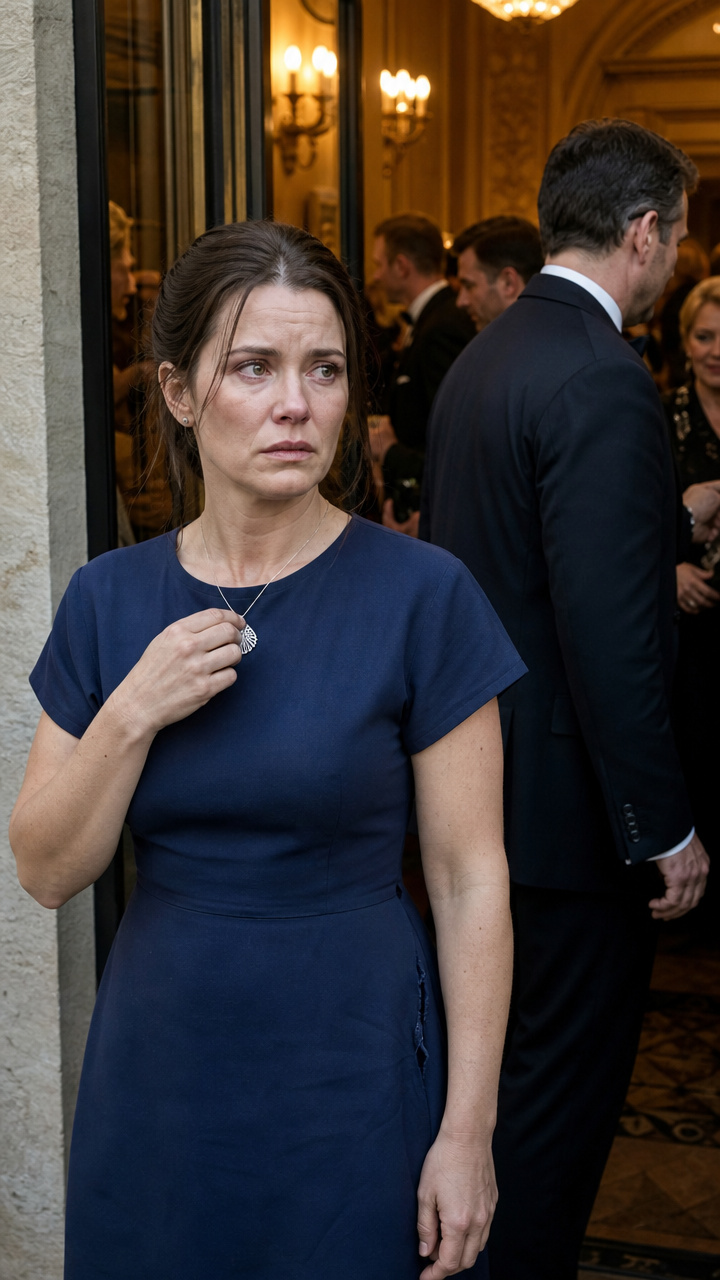
There had been more love in that decision than in most of the fortune Clara had inherited.
Henry restored the beginning of her story. His ten-year search moved her beyond words.
But Rosa had given her life and taught her how to live.
The pendant had survived only because a poor widow had once decided that a frightened child deserved to be held, protected, and loved.
The two women had never met.
They never would.
Yet, without knowing one another, they had passed Clara from one loving hand to another across thirty years of loss.
For the rest of her life, Clara would honor both the mother who never stopped searching and the mother who found her first.
Part Eighteen — Three Weeks
The divorce took less than three weeks.
Clara asked for no money. She did not need it, and she wanted nothing from Ethan that would keep her legally connected to him for even one day longer than necessary.
She also refused revenge.
That surprised everyone around her, especially Henry, who had every opportunity to make Ethan’s downfall permanent and seemed to be waiting for Clara to ask.
She did think about revenge.
During the first few weeks, there were nights when memories of Ethan’s quiet cruelty rose inside her and demanded an answer.
But when Clara examined her feelings honestly, she realized she did not truly want him to suffer.
She only wanted to be free of him.
And she already was.
Using her father’s wealth to crush a small, frightened man would keep Ethan at the center of her life for months or years. It would mean continuing to live according to him.
For five years, she had shaped herself around his opinion.
She would not spend another five arranging her life around hatred.
That would be the same cage with a different color on the door.
Let him live with himself.
In time, Clara understood that this was the purest form of justice—and it required nothing from her.
Ethan’s reputation collapsed without her help.
No serious company in the region wanted to hire the man who had publicly humiliated the missing daughter of the Whitmore family, sending her to stand beside the restrooms only an hour before the truth emerged.
Everyone whose opinion mattered in his world had seen his cruelty.
Now the consequences followed him with the same persistence as the behavior that had once haunted Clara.
Part Nineteen — White Roses
Six months later, Clara stood beside her father at Rosa Alvarez’s grave in Southside Atlanta.
Henry placed a bouquet of white roses near the headstone.
“Thank you,” he whispered, his voice breaking. “For loving my daughter when I couldn’t be there.”
“For keeping her alive until I found her again.”
Clara looked at her father—a man who could buy nearly anything, yet stood helpless before the grave of a woman who had owned almost nothing.
She understood why he had come.
There was one thing his fortune could never purchase: the chance to thank, in person, the woman whose love had carried his daughter through thirty years.
Clara wished Henry could have met Rosa.
She wished he could place his hands over the hands that had once protected Clara, the hands that had held her until he was finally able to find her.
But he was thirty years too late.
All he could do was bring white roses to a modest cemetery and speak to someone who could no longer hear him.
Clara believed Rosa would have liked him.
Then again, Rosa probably would have set the flowers aside, placed a plate of food before him, and asked whether he was eating properly. She loved people not for their wealth or their lack of it, but with the full, practical attention that made everyone feel they had been expected.
Clara wore the same navy dress she had worn to the gala.
She had chosen it on purpose.
The silver sun now rested complete against her throat, both halves joined on a single chain.
She stood between the grave of the woman who had raised her and the living hand of the father who had once lost her, without feeling that she had to choose between them.
For the first time in her life, she felt whole.
Part Twenty — My Light Always Returns
A few weeks later, Clara opened the Rosa Alvarez Foundation, an organization dedicated to helping women escape financial and emotional abuse.
She chose that mission despite Henry’s careful suggestion that he fund something grander, perhaps a hospital wing bearing the Whitmore family name.
Clara did not need a wing.
She wanted to reach the woman she had been for five years—the woman slowly silenced by reasonable-sounding remarks, ordered to make herself smaller for someone else’s comfort, and unable to point to a bruise that would prove anything was wrong.
This kind of abuse left no visible mark. It rarely appeared in police records. That was why recognizing it, naming it, and leaving it could be so difficult.
Clara had escaped because a pendant happened to catch the attention of a billionaire. Most women had no such pendant and no billionaire waiting nearby.
She knew better than to build a foundation on luck.