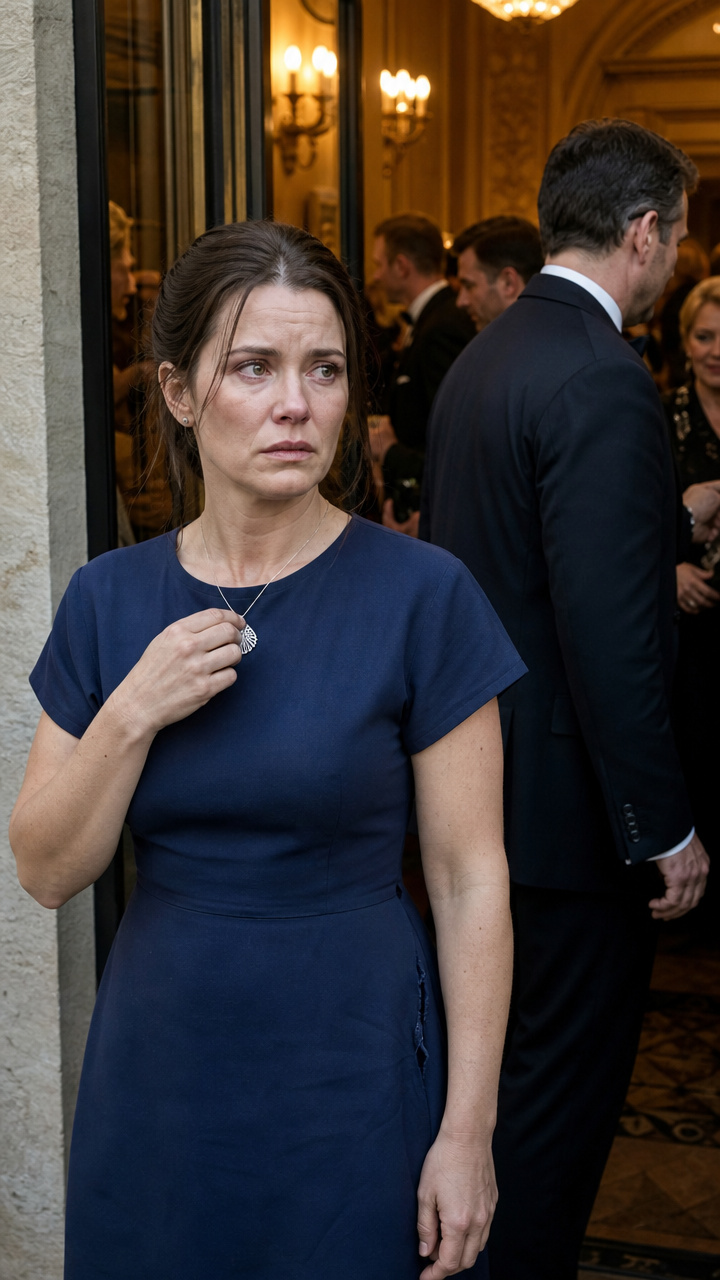
Instead, she built it on what could truly save someone: lawyers, financial assistance, safe housing, and, above all, a person willing to look a frightened woman in the eyes and say:
“What happened to you was real. It was not your fault. You do not need anyone’s permission to leave.”
She gave the foundation Rosa’s name because Rosa had taught her its central principle.
A person’s value is not determined by the price someone else assigns to her.
At the opening ceremony, there were no diamonds and no wall of reporters surrounding Clara. There was only the restored pendant at her throat.
When she stepped toward the microphone, the room quieted.
“For years,” she began, her voice steady, “someone tried to convince me that my worth depended on money, status, and the family I came from.”
“He told me to hide because he was ashamed of my clothes and my past.”
“But I learned something.”
“Honor is not inherited through a famous name. Money cannot buy it. And humiliation cannot erase it, no matter how publicly it is delivered.”
Several people in the audience were already crying.
Clara offered a gentle smile.
“Sometimes life allows someone to break you in front of the world so that the world can witness how you rise afterward.”
When she left the stage, a woman in worn clothing approached her, tears running down her face.
“Because of your story,” the woman whispered, “I finally found the courage to leave my husband.”
Clara embraced her and did not let go for a long time.
Because her story had not truly begun in that ballroom—not with the pendant, not with the recovered name, and not with the return of a wealthy father.
It began the moment Clara stopped believing she needed anyone’s permission to exist.