But after sixty, love no longer needs polished vows.
It asks for only one thing: someone who will still be there in the evening and wake beside you in the morning.
We married quietly.
There was no decorated hall, no orchestra, no crowd of relatives raising champagne glasses.
We signed the papers at the county courthouse beneath cold fluorescent lights. The two witnesses cried even harder than we did. Daniel wore his best old suit, pressed so carefully that one might have thought the fate of the entire world depended on the crease in his sleeve. I wore the burgundy dress I had bought with trembling hands.
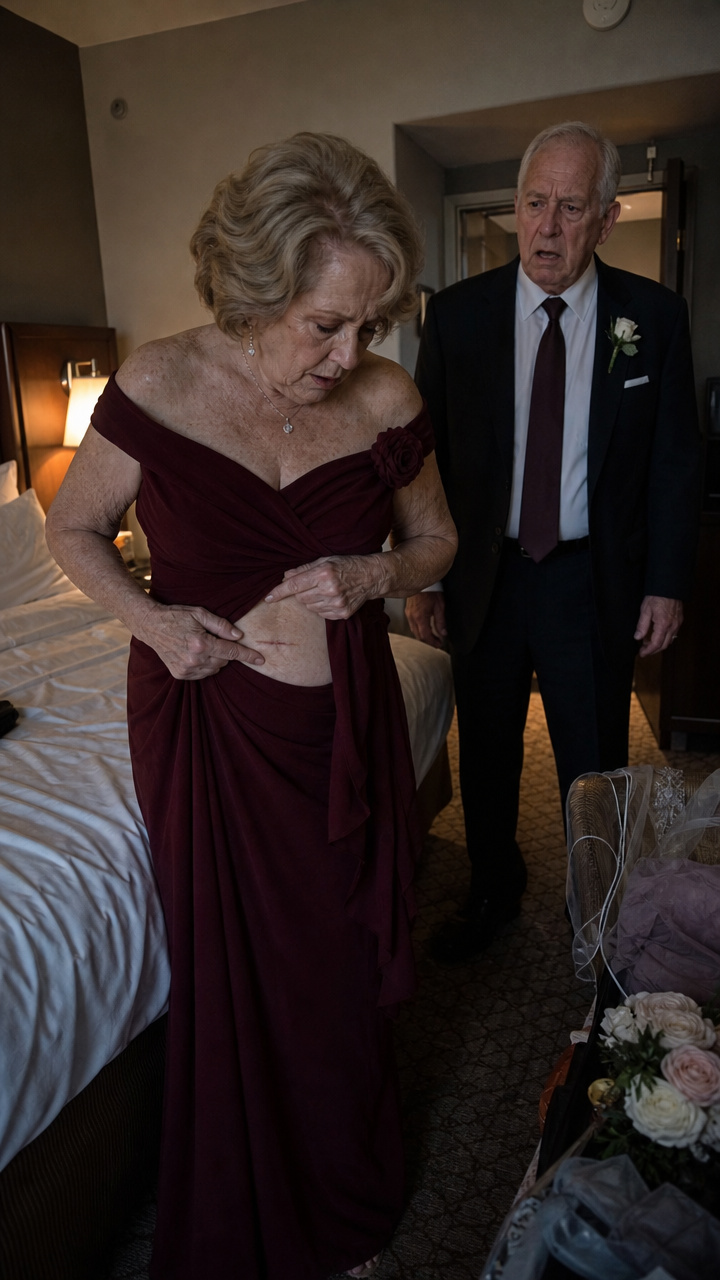
That evening, I sat on the edge of the hotel bed.
The room was unnaturally quiet.
The curtains were drawn, a small lamp cast a warm circle of light over the carpet, and an embroidered cloth lay folded on a chair. A friend had given it to us, saying it would bring happiness on our first journey as husband and wife.
Daniel entered slowly.
Not like a young bridegroom.
He came in like a man afraid that one careless movement might destroy the happiness he had waited too long to find.
He reached for the buttons of my dress and undid them one by one.
I closed my eyes.
Forty years of waiting.
One breath.
One life.
The dress slipped soundlessly to the floor.
For a moment, time stopped.
Daniel went still.
Then he took one small step backward.
There was no embarrassment in his face, and no astonishment.
There was pain.
A deep, stunned pain, as if something he had buried long ago had suddenly risen from the ground.
My fingers tightened around the edge of the sheet.
“Daniel… what is it?”
He did not answer.
His eyes were fixed on my stomach.
Not as though he had seen something unfamiliar.
He was looking at me the way people look when they suddenly recognize something they once lost.
There are scars we grow so accustomed to carrying that we forget they are there. Then, without warning, one of them becomes a doorway into someone else’s memory.
His gaze had stopped on a thin, curved scar low on my abdomen, pale from the passing years.
I had stopped noticing it long ago.
No one had ever asked how I got it.
Daniel’s lips trembled.
“That can’t be…” he whispered.
The walls seemed to draw closer.
The lamp hummed softly. Somewhere beyond the door, an elevator stopped, and the ordinary sound seemed strangely threatening.
Daniel came toward me.
One step.
Then another.
He did not touch me. He only lifted his shaking hand toward the old scar and stared at it as though all the years we had lost had suddenly gathered in that single room.
Finally, barely audible, he said:
“That’s from the operation…”
I looked at him in confusion.
“Yes. I was twenty. The doctors said I might not survive without surgery.”
His hand fell slowly to his side.
The color drained from his face.
“Then it really was you.”
I could not understand him.
His words scattered before they could become meaning. My heart began pounding with the force of a young woman’s heart.
“Daniel… what are you talking about?”
He lowered himself onto the edge of the bed and remained silent for a long time. Every memory seemed to hurt him physically.
“I looked for you,” he said at last. “When I came back home, the neighbors told me you had been rushed to the county hospital. No one could explain anything clearly. They only said the surgery had been dangerous.”
I sat beside him.
I had believed that chapter of my life was closed.
I discovered that it had never truly shut.
“I was barely conscious for weeks afterward,” I said. “And when I finally returned home, there were debts waiting for me. My father was waiting too.”
Daniel nodded slowly.
“I came back a month later. I intended to ask you to marry me. I had money by then. I had even bought a ring. I thought we finally had a chance.”
A bitter smile crossed his face.
“But I was told you no longer wanted to wait for me.”
I stared at him.
“Who told you that?”
He closed his eyes.
“Your father.”
The room sank into silence again.
Something inside me seemed to snap.
My father.
He had always said that love could not feed a family. But I had never imagined he might have gone so far.
“He stopped me outside your house,” Daniel continued. “He said you had asked me not to contact you again. He told me you had met someone else and decided to leave the past behind.”
I covered my mouth with one hand.
Suddenly, I saw dozens of evenings from my youth: myself beside the window, waiting for a letter, listening for footsteps, hoping for any sign that Daniel had not forgotten me.
“I wrote to you,” I whispered.
His head lifted sharply.
“What?”
“Every week. For almost a year. Then for several months after that.”
He slowly shook his head.
“I never received a single letter.”
We were both silent.
Forty lost years stood between us like a wall.
Then I remembered the old tin box.
All of Daniel’s letters were still inside. I had read each one so many times that I knew entire passages by heart.
“Your letters simply stopped coming,” I said.
Daniel reached into his wallet.