From an inner pocket, he took out a small photograph. It was worn and yellowed at the edges. In it, I was wearing my high-school uniform, my hair divided into two long braids, my smile awkward and shy.
“She stayed with me,” he said. “All these years. Even when I got married.”
I looked up in surprise.
“You were married?”
He nodded.
“For a short time. We both understood that we were living beside each other, not with each other. Eventually, she met someone she truly loved. We separated peacefully. We never had children.”
A strange relief moved through me.
Not because I was glad his marriage had failed.
Because I suddenly understood that I had not been the only one living with a wound that never healed.
Neither had he.
“So all these years…” I began.
“Yes.”
He took my hand with extraordinary care, as if it might disappear beneath his fingers.
“I never stopped thinking about you.”
Tears rolled down my cheeks.
They were not bitter tears.
They were something else entirely.
They belonged to a woman who had finally learned the truth.
There had been no betrayal.
No indifference.
No forgotten love.
Only someone else’s fear, and several cruel decisions made on our behalf.
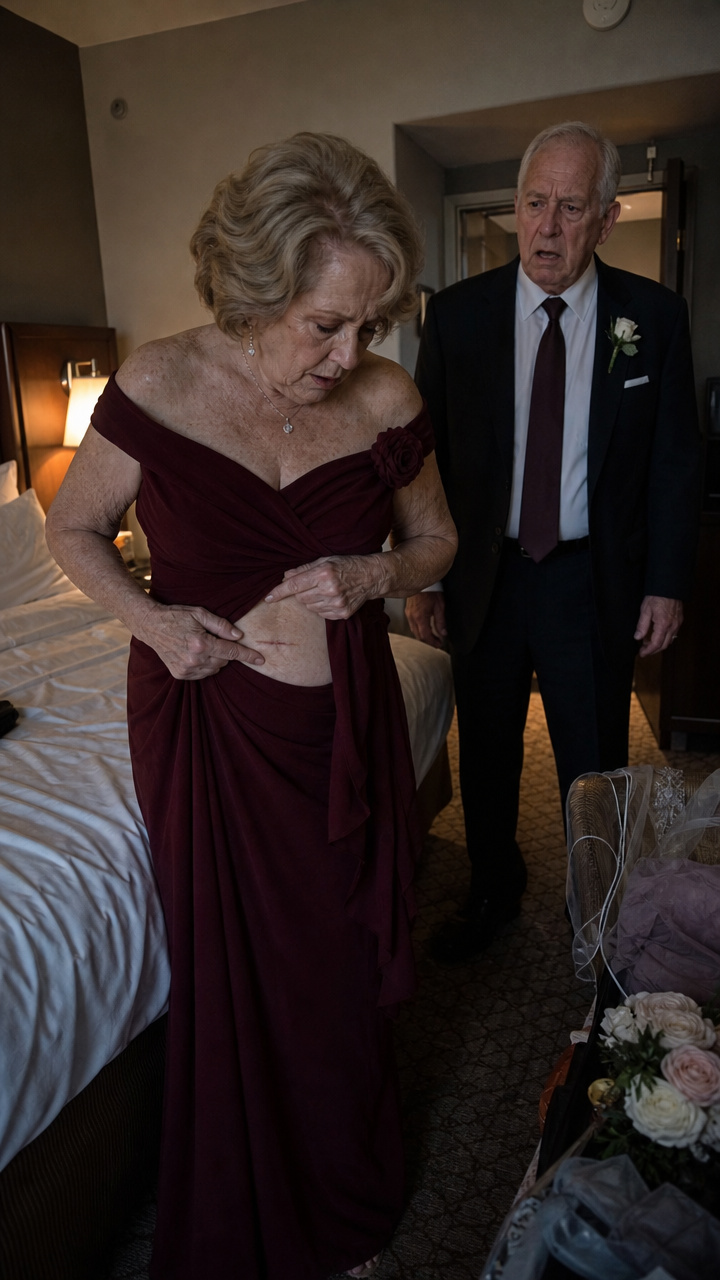
“And the scar…” Daniel said softly. “I recognized it because I waited outside that operating room for almost eight hours. A nurse accidentally told me where the incision would be. I kept praying that you would live.”
I could barely breathe.
“You were there?”
He smiled through his tears.
“I was. Until your father asked me to leave. He said he would not let me ruin your life with my poverty.”
I covered my face.
All my life, I had believed Daniel abandoned me.
All those years, he had believed I rejected him.
We had both been prisoners of the same lie.
For several minutes, neither of us spoke.
Then Daniel rose and walked to the window. Beyond the glass, city lights shimmered across the darkness. The world continued its ordinary life, unaware that in one small hotel room, two people had finally found one another for the first time.
He turned toward me.
“Do you know what I regret most?”
I shook my head.
“Not the youth we lost.”
“Not the dreams that never came true.”
He paused.
“I regret that I once allowed someone else’s words to become stronger than my love for you.”
I went to him and held his face between my hands.
“No, Daniel.”
“We were young. We believed the people we thought were adults knew better.”
“This was not our fault.”
He rested his forehead against mine.
And for the first time in forty years, nothing remained between us—not questions, not silence, not words left unsaid.
Only the truth.
That night, I understood something simple.
Sometimes fate returns a person not to restore the years you lost, but to heal the heart that carried someone else’s pain for far too long.
In the morning, a narrow beam of sunlight slipped through the curtains and touched Daniel’s face. He was sleeping peacefully, without the worried frown that had appeared in his dreams for years.
I watched him and thought that sometimes a person needs almost an entire lifetime to arrive at the place where he should have been from the beginning.
He opened his eyes and smiled immediately.
“Good morning, wife.”
Those two words warmed me more deeply than any declaration of love.
I laughed softly.
“Good morning, husband.”
We had breakfast in the little hotel café. No one paid any special attention to us. A young waitress smiled, brought a pot of tea and a basket of warm rolls, and moved on to another table.
To her, we were simply an elderly couple enjoying a quiet morning.
She did not know that our honeymoon had arrived almost forty years late.
When we returned home, we went straight up to the attic of my old house.
I searched for the tin box for a long time. At last, I found it in the far corner beneath a stack of old magazines. The ribbon had faded, the lid was covered with tiny scratches, but everything inside was exactly as I remembered.
Letters.
Dozens of letters.
I placed the box on the table.
Daniel hesitated before opening it. His hand rested on the lid, but he did not lift it immediately. Finally, he took out the first envelope.
He looked at the date.
Then at his own handwriting.
He read in silence.
Sometimes he closed his eyes. Sometimes a faint smile touched his mouth.
Then it was my turn.
I brought out a neat stack of yellowed envelopes. Every one of them had eventually found its way back to me.
My father had never mailed them.
I had not known.
Each envelope bore only the address written in my own hand. There was no postmark, no mark showing that it had traveled anywhere.
None of my letters had ever left our house.
Once again, I could not stop the tears.
Daniel wrapped his arms around me.
“So our words were beside each other all this time,” he whispered.
I nodded.
“They were simply never allowed to meet.”
That day, we did not speak bitterly about my father.
He had been dead for many years.
Perhaps he truly believed he was protecting me. Perhaps he thought poverty was more dangerous than heartbreak.