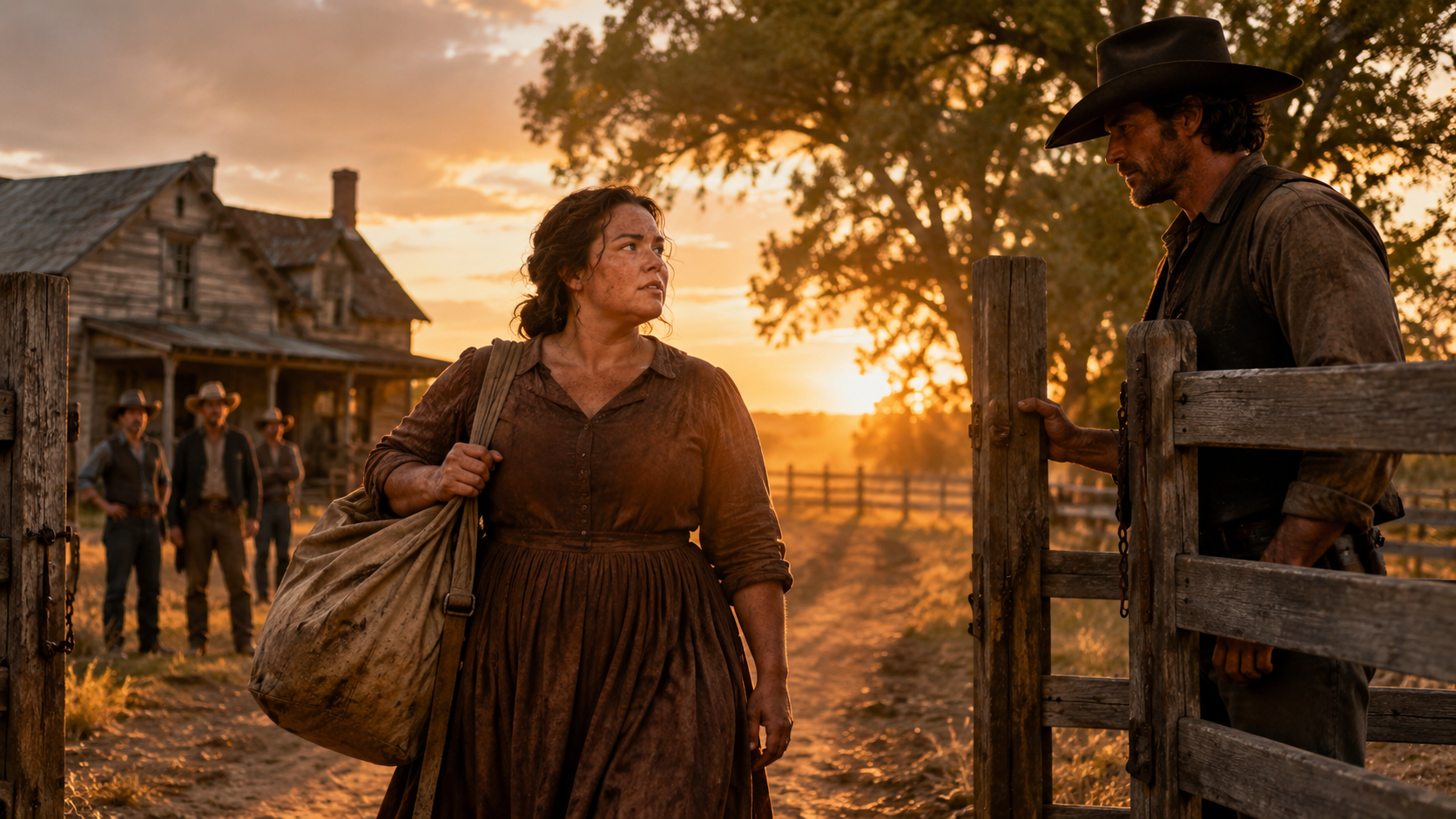
Fear rose in Elsie hot and fast.
Beneath it came something stronger.
“No,” she said.
Gideon looked at her.
“No,” she repeated. “He does not get my mother’s box.”
Within minutes, six riders left Black Creek.
Elsie rode a chestnut mare Gideon warned had a wicked temper. The mare tested her once by sidestepping hard near the gate. Elsie leaned close and patted her neck.
“I walked nine miles in August with every fool in town watching,” she murmured. “You will have to do better than that.”
The mare settled.
They took the creek trail and came upon the Rowan smokehouse from behind the cedars.
Asa Crowe was on his knees inside, prying at the brick beneath the old curing hooks.
Elsie dismounted before Gideon could help.
“Take your hands off my mother’s floor.”
Crowe froze.
Slowly, he turned.
His coat was off. Sweat darkened his collar. Without witnesses he controlled, he looked smaller and meaner.
“Miss Rowan,” he said. “This property remains under lien.”
“The lien is forged.”
“You cannot prove—”
“We can,” Gideon said behind her. “Peter Lyle’s confession names you. Marietta Quill’s records show payment transfers. Sheriff Vale is riding here with deputies.”
Crowe’s hand twitched toward a pry bar.
Silas stepped forward with a coil of rope in his hand, not as a weapon but as a warning.
“Don’t make us drag dignity into this,” Silas said.
Crowe looked at Elsie.
Not Gideon.
Not Silas.
Her.
“You think you won?”
“No,” Elsie said. “I think my father is still dead. I think my mother died hiding proof because men like you taught the county to fear paper more than sin. I think families lost land because people with voices stayed quiet. Winning is too small a word for what should have been justice from the beginning.”
For the first time in years, Asa Crowe had nothing clever to say.
Sheriff Vale arrived with two deputies twenty minutes later. Crowe was arrested for forgery, fraud, intimidation, and trespass. His hired men surrendered without argument.
Elsie did not watch him leave.
She knelt inside the smokehouse and lifted the loosened bricks one by one. Beneath them sat a cedar chest wrapped in oilcloth.
Her mother’s chest.
Her hands trembled as she opened it.
Inside lay recipes written in three generations of women’s hands.
Molasses cake.
Pepper biscuits.
Chicken stew for fever days.
Wedding ham.
Funeral bread.
And beneath the recipes, tied with blue thread, were letters, copied deeds, well maps, payment lists, and a ledger of every false claim Asa Crowe had made across the county.
Gideon knelt beside her.
“There’s enough here to bury him.”
Elsie touched the papers.
“No,” she said softly. “Enough to unbury everyone else.”
The discovery cracked Hollow Bend open.
By Monday, Widow Clara Pike came from the north road with a statement about the pasture Crowe had taken after her husband died.
By Wednesday, a miner’s son arrived carrying a note with a forged signature.
By Friday, men and women who had whispered for years began walking through Black Creek’s gate.
Gideon’s dining room became a courthouse without a judge. Marietta’s lawyer took testimony at the long pine table. Sheriff Vale carried statements to town and returned with more. Silas kept coffee hot. Caleb carried wood, water, and apology in equal measure.
And Elsie cooked.
She cooked stew for widows who cried into their sleeves. She cooked biscuits for boys who had inherited debts that were never real. She cooked pies for women who had been called difficult because they remembered numbers better than men expected. She cooked coffee strong enough to keep Marietta Quill awake through depositions, though Marietta insisted sleep was an indulgence invented by lazy bones.
For four weeks, Black Creek Ranch smelled of flour, ink, justice, and fear slowly leaving people’s bodies.
Gideon guarded the kitchen doorway from those who thought grief gave them the right to crowd a woman. He carried water without being asked. He split wood before dawn. He said little.
But sometimes, when Elsie looked up from kneading dough, she found him standing near the door with his hat in his hands, watching her as if the sight of her had become part of the house he had not known he was missing.
The trial lasted six days.
Asa Crowe wore a dark suit and the calm expression of a man who had escaped consequences so many times he mistook luck for innocence.
Then Peter Lyle testified.
Then Marietta Quill testified.
Then Sheriff Vale placed Thomas Rowan’s broken watch on the judge’s bench and admitted, under oath, that he had delayed because he was afraid.
Finally, Elsie read her mother’s last letter aloud.
My sweet girl,