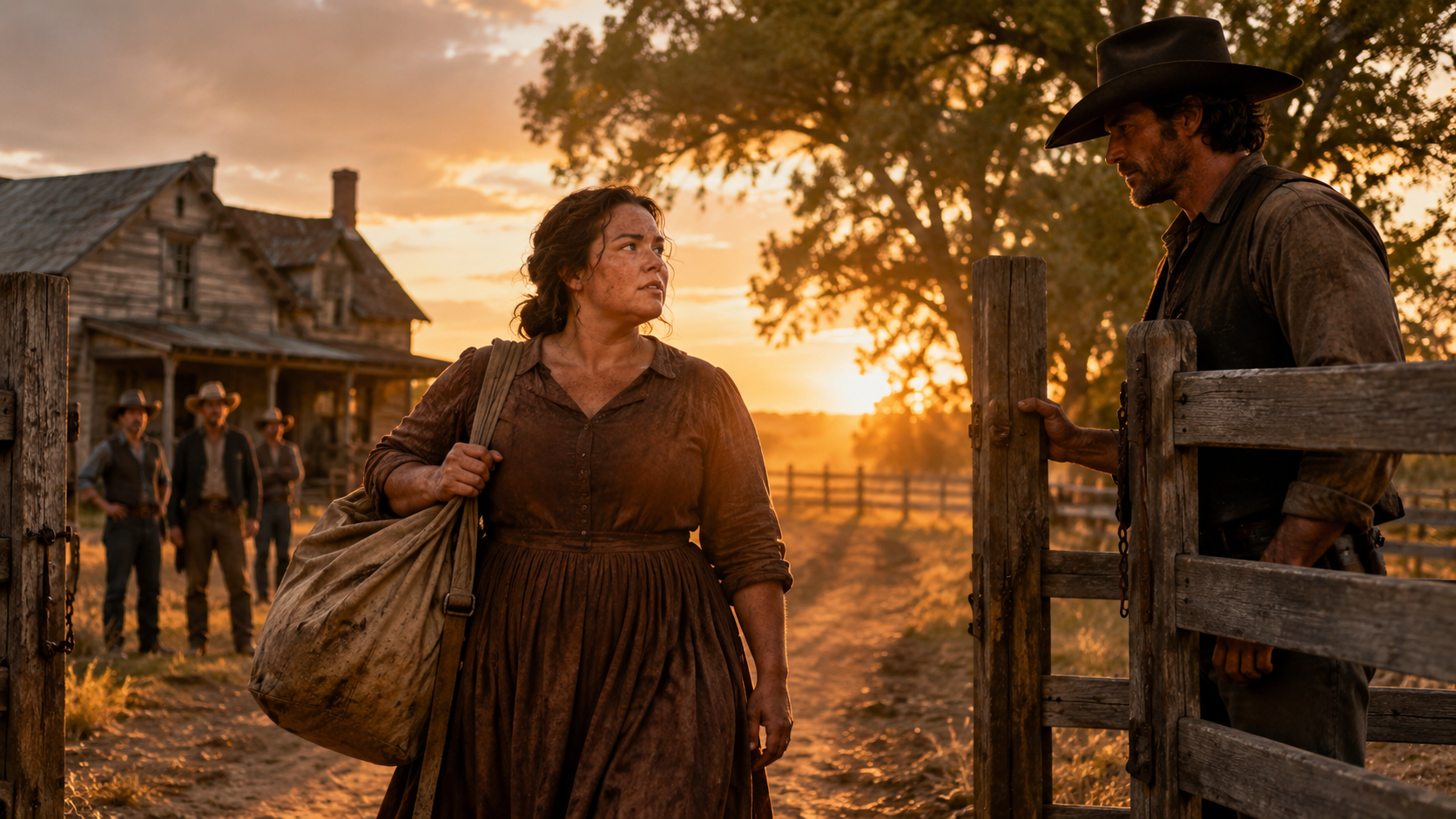
“They’ll never take her,” someone said from the shade of the livery stable.
“Take her?” another man laughed. “They’d need two wagons just to get her up the hill.”
Elsie Rowan heard every word.
She kept walking.
The road outside Hollow Bend shimmered with late-summer heat, and dust clung to the hem of her brown dress until it looked as if the earth itself had grabbed hold of her and tried to keep her back. Her boots were split at the sides. Her hands were raw from carrying a canvas bundle tied with rope. In that bundle were all the things Asa Crowe had not managed to steal: her mother’s recipe book, her father’s pocket watch that no longer ticked, a cracked blue teacup, and three letters she had never dared to read in daylight.
Behind her, the town watched.
It always watched.
Hollow Bend had watched when Asa Crowe rode to her father’s farm with a paper full of numbers and lies. It had watched when he told her the land was no longer hers. It had watched when he gave her one hour to leave the only home she had ever known. It had watched when she stepped off the porch with her bundle against her chest and a bruise blooming near her cheekbone from the doorframe she had been pushed through.
And when she passed the church wagon on the bridge, the preacher’s wife had looked down at her, lifted one gloved hand to her mouth, and whispered something to the woman beside her.
Neither of them offered a seat.
So Elsie walked.
At the edge of town, a boy from the livery called after her, “Black Creek Ranch is nine miles, Miss Rowan.”
“I know.”
“They don’t hire women out there.”
“They eat, don’t they?”
The boy did not answer.
A group of men near the feed store laughed, but the laugh sounded weaker than before. Elsie did not look back. Looking back was for people who expected someone to come after them.
No one came.
The sun rose higher. The road climbed through dry grass and sage. Twice she stopped to rest beneath thin trees that gave more shadow than comfort. Once a wagon passed her, and the driver looked away before she could lift her hand.
By the time the black fences of Black Creek Ranch appeared across the valley, Elsie’s mouth tasted of iron and dust. The house stood beyond a long lane lined with cottonwoods, its white paint weathered silver by wind and years. Behind it stretched barns, corrals, smokehouses, hay sheds, and a kitchen garden gone wild with neglect. It was not a grand place. It was something harder to build than grandeur.
It was a place that had survived grief.
A man at the gate saw her first. He was older, thin as a fence rail, with a gray mustache and eyes that missed little.
“You lost, ma’am?”
“No.”
“You looking for somebody?”
“Yes.”
“Who?”
“Mr. Gideon Hale.”
The man’s expression changed.
Not warm.
Not cold.
Careful.
“And what business do you have with Mr. Hale?”
“I want work.”
His gaze dropped to the bundle in her arms, then to her dusty boots, then quickly back to her face. That quickness told Elsie he had been taught manners late but had learned them well enough.
“What kind of work?”
“Kitchen work.”
The man scratched his chin. “Name?”
“Elsie Rowan.”
His eyes sharpened.
“Rowan?”
“My father was Thomas Rowan.”
“From the south ridge farm?”
“Yes.”
The old man breathed out through his nose. “Asa Crowe’s been busy, then.”
“He has.”
“And you walked here?”
“I didn’t fly.”
A sound came from somewhere behind the barn. A laugh, quickly swallowed.
The old man turned his head. “Caleb, if you’ve got enough air to snicker, you’ve got enough air to clean the tack room.”
A young ranch hand stepped into sight, red-faced and ashamed.
Elsie looked at him.
“Say it,” she said.
The young man blinked. “Ma’am?”
“Whatever you were laughing about. Say it where I can hear.”
His ears turned redder. “I didn’t mean anything.”
“That is rarely true.”
The old man covered a smile with the back of his hand.
Caleb lowered his eyes. “I just wondered if kitchen work would be too much.”
Elsie shifted the bundle higher against her chest.
“I buried my father in frozen ground with a shovel that had a cracked handle. I carried water for two years after our well rope broke. I cooked for men who thought hunger made them kings and grief made me their servant. A stove will not frighten me.”
The young man swallowed.
“No, ma’am.”
“What is your name?”
“Caleb Morris.”
“Then, Caleb Morris, when you wonder about a woman, start with what she has lived through before you measure what she looks like.”
The old man laughed then, full and loud.
“Mercy,” he said. “Black Creek needed that sentence ten years ago.”
Before Elsie could answer, the porch door opened.
Gideon Hale stepped out.