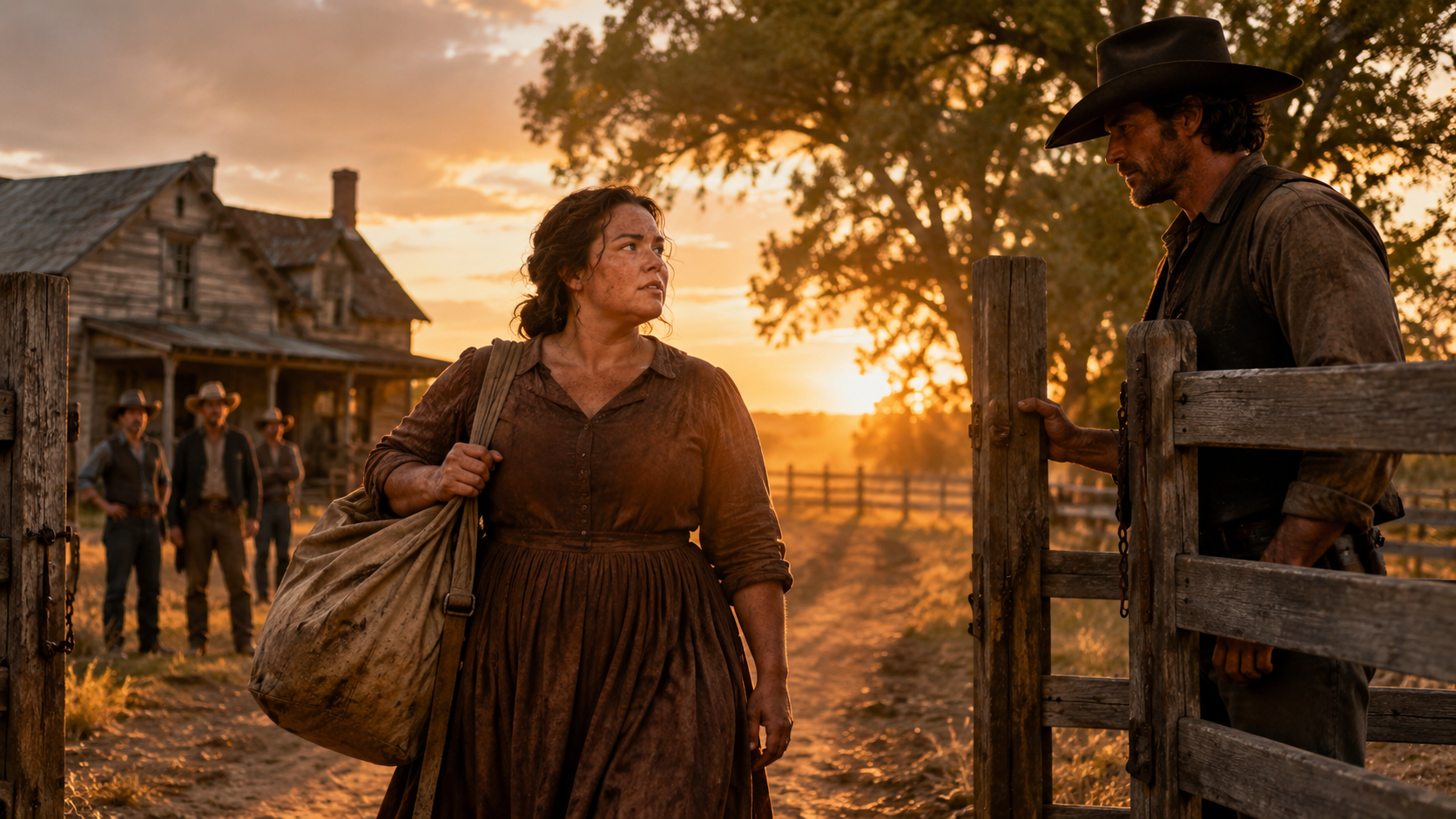
She knew him by silence before she knew him by sight. Every man near the yard straightened. Even the horses seemed to lower their heads. He was tall, lean, and broad through the shoulders, with black hair touched by early gray at the temples. His shirt sleeves were rolled to the elbows. He wore no fine coat, no polished boots, no gold watch chain. Nothing about him shouted wealth.
But authority rested on him like a weathered coat.
His face was not old, but sorrow had carved patient lines around his mouth. His eyes were a clear, cold blue, the kind of blue that made a person think of winter rivers and honest steel.
He came to the gate and stopped.
He looked at her face first.
Not at her size.
Not at the dust.
Not at the bruise.
Her face.
“Miss Rowan.”
“Mr. Hale.”
“Silas here says you’re asking for kitchen work.”
“If Silas heard me, then Silas is correct.”
The old man grinned. “She’s correct about other things too.”
Gideon did not look away from Elsie.
“Have you cooked for ranch hands before?”
“My father hired five men before the drought. Three after. One after that. Then none. I cooked anyway.”
“For who?”
“For my father. For myself. For neighbors too proud to ask and too hungry not to eat.”
Gideon’s jaw moved once.
“You walked from Hollow Bend?”
“Yes.”
“In this heat?”
“Yes.”
“With that bruise?”
Elsie’s fingers tightened on the bundle.
“The bruise didn’t ask permission to come with me.”
A flicker moved through his eyes. Anger, maybe. Not the kind that made noise. The kind that decided where it would stand.
“Water,” he said.
Silas was already moving.
Gideon opened the gate.
“Come in.”
Elsie did not move.
“I was not invited past the gate.”
“You are now.”
“On what terms?”
That earned the slightest lift of his brow.
“Work terms.”
“Then I’ll come in.”
She stepped onto Black Creek land, and something in her chest shifted. Not relief. Relief was too soft a word. It was more like the first breath after being held underwater by a hand you could not fight.
Silas returned with a dipper. Elsie drank slowly, though every part of her wanted to gulp. Her mother had taught her never to let desperation eat all her manners. When she finished, she handed the dipper back with both hands.
“Thank you.”
Gideon studied her.
“My wife ran this kitchen before she died,” he said. “She ran half the ranch too, though I was foolish enough at the time to believe I did. Since then, we’ve had six cooks. One left before breakfast. One burned beans so badly the pot still smells haunted. One cried whenever Silas spoke. One tried to make pudding with salt. One stole bacon and blamed coyotes. The last one married a stage driver and left us three recipes, all of them wrong.”
Silas sighed. “The pudding with salt was a dark week.”
Gideon continued, “I need a cook. But I do not hire a person because the town has been cruel to them.”
“I did not come selling cruelty.”
“No. You came asking for work.”
“Yes.”
His gaze moved toward the house.
“The pantry has flour, onions, potatoes, carrots, dried peaches, beans, eggs if the hens have kept their promises, and a ham shoulder. Twelve men eat in one hour. Feed them well, and you sleep in the cook’s room tonight. Tomorrow we speak wages. If the meal fails, I’ll drive you back to town myself and pay for a hotel room.”
Elsie looked at the house, then at the men pretending not to listen.
“So either way, I do not sleep on the road.”
“Either way.”
“And if they complain?”
Gideon glanced at the ranch hands.
“They may complain honestly. They may not be cruel.”
Elsie nodded once.
“Then we understand each other.”
She started toward the porch, then paused.
“Mr. Hale?”
“Yes?”
“I won’t need an hour.”
Silas chuckled.
Gideon tilted his head. “How long?”
“Forty minutes.”
The yard went quiet.
Gideon looked at her for one long breath.
“Forty, then.”
Elsie entered the kitchen and closed the door behind her.
The room was large, square, and tired. Copper pans hung dull above the stove. Flour sacks leaned open in the pantry. A long pine table stood in the middle, scarred by knives, mugs, elbows, and years of men sitting where a woman’s laughter used to be. Dust lay in the corners. The stove had a weak fire, more memory than flame.
Elsie set her bundle on a clean shelf.
Then she washed her hands.
The first rule of cooking, her mother used to say, was that panic had no place near flour. Panic made hard biscuits, sour faces, and foolish choices.
Elsie did not panic.
She fed the stove until the fire drew bright. She cut ham fat into a skillet and let it render. She peeled potatoes in fast, even strokes, boiled them, mashed them with milk and salt, then folded in fried onion until the smell filled the room like a promise. She rolled biscuit dough with a wine bottle because the rolling pin was missing. She made carrot gravy, sliced ham thin, stewed dried peaches with sugar and cream, and set coffee to boil strong enough to wake a judge from the grave.