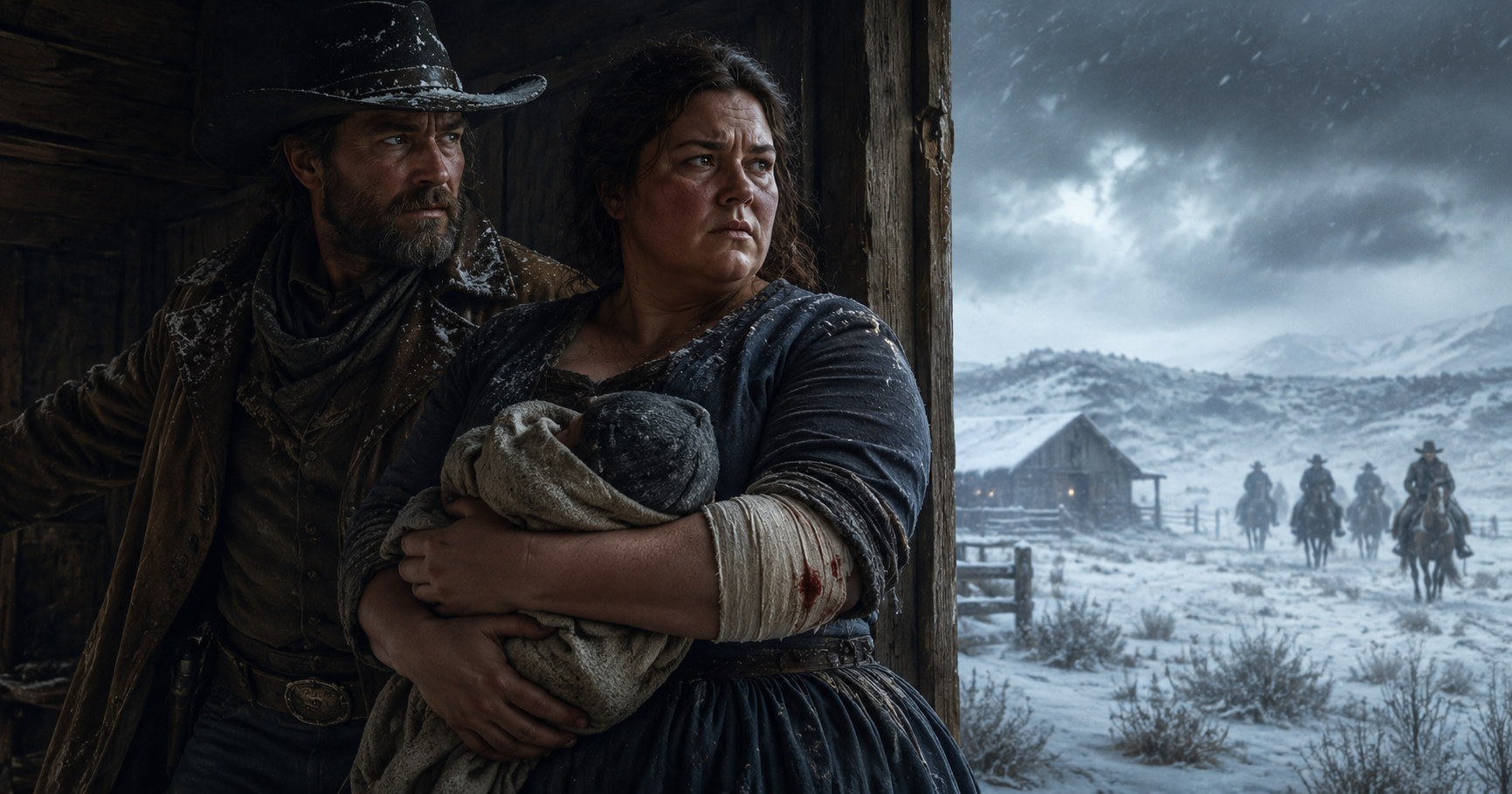
Harlan stood beside her.
“You wanted him dead,” she said.
“Yes.”
“So did I.”
“I know.”
“But alive, he has to hear my name without owning it.”
Harlan looked at her.
“What name?”
She took a breath.
“Mara Blackwood.”
Then she looked down at Anna sleeping in her arms and at Thomas bundled against Harlan’s chest.
“Maybe one day, Mara Reed. If the man asking understands I come with a daughter, a sister, scars, a temper, and a body I am finished hating.”
Harlan smiled for the first time since Clara died.
“That sounds like a fortune.”
Mara laughed then.
A real laugh.
It startled the horses.
Spring came late to the valley that year.
Clara Reed was buried properly under the cottonwood when the ground softened enough for flowers. Mara stood beside Harlan at the grave with Anna in one arm and Thomas in the other because the boy still reached for her whenever he was tired. Ruth stood with baby Eli wrapped close to her chest. Gideon stood behind them, quieter than he had once been, learning day by day that love was not obedience and marriage was not ownership.
The town talked, of course.
It talked about the large widow who had moved into Harlan Reed’s ranch before his dead wife had been cold a month. It talked about the baby girl with storm-gray eyes. It talked about Dorian Voss in chains, about Jonas Creed’s false loyalty, about the gunshots on the Reed porch, about whether Mara Blackwood was brave or shameless.
Mara heard enough of it at the mercantile one Saturday.
A thin woman in a blue bonnet whispered too loudly, “Some women know how to make themselves necessary.”
Mara turned.
For one old second, the old shame rose in her. The instinct to shrink. To laugh softly. To apologize for being visible.
Then Thomas, round and healthy on her hip, grabbed her collar and said his first word.
“Mama.”
The store went silent.
Mara looked down at him.
He patted her cheek.
“Mama.”
The woman in the blue bonnet looked away.
Mara smiled.
“Yes,” she said to the boy. “I suppose I am.”
Harlan asked her to marry him in May.
Not because scandal demanded it.
Not because the babies needed explaining.
Not because loneliness had made him careless.
He asked beneath the cottonwood, beside Clara’s grave, after laying fresh wildflowers on the earth.
“I loved her,” he told Mara.
“I know.”
“I will love her all my life.”
“I know that too.”
“I love you now.”
Mara’s eyes filled.
“Am I second place?”
Harlan took her hands.
“No. Love is not a table with one chair. Clara has her room in my heart. You have yours. Thomas has his. Anna has hers. Somehow the heart builds more rooms when the right people knock.”
Mara looked toward the cabin, where Ruth was singing to the babies and Gideon was repairing the cradle.
“I knocked half-dead and bleeding.”
“You still knocked.”
She laughed through tears.
“Yes, Mr. Reed. I will marry you.”
The wedding was small.
Ruth stood beside Mara. Jonas came without his badge and stood near the back like a man still unsure he deserved peace. Gideon held Thomas, who tried to chew Harlan’s boutonniere. Anna sat on a quilt beneath the cottonwood and watched the leaves move above her with solemn, knowing eyes.
When the preacher asked if anyone objected, Mara turned and looked at the road.
No one came.
Dorian Voss lived many years in prison.
He wrote petitions. They were denied.
He wrote letters to Mara. They were returned unopened until the warden stopped allowing them.
Once, in an old territorial paper, he read that Harlan and Mara Reed had expanded the ranch and donated land for a schoolhouse where girls could learn sums, letters, and how to sign their own names before any man tried to sign for them.
He tore the paper in half.
Mara never visited him.
She had better things to do.
She ran the ranch books better than Harlan ever had. She sold pies every Saturday and charged full price to the women who had once whispered about her. She kept a spare bed ready for women who arrived in storms, and she never asked whether they had been perfect enough to deserve rescue.
Ruth became the first teacher in the little schoolhouse.
Gideon became gentle the hard way, by practicing it when no one praised him.
Jonas moved west eventually, but every Christmas a letter arrived in careful handwriting, always addressed to Mara Reed, the woman who taught me a door can open both ways.
Thomas grew tall.
Anna grew fearless.
People often said they looked like brother and sister, though one had Clara’s dark hair and the other had Mara’s stubborn chin. Whenever strangers asked which child was hers, Mara always answered, “Both, if they are causing trouble. All of them, if they are hungry.”
Years later, when Mara was old and her body had grown softer with age, she no longer entered rooms sideways.
She entered them like weather.