Grandchildren ran to her skirts. Men stood when she came into church. Women crossed streets to ask her advice. More than one frightened wife found a bed in her spare room and a shotgun above the door.
On the last winter of her life, Mara sat beside the same kitchen window where the lamp had burned the night Dorian came.
Harlan, gray and bent, placed a small tin cup on the sill.
Inside it was the bit of lead he had taken from her arm.
“Why keep that ugly thing?” one granddaughter asked.
Mara looked at the blackened metal.
“Because it reminds me that the thing meant to stop me only proved how far I could go.”
That night, with snow falling softly beyond the glass, Mara lay in the bed that had once belonged to grief and had become, over decades, a place of births, fevers, whispered prayers, and ordinary sleep.
Harlan held her hand.
Anna sat on one side of the bed.
Thomas sat on the other.
Ruth rested at the foot with a white ribbon pinned to her dress.
Mara opened her eyes once.
“The door,” she whispered.
Harlan leaned close.
“What, love?”
She smiled faintly.
“You opened it.”
Harlan kissed her hand.
“No,” he said. “You did.”
Her last word was not Dorian’s name.
It was not fear.
It was “home.”
When she was buried under the cottonwood, Clara lay on one side of Harlan’s plot and Mara on the other, because Mara herself had arranged it that way.
“No woman gets erased so another can be loved,” she had said.
The ranch remained.
The schoolhouse remained.
The kitchen window remained.
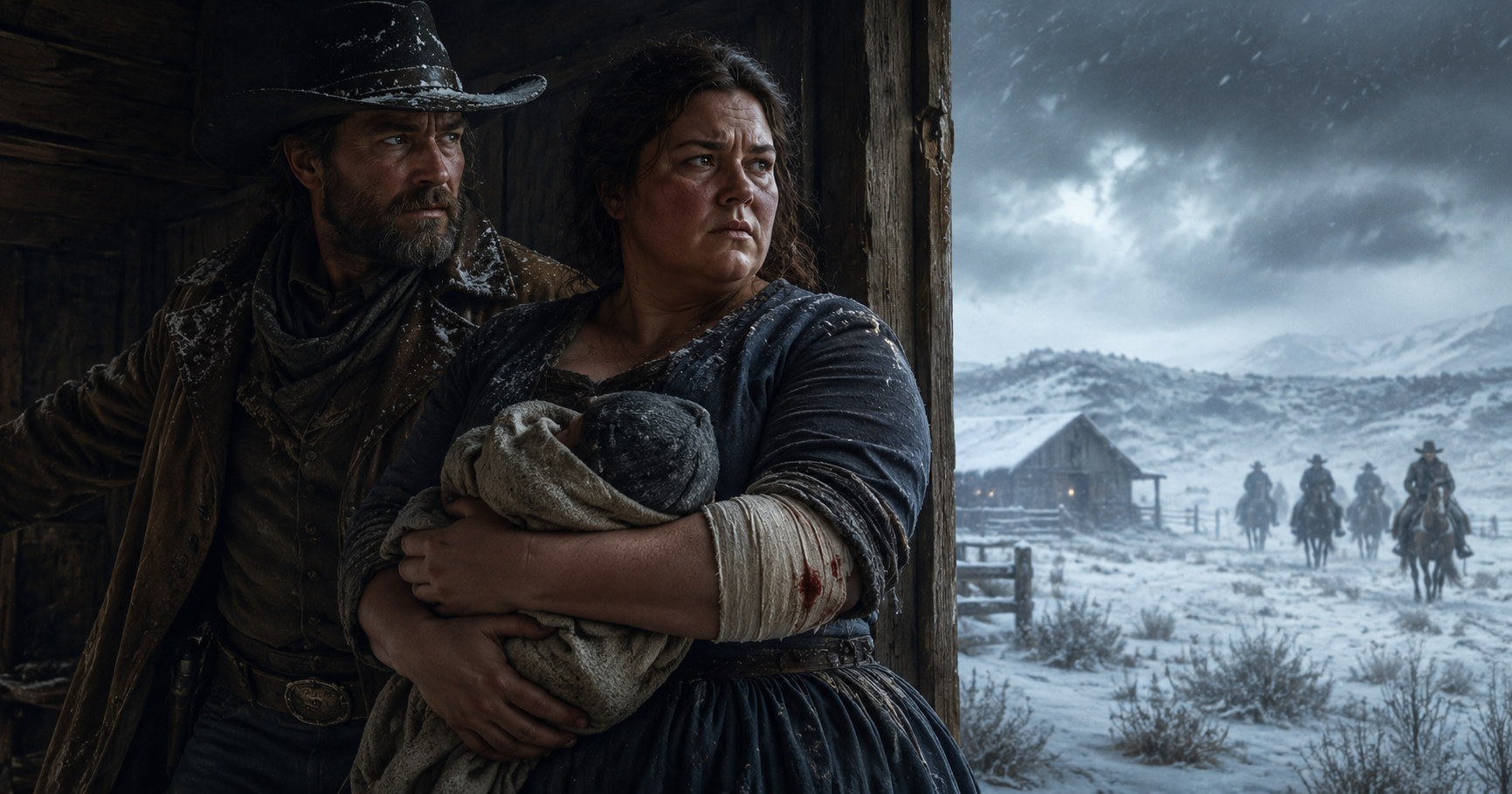
And for generations, whenever a storm rolled down from the mountains and rattled the old porch door, someone in the Reed family would tell the story of the heavy widow who crossed Wyoming with a baby in her coat and a bullet in her arm.
Some would say she came to be saved.
The oldest ones always shook their heads.
Mara Blackwood Reed did not come to that cabin to be saved.
She came carrying life in both arms.
And everyone who opened the door lived because of it.