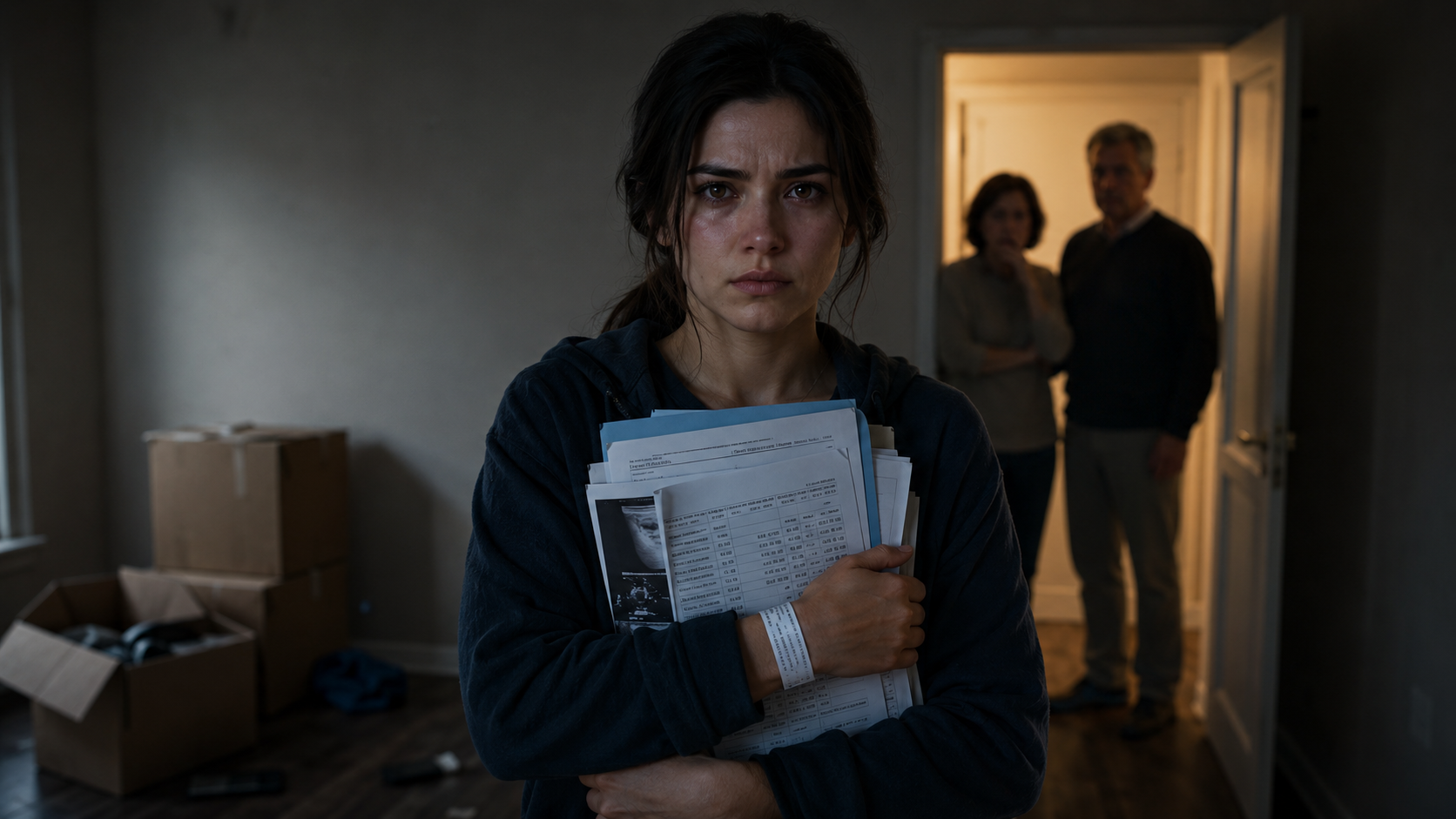
Mr. Keane was not in the room, but his statement was.
So was the footage.
So were the bank receipts.
So were the hospital records.
My parents’ lawyer began with phrases that sounded polished and dead.
Family breakdown.
Emotional distress.
Medical confusion.
Miscommunication.
Regrettable handling of property.
Celia let him finish.
Then she opened the first binder.
The sound of those metal rings clicking open felt like a door unlocking.
“Let’s use dates,” she said.
For the next ninety minutes, she rebuilt the truth in front of everyone.
June 3 — emergency admission.
June 4 — surgery.
June 5 — patient conscious and responsive.
June 6 — nurse call to apartment building requesting personal items.
June 7 — parents enter apartment.
June 7 — father tells landlord tenant is deceased.
June 7 — security footage shows removal of property.
June 8 — first resale listing posted.
June 9 — memorial post published.
June 10 — donation page receives first payment.
June 12 — patient discharged alive.
June 13 — patient sends message requesting return of property.
June 13 — father replies: Stop making this harder than it needs to be.
Celia did not raise her voice.
She did not need to.
Facts have their own volume when arranged correctly.
Every time my mother began to cry, Celia paused.
Waited.
Then continued.
That was the beautiful thing about documents.
They had no manners to exploit.
They did not get uncomfortable.
They did not forgive because crying made the room awkward.
They simply waited to be read.
My father lasted until the bank receipts.
Then he slammed his hand on the table.
“This is insane,” he snapped. “She left us years before this. She moved out, changed her attitude, acted like she was better than everyone.”
His lawyer touched his sleeve.
“Victor—”
“No,” my father said, pulling away. “She needed a lesson. She thought independence meant she didn’t owe us respect.”
The room went still.
My mother whispered, “Stop.”
But it was too late.
The sentence was already alive.
A lesson.
Not confusion.
Not grief.
Not panic.
A lesson.
Celia leaned back slightly.
“Thank you, Mr. Raines,” she said. “That clarifies intent.”
For the first time, my father looked afraid.
Not sorry.
Afraid.
I watched him understand that anger, his favorite weapon, had finally misfired.
My mother covered her face.
Julian closed his eyes.
And I felt something I did not expect.
Not joy.
Not victory.
Grief.
A clean, final grief.
Because some part of me, some foolish child inside my ribs, had still hoped that if the proof became undeniable enough, my parents might look at me and say one true sentence.
We hurt you.
We lied.
We stole.
We are sorry.
But they could not give me that.
They could only confess by accident.
The settlement changed after that.
Restitution for stolen property.
Compensation for lost business income.
Return of memorial donations through a supervised process.
Payment of legal fees.
A public correction.
A no-contact agreement.
And one line my mother fought harder than all the money.
One line that said:
Mara Vale was alive and recovering from surgery at the time statements were made representing her as deceased.
Alive.
Such a small word.
Such a terrible thing to have to prove.
My mother looked at me when they finally agreed.
Her eyes were red, but dry now.
“Was this worth losing your family?”
I looked at her white dress.
At my father’s clenched jaw.
At Julian, who looked ruined and relieved.
Then I touched the empty place on my wrist where my grandmother’s watch used to be.
“I lost my family when you sold the things I needed to come home,” I said.
She flinched.
This time, I did not comfort her.
Two weeks later, the correction was posted.
It was stiff, legal, bloodless.
But it existed.
People read it.
People shared it.
People found the old memorial page and the donation comments.
Some were cruel, because the internet can smell pain and arrive hungry.
But others were kind.
Women wrote about mothers who opened credit cards in their names.
Men wrote about fathers who sold tools, cars, heirlooms, anything they could call “family property.”
People wrote about being erased not by strangers, but by the people who knew exactly where to cut.
One comment stayed with me.
They didn’t mourn you. They monetized your absence.
Tessa sent it to me with no words.
She didn’t need any.
The returned donation money went where it should have gone in the first place.
Not to my parents.
Not to me.
To a recovery fund for patients who leave the hospital with no one safe to call.
The first time Celia showed me the receipt, I cried harder than I had cried in months.
Not because it fixed anything.