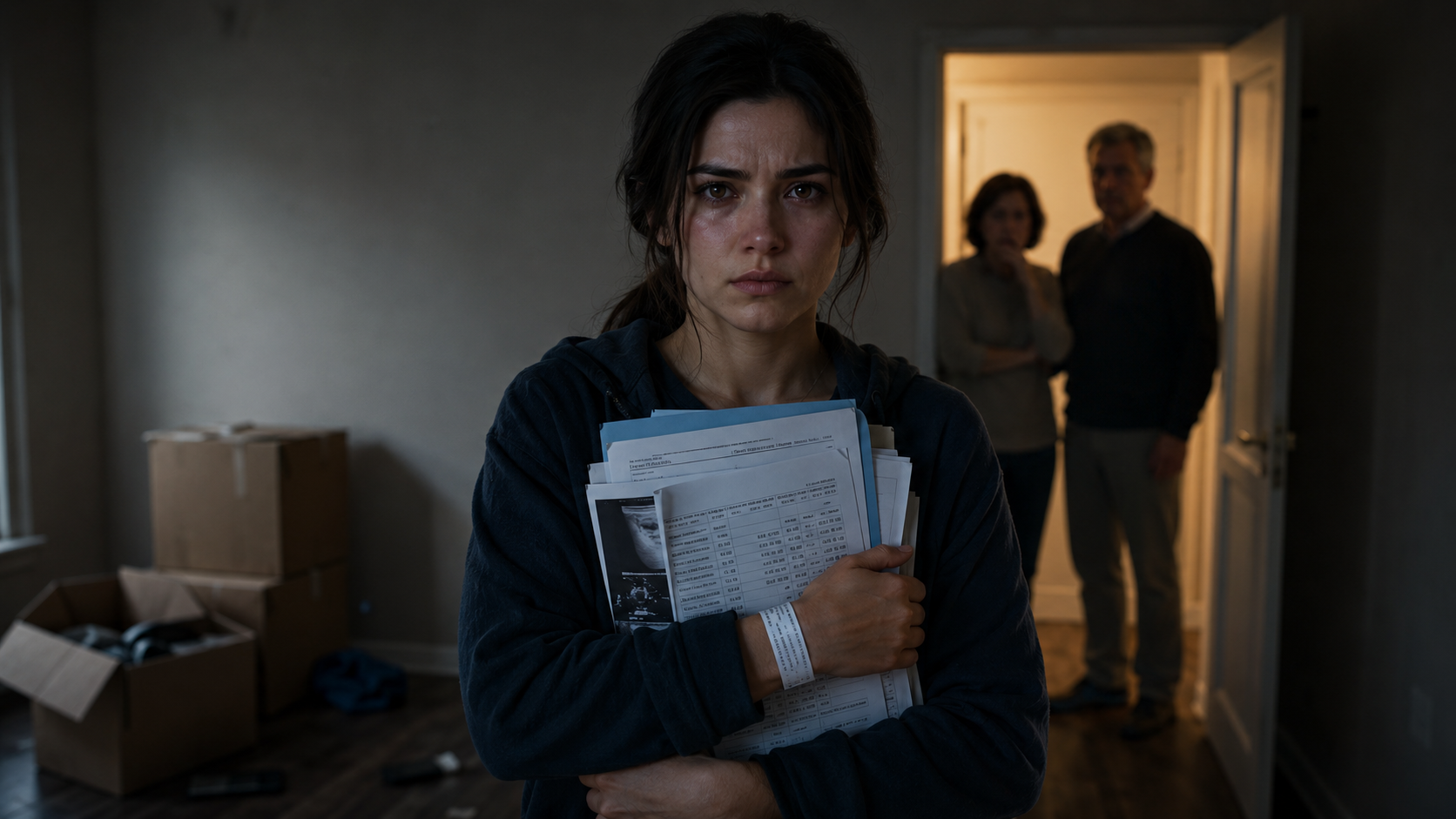
Donation transfers.
Photos of my parents’ van outside my building.
Mr. Keane’s sworn statement.
The security footage.
I watched the footage only once.
Tessa sat beside me.
Celia sat across from me.
On the screen, the hallway outside my old apartment appeared in washed-out gray.
The date glowed in the corner.
I had been alive on that date.
Breathing through pain.
Learning to sit up.
Calling my mother and getting voicemail.
Then my parents entered the frame.
My father unlocked the door.
My mother looked over her shoulder like she was afraid of being caught, not afraid of losing a child.
Julian followed with boxes.
At first, I felt nothing.
Then my mother came out carrying my green winter coat.
The one I had saved for two months to buy.
She held it against herself, checked the sleeves, then folded it over her arm.
Something inside me went very still.
Not the computer.
Not the camera.
The coat.
That was what hurt.
Because theft is not always about value.
Sometimes it is about the small proof that someone touched your life and decided it belonged to them.
At minute eleven, my father came out carrying my desk drawer.
At minute fourteen, Julian carried my books.
At minute nineteen, my mother came out with the wooden case.
I stopped the video.
Tessa put her hand over mine.
“Do you want to stop?”
“No.”
I pressed play.
Mr. Keane appeared at the end of the hall.
He spoke to my father.
There was no audio, but the body language was clear.
My father stepped close.
My mother turned away.
Julian stared at the floor.
Then my father took something from his wallet and pressed it into Mr. Keane’s hand.
The old man did not look proud.
He looked trapped.
The video continued until the hall was empty.
Until my door stood open.
Until my apartment looked like a mouth with all its teeth pulled out.
When it ended, Celia closed the laptop gently.
No one spoke.
Finally, I said, “They didn’t even turn off the light.”
Tessa’s face crumpled.
That was the detail that stayed with me.
Not the boxes.
Not the van.
The light.
They emptied my apartment and left the bedroom light burning.
As if the room were waiting for someone who would never come home.
Except I did.
Not to that apartment.
But to myself.
My mother called the day after the amended filing.
She used my aunt’s phone.
I answered because Celia said sometimes people confess when frightened.
She was right.
“Mara,” my mother said.
Her voice had the softness she used in public.
The voice that made people touch her shoulder and say, “You poor thing.”
“Diane,” I said.
She gasped.
I had never called her by her name before.
“You’re my daughter.”
“I was your daughter when you wrote my memorial post.”
Silence.
Then a small, wounded laugh.
“You’ve become so cold.”
“No,” I said. “I’ve become documented.”
She inhaled sharply.
“Your father and I made mistakes.”
“You committed fraud.”
“You always use such ugly words.”
“They’re accurate words.”
“You were sick. You weren’t thinking clearly. We were scared.”
“You told people I died.”
“We thought we lost you.”
“I called you from Tessa’s couch.”
“You were hysterical.”
“I asked for my laptop.”
“You cared about things more than family.”
I looked at my desk, at the new laptop I had bought in installments, at the bills I had paid late because my parents had sold the equipment that kept my business alive.
“I cared about rent,” I said.
“You humiliated us.”
There it was.
Not grief.
Not fear.
Humiliation.
The true family emergency.
My mother started crying, but the sound was thinner now. Less powerful through distance. A performance without a stage.
“Do you know what people are saying about us?”
“Yes.”
“How can you do this to your own parents?”
I almost smiled.
“I learned from you.”
She stopped crying.
“What does that mean?”
“You showed me that family can announce someone dead when it benefits them. I’m only announcing what you did while I’m alive.”
Her voice went flat.
“You will regret this.”
“I already regret giving you my spare key.”
She hung up.
A month later, we sat across from them in a mediation room with beige walls and a coffee machine that made everything taste faintly burned.
My father looked smaller in person than he had in my nightmares.
That surprised me.
For two years, he had been a giant shadow in my head. A voice. A locked door. A hand slamming down on a table.
But across from me, he was just a man in an expensive watch, sweating through his collar while his lawyer whispered instructions he did not want to hear.
My mother wore white.
Of course she did.
She looked like someone auditioning for innocence.
Julian sat three chairs away from them with his own lawyer. He had not looked at our parents once.