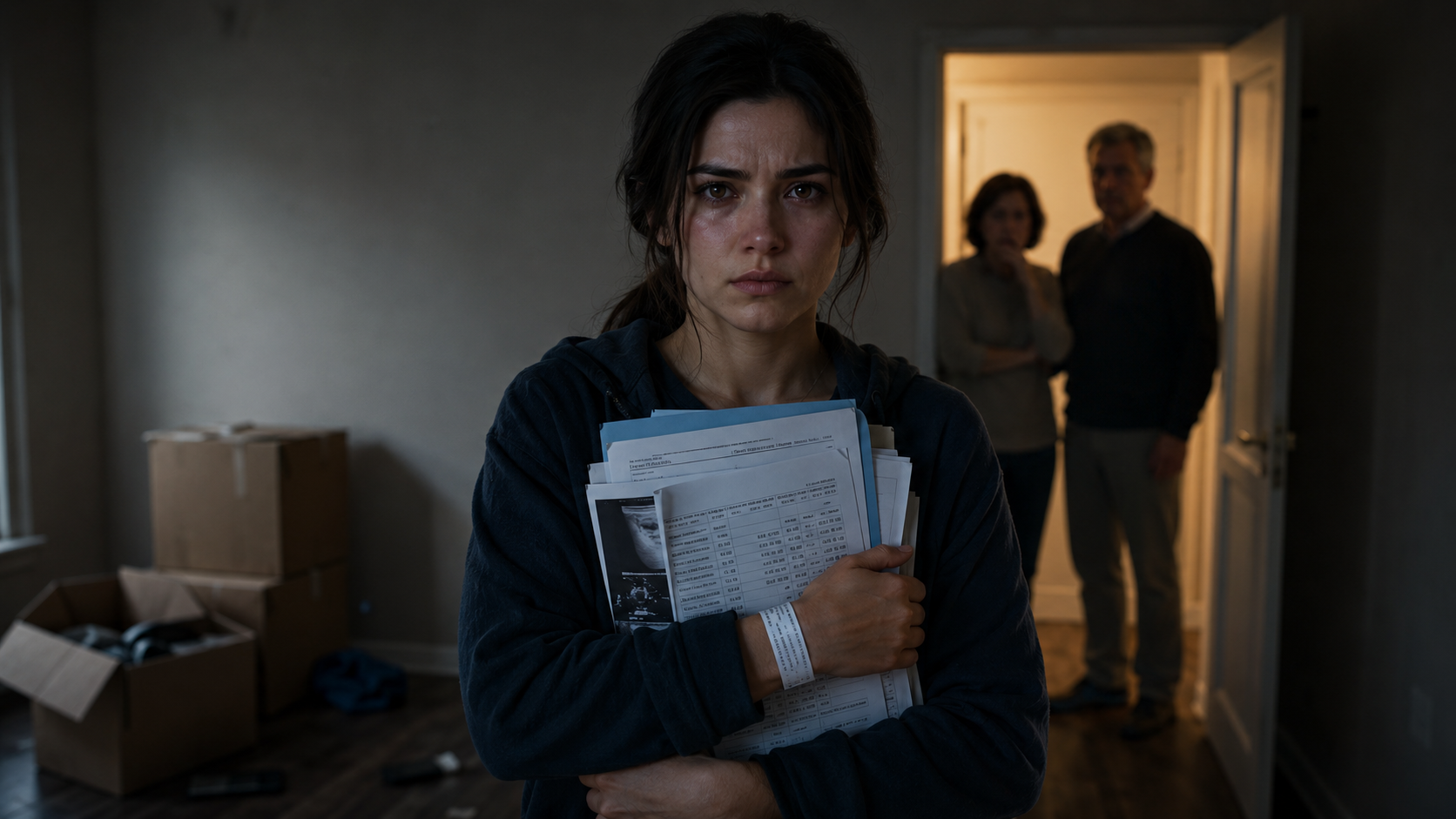
I didn’t know what to say.
Celia did.
“Mr. Keane, we’re not here to pressure you. We’re here because you may have information about what happened at Ms. Vale’s apartment.”
Ms. Vale.
My chosen name.
Not Raines.
I had legally changed it six months after my parents declared me dead.
My mother said it was dramatic.
I thought it was accurate.
Mr. Keane stepped aside.
“Come in.”
His apartment was small and painfully neat. A chair by the window. A stack of mystery novels. A framed photo of a woman who had to be his wife. On the table sat a brown envelope, a flash drive, and a notebook with a cracked black cover.
He touched the notebook first.
“I wrote things down,” he said. “Memory gets slippery when you get old. Paper doesn’t.”
I felt Tessa glance at me.
Paper doesn’t.
Mr. Keane sat slowly.
“They came on a Thursday,” he said. “Your mother, your father, and your brother. I remember because garbage pickup was late that week and the hall smelled awful.”
Celia opened her recorder, asked permission, then began.
Mr. Keane talked for forty minutes.
He said my father arrived first, carrying a box of black trash bags.
He said my mother wore sunglasses indoors.
He said Julian looked pale and kept asking if they should wait.
He said the landlord came down, confused, because my rent had been paid through the month.
My father told him I had died.
My mother covered her face.
Julian said nothing.
Mr. Keane said he knew it was a lie because he had spoken to me the day before surgery. I had told him I would be away for medical reasons. He also knew because a nurse from the hospital had called the building asking whether anyone could bring me a phone charger from my apartment. She had left her name and number at the desk.
“I told your father that,” Mr. Keane said. “I said, ‘Sir, the hospital called yesterday.’”
My hands turned cold.
“What did he say?”
Mr. Keane looked at the table.
“He said, ‘She’s dead to this family either way.’”
Tessa whispered something under her breath.
Celia’s face did not change, but her pen stopped moving for half a second.
“And Mrs. Raines?” Celia asked.
Mr. Keane swallowed.
“She said, ‘Don’t be sentimental, Harold. Girls like Mara always come crawling back if you leave them something to crawl back to.’”
The room blurred at the edges.
I stared at the brown envelope.
Girls like Mara.
Not daughters.
Not children.
Girls like Mara.
As if I were a category of problem.
Mr. Keane continued.
He saw them remove boxes, electronics, clothing, books, framed photographs, and a small wooden case I knew immediately.
My grandmother’s watch had been inside it.
He tried to stop them when they carried out my desk.
My father gave him cash.
Five hundred dollars.
“Not as a bribe,” Mr. Keane said quickly, ashamed. “At least, not how he said it. He said it was for my trouble. For helping keep the building calm. He said grief made people unreasonable.”
“Did you take it?” Celia asked.
“Yes.”
He covered his face with one hand.
“I needed medication that month.”
I should have been angry.
Part of me was.
But another part remembered Mr. Keane fixing the lobby heater with duct tape because the landlord was cheap. I remembered him eating soup from a thermos at midnight. I remembered that my father had always known exactly where people were weak and exactly how much pressure to apply.
“What changed?” I asked.
Mr. Keane looked at me.
“You came back.”
“I didn’t come back.”
“Yes, you did. Not to the building. To the truth.” He pushed the brown envelope toward Celia. “A few weeks after, I saw your mother’s memorial post. Then I saw the donation link. I knew then it wasn’t just family cruelty. It was money.”
He tapped the flash drive.
“I copied the hallway camera before the system erased. I also took photos of the van. License plate. Boxes. Your father handing the landlord a paper. I kept the phone message from the nurse too.”
Celia’s eyes lifted.
“You still have the message?”
Mr. Keane nodded.
“Old answering machine. My wife used to say I kept everything.”
He looked at me.
“She was right.”
For the first time that day, I cried.
Not loudly.
Not dramatically.
Just one tear, then another.
Because the world had taken so much from me that I had forgotten strangers could save things.
My parents had counted on everyone looking away.
They had forgotten that sometimes the quietest people keep the best records.
The next three weeks were not peaceful.
They were surgical.
Celia moved with frightening precision.
She filed the amended evidence packet.
Hospital admission logs.
Surgical notes.
Discharge instructions.
The nurse’s call record.
My text messages.
My father’s reply: Stop making this harder than it needs to be.
Bank receipts.
Pawnshop receipts.
Online resale screenshots.