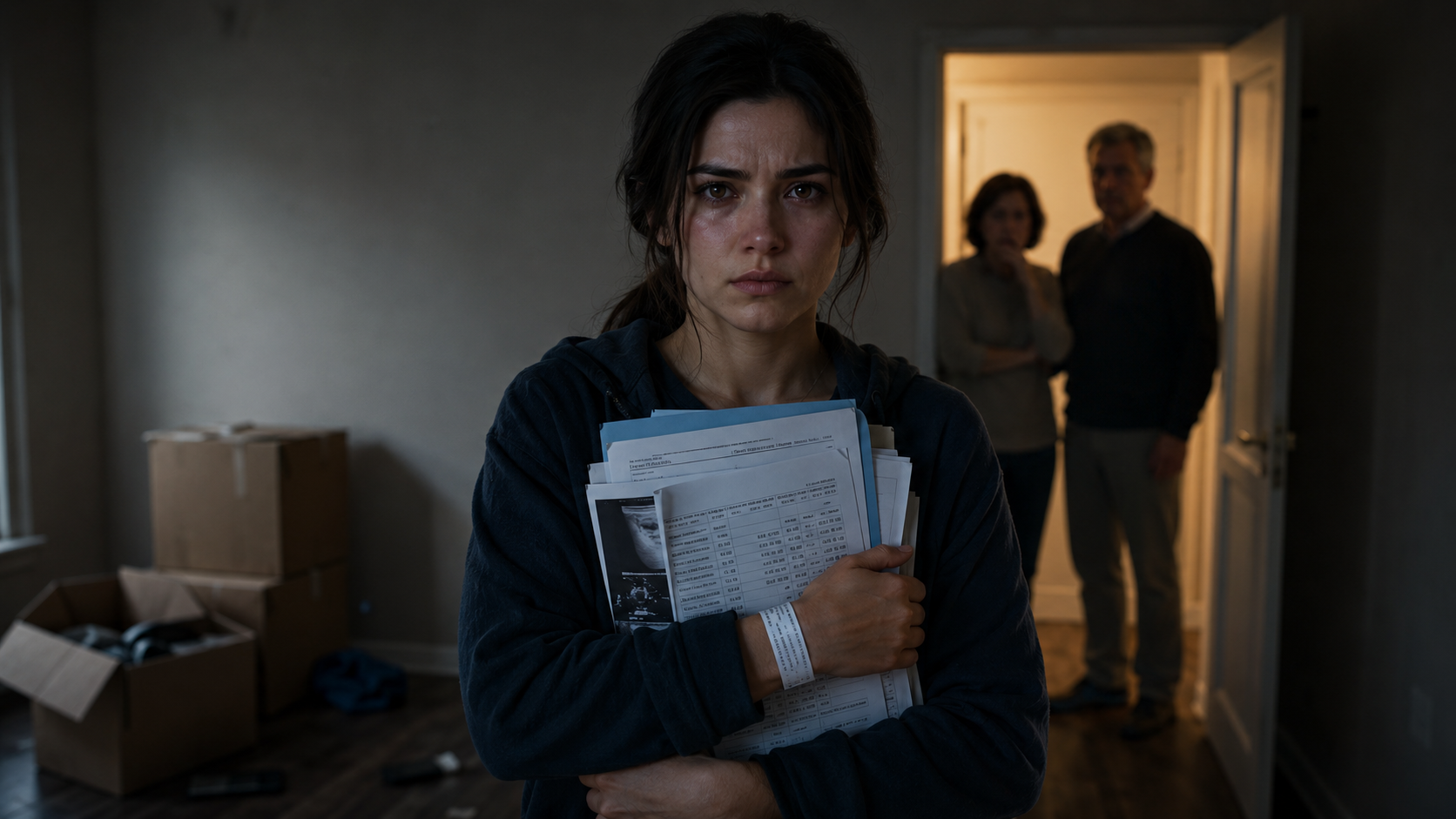
Not the way my parents announced.
Not in a coffin.
Not in a hospital bed.
She died slowly, piece by piece, while waiting for people who loved control more than they loved her.
The woman left behind did not cry easily.
She made coffee.
She opened her laptop.
She emailed my lawyer.
Subject: Possible witness — urgent.
By 7:15, Tessa was at my door with wet hair, two coffees, and the expression of a woman prepared to commit several crimes in my defense.
Tessa had been my emergency contact before I knew I needed one.
She was the friend who picked me up after discharge when my parents “couldn’t handle the drama.”
She was the friend who let me sleep on her couch and never once called it generosity.
She was the friend who said, “We are going to make a folder,” while I lay there feverish, broke, and terrified.
That folder became two folders.
Then a box.
Then four binders.
Hospital.
Messages.
Property.
Money.
Witnesses.
The first binder had saved my sanity.
The fourth was about to ruin my parents’ lives.
Tessa stepped inside, saw my face, and lifted the coffee like a peace offering.
“Is this a speak-first morning or a drink-first morning?”
“Mr. Keane may have the security footage.”
She lowered the coffee.
“Oh.”
“And my father paid him to stay quiet.”
Her eyes sharpened.
“Oh.”
“And Julian wants to be useful because consequences finally developed teeth.”
Tessa handed me one coffee.
“Good. I hope they bite him gently. Then harder.”
At 9:00, we were in a glass conference room downtown, sitting across from my lawyer, Celia Grant.
Celia looked nothing like the kind of lawyer my parents imagined me having.
They would have expected someone loud. Flashy. Expensive in a way that announced itself.
Celia wore plain black suits, spoke softly, and had the emotional temperature of a locked filing cabinet.
She frightened people by listening too carefully.
When I finished telling her about Julian’s call, she wrote one line on her legal pad.
Find Keane.
Then she looked up.
“This is significant.”
“How significant?”
“If he confirms what your brother said, very.”
Tessa leaned forward. “Define very.”
Celia tapped her pen once.
“Right now, their defense rests on confusion, grief, and family misunderstanding. They claim they reasonably believed Mara had abandoned the apartment after a medical crisis. They claim the death announcement was a tragic miscommunication spread by others. They claim the donations were meant to help with medical debt and later became confused with memorial support.”
Tessa’s mouth twisted. “That’s disgusting.”
“Yes,” Celia said. “But disgusting is not always legally fatal. Evidence is.”
I placed my hospital folder on the table.
“We have evidence.”
“We have strong evidence,” Celia agreed. “Hospital records proving you were alive and conscious. Discharge records. Messages you sent asking for your belongings. Bank receipts showing deposits matching the online sales. Screenshots of the memorial page. The donation records. The landlord’s revised statement.”
She paused.
“But a witness who heard them lie in real time and preserved security footage would make their version very difficult to maintain.”
Tessa smiled without warmth.
“I love difficult for them.”
Celia turned to me. “Can you handle seeing the footage if it exists?”
I thought about my parents entering my apartment.
My mother opening drawers.
My father unscrewing my hard drive.
Julian carrying boxes.
My life reduced to items.
Could I handle seeing it?
No.
Would I watch it anyway?
Yes.
“I can handle facts,” I said.
Celia studied me for one second longer than usual.
Then she nodded.
At 10:12, Julian sent the address.
Not to me.
To Celia.
A small mercy.
Mr. Keane was living in a senior housing complex on the edge of the city, thirty minutes from my old apartment and a lifetime from who I had been when I lived there.
Celia called first.
Then she asked if I wanted to come.
I said yes too quickly.
Tessa drove.
She did not play music. She did not fill the silence with advice. That was one of the reasons I loved her. She knew that some silences were not empty. Some were full of teeth.
Mr. Keane opened his door wearing slippers, a cardigan, and the face of a man who had been waiting to be found.
He was thinner than I remembered.
Older.
But his eyes were the same.
Sharp.
Sad.
Kind in a way that made my chest hurt.
“Miss Mara,” he said.
I had not expected my own name to undo me.
For two years, I had heard my parents twist it into absence.
Poor Mara.
Our late daughter.
She’s gone now.
To hear it said like I was standing in front of someone who knew exactly where I belonged almost broke something open inside me.
“Hi, Mr. Keane,” I said.
His mouth trembled.
“I should have called you.”