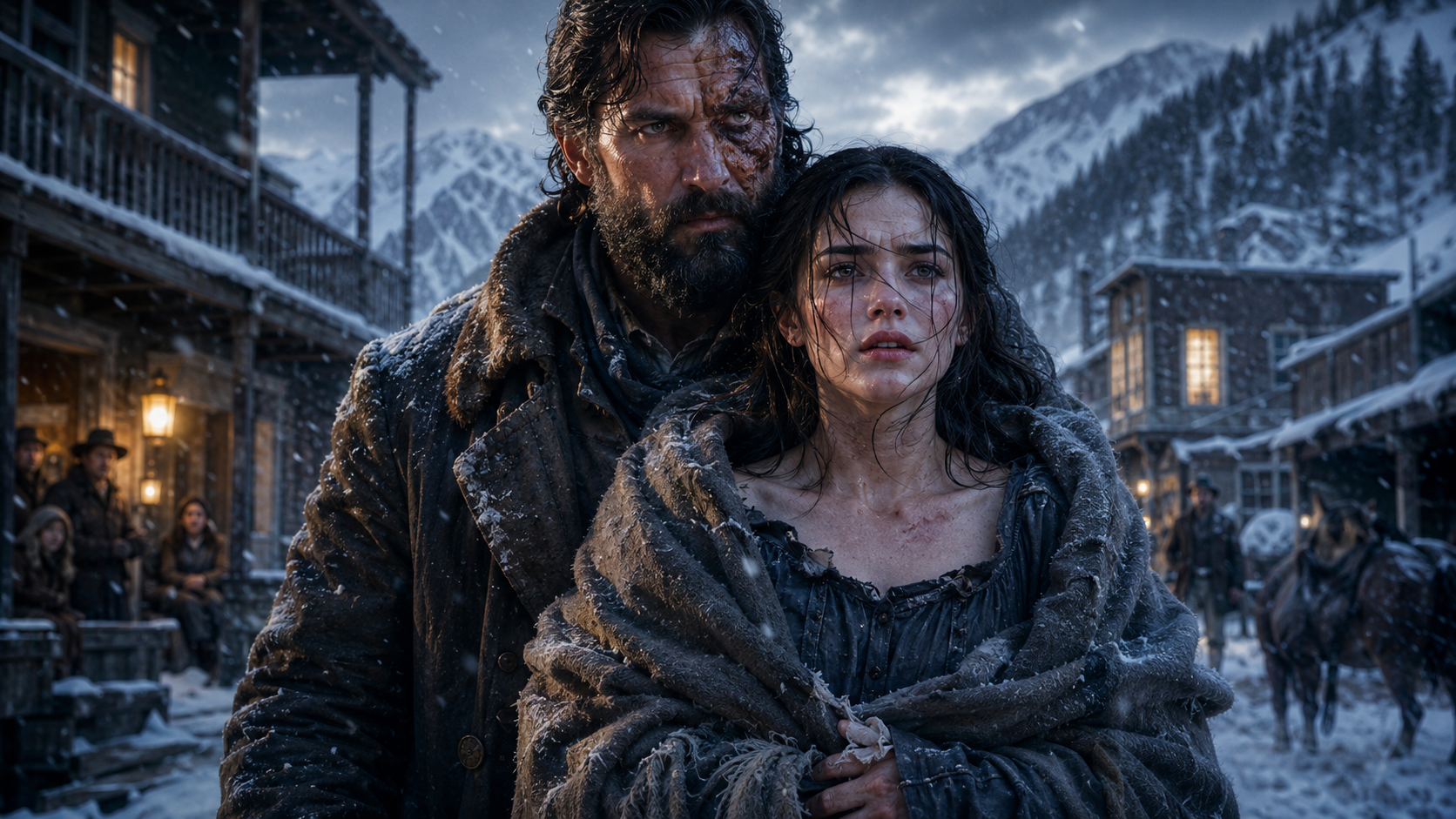
He said little.
“Lean forward.”
“Keep your chin down.”
“Breathe through the blanket.”
His voice gave her something to follow when the world became white noise.
After an hour, or perhaps five minutes, or perhaps the rest of her life, the cold began to change. At first it hurt. Then it stopped hurting, and that frightened her more.
“My feet are gone,” she whispered.
“They’re still there.”
“I can’t feel them.”
“I know.”
“Maybe that means they left.”
A rough sound came from him. It might have been a laugh if it had belonged to a man who remembered how.
“Stubborn woman.”
“I have been called worse today.”
“I heard.”
She closed her eyes. “Why did you help me?”
The horse climbed steadily.
Jonas did not answer for a long while.
Then he said, “Because nobody else did.”
That should not have broken her.
It did.
Eliza bowed her head and cried into the wool blanket, the tears freezing almost as soon as they left her skin. She cried for her brother Thomas, dead on a road west of Helena. She cried for the seven months she had spent with men who treated mercy as a weakness to be beaten out of the world. She cried for the town that had known her since girlhood and still found it easier to believe she had become wicked than that wickedness had been done to her.
Her body sagged.
Jonas noticed immediately.
“Stay with me.”
“I’m awake.”
“No, you’re answering. That ain’t the same.”
“I’m tired.”
“Be tired tomorrow.”
“I might not have tomorrow.”
His arm became iron around her.
“You do.”
“You don’t know that.”
“I said you do.”
There was such command in his voice that some foolish part of her believed him.
The horse stumbled near a ravine. Jonas cursed softly, slid down, and led the animal on foot while keeping one hand on Eliza’s leg to steady her. The storm swallowed everything beyond a few yards: trees, sky, trail, God.
At last, through the blur, a glow appeared.
Then logs.
Then a door.
Eliza remembered being lifted. She remembered protesting because she was too heavy, because she had been told too many times that she was too much trouble, too much body, too much need.
Jonas ignored her.
“You weigh less than a wet saddle,” he said.
“That is not a compliment.”
“It is from me.”
The door opened.
Warmth rushed out.
Eliza smelled woodsmoke, coffee, cedar, drying leather, and stew. The cabin was larger than she expected, built deep into the shoulder of the ridge with stone at the back wall and thick logs darkened by years of smoke. A great hearth burned at one end. Tools hung in careful rows. A small table stood under a window half buried in snow. Dried herbs, onions, and strips of meat hung from rafters.
Jonas set her on a bed near the fire as gently as if she were made of thin glass.
She tried to sit up.
“No.”
“I need—”
“You need heat.”
“My dress—”
“Is frozen.”
Her breath caught.
He saw the fear before she could hide it.
Jonas stepped back at once and turned his face away. “I’ll cut the outer cloth where it’s iced. You’ll stay covered. I’ve got my mother’s old screen in the corner. I’ll set it up. You can cuss me the whole time if you need.”
Eliza stared at him.
He was still turned away.
A man who could have taken any amount of space instead gave her all of it.
She began to shake, not from cold this time.
“I don’t have strength to cuss.”
“Then blink mean.”
Despite everything, a broken laugh escaped her.
Jonas set the screen, warmed blankets by the fire, and worked with the brisk care of someone who had treated wounds before. He never touched without warning. He kept his eyes on his hands or the floor. When her boots had to come off, he did it slowly, murmuring, “This will hurt,” before pain tore through her feet and made her gasp.
“Good,” he said.
“That was good?”
“Pain means blood’s coming back.”
“I dislike your definition of good.”
“Most do.”
He gave her bitter tea, broth from a tin cup, and a stone wrapped in flannel for her feet. At some point, she woke to find him seated beside the hearth with a rifle across his knees, watching the door while the storm clawed at the roof.
“You think they’ll come?” she whispered.
His face turned toward her.
In firelight, the burned half looked less monstrous than mournful.
“Not tonight.”
“But later?”
“Maybe.”
“You should have left me.”
“No.”
“You do not know what Judge Creed is.”
“I know enough.”
Eliza swallowed. “No, you don’t. He is not only a judge. He has men. Money. Friends in Helena. He knows about the Copperline bonds. He knows I saw him.”
Jonas leaned forward.
There it was: the first spark of something colder than anger.
“What did you see?”
Eliza closed her eyes.
For months, the truth had sat inside her like a live coal. She had been afraid to speak it because every time she opened her mouth, someone else told the story first.