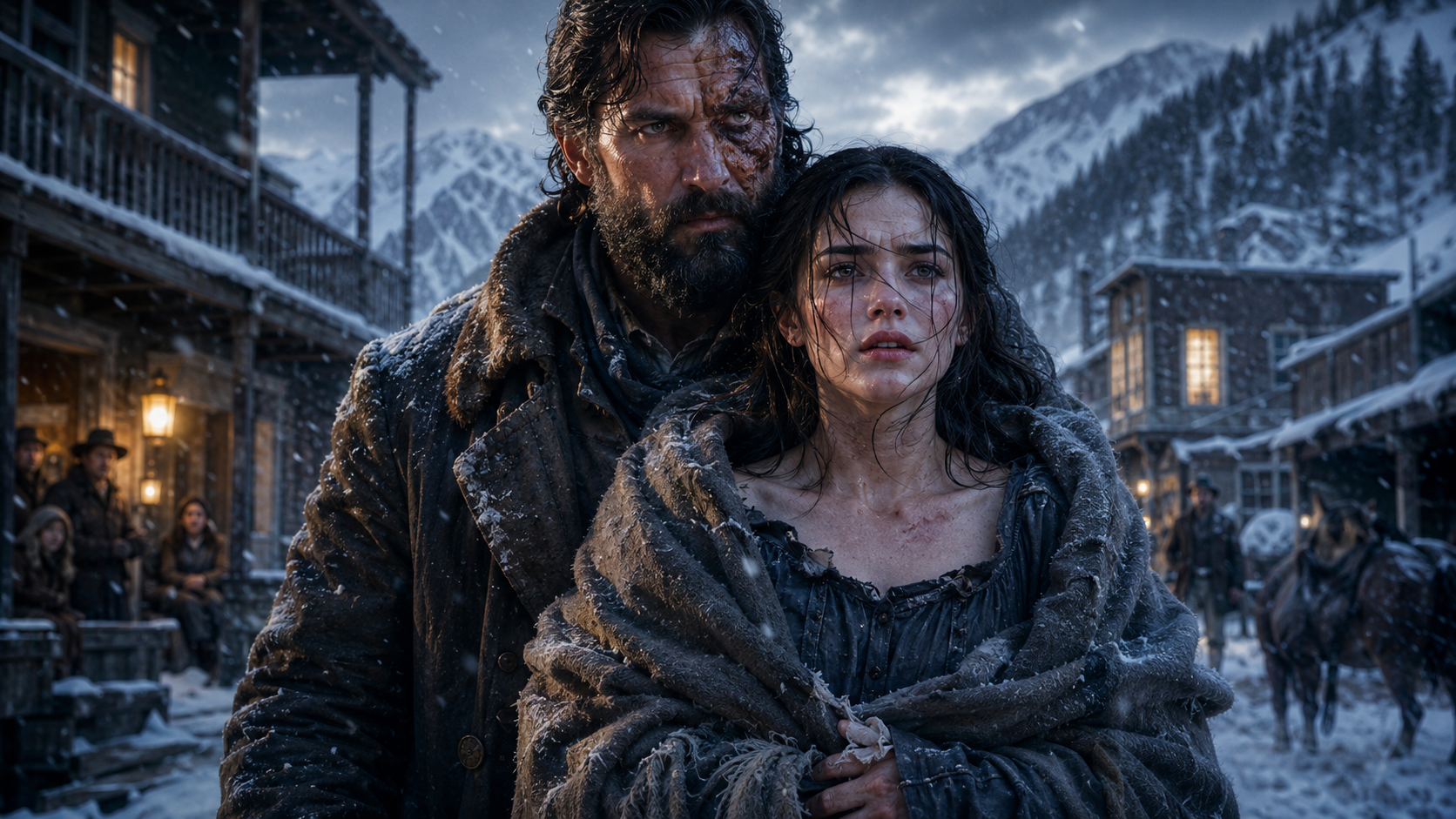
But the storm was at the door.
The town was below.
And this stranger had ridden into both for her.
“My brother and I were traveling west,” she said. “Thomas had sold our father’s place after the fever took our parents. He meant to buy sheep country near the Bitterroot. I was to keep books and bake pies for hired men. That was the plan.”
Her voice trembled.
“Near Sawtooth Bend, the Bracken gang stopped the coach. Thomas reached for the shotgun under the seat. Rafe Bracken shot him before he cleared the barrel.”
Jonas did not interrupt.
His stillness helped.
“They took me because I had seen faces. At first they meant to kill me. Then Bracken decided a woman could cook, mend, distract guards, and make men hesitate. He told others I was his willing woman because he liked watching me deny it.”
Jonas’s scarred hand tightened around the rifle stock.
Eliza continued.
“I survived by becoming useful. I cooked. I cleaned wounds. I listened when they forgot I had ears. That is how I learned about the Copperline robbery. Judge Creed was not robbed by the gang. He hired them.”
The fire cracked loudly.
Jonas’s good eye narrowed.
“He gave them the route?”
“And the guard changes. And the names of men carrying payroll bonds. He promised them safe passage through Mercy Ford afterward. But Bracken kept a ledger. Payments, dates, names. Creed feared it.”
“Where is it?”
Eliza looked toward the window, where snow had covered nearly all the glass.
“Not with Bracken. Not anymore.”
Jonas waited.
“When the marshals raided the camp, Bracken fled with two men and took me as shield. We crossed a frozen creek. He fell through near the old mill gorge. The saddlebag with the ledger went under. Bracken drowned. One of his men dragged me out, then left me when he heard riders. I walked until I found Mercy Ford.”
“And Creed got to you before the marshals did.”
She nodded. “He told me no one would believe a woman who had lived among outlaws. He said if I spoke, he would swear I planned the Copperline raid. He said my brother’s death would become my shame too.”
“He needed the ledger.”
“He still does. I know where it sank. I marked the place with a broken willow branch before I ran.”
Jonas stood and crossed to the window. For a moment, he was only a broad shadow against storm-white glass.
“The gorge is below Mercy Ford.”
“Yes.”
“Close enough for Creed to search when weather clears.”
“Yes.”
He turned back. “Then we get there first.”
Eliza laughed once, bitterly. “I cannot even stand.”
“You will.”
“And if I cannot?”
“I’ll carry you.”
“You say that like it is simple.”
“It is.”
“No, Mr. Vale. It is not. Nothing about me is simple.”
He looked at her for a long moment.
Then he said, “Good.”
She had no answer to that.
For four days, the ridge disappeared beneath snow.
Eliza slept in pieces. Sometimes fever dragged her backward into the outlaw camp, and she woke fighting blankets, certain hands were reaching for her. Each time, Jonas was there but not too close.
“You’re in my cabin.”
“The door’s barred.”
“Nobody touches you here.”
Once she woke crying for Thomas, and Jonas placed a cup of water on the floor beside the bed because she could not bear a hand near her. Another time she woke to find him outside splitting wood in snow up to his thighs, his burned face turned away from the wind as if the weather owed him money.
By the fifth morning, she could stand with one hand on the bedpost.
By the sixth, she took three steps and called it victory.
Jonas called it reckless.
She called him sour.
He almost smiled.
The cabin slowly became more than a place where she had not died.
She learned that Jonas kept his coffee in a tin marked Nails because no visitor would steal nails. He owned six rifles but only two plates. He could stitch a wound with terrifying precision and burn biscuits with equal confidence. He had a habit of standing in doorways as if expecting trouble to arrive on schedule.
She also learned there had once been laughter in the cabin.
A woman’s shawl lay folded in a cedar chest. A child’s slate leaned behind a stack of books. On the mantel stood a wooden bird, carved smooth by small hands.
Eliza did not ask at first.
People in pain recognized locked rooms in one another.
On the seventh evening, she found him sharpening a knife by the fire.
“Who were they?” she asked softly.
His hand stopped.
“The shawl. The slate. The bird.”
For a moment she thought he would not answer.
Then he set the knife aside.
“My wife was named Ruth. My boy was Eli.”
Eliza sat very still.
“Fever took the mining camp at Alder Creek,” Jonas said. “Company men locked the sick families in a supply barn to keep infection from spreading. I was hauling timber downriver. Came back to smoke.”
Her breath caught.
“They burned it?”
“Said a lantern fell.”
His voice had gone flat.