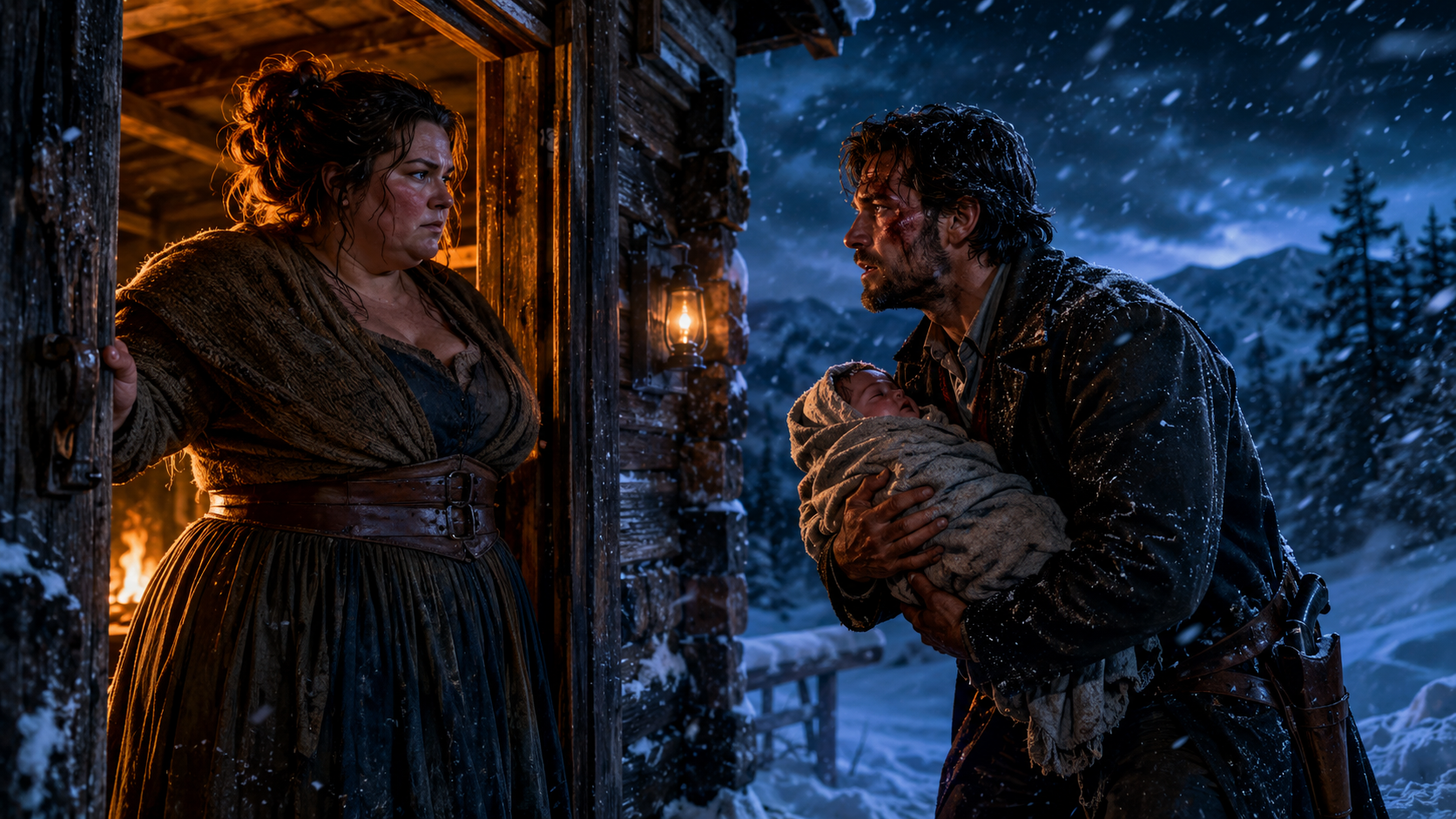
People in Briar County had a way of weighing women without ever touching a scale.
They weighed them in doorways, in church pews, in grocery aisles, in the silence after a joke went too far and everyone pretended it had not been cruel. They weighed them with eyes, with whispers, with little smiles that said, Poor thing, as if pity were kinder than contempt.
For most of her life, Iris Marlowe had been measured that way.
Too broad in the hips.
Too soft in the arms.
Too round in the face.
Too loud when she laughed.
Too much woman for a porch swing, too much woman for a wedding dress, too much woman for a man to proudly claim in daylight.
She had heard it all by the time she turned thirty-two.
At fourteen, boys at school had called her “the barn door” because she once blocked a hallway while carrying books. At seventeen, a girl she thought was her friend told her she had a beautiful face, then added, “It’s a shame about the rest.” At twenty-four, a ranch hand named Miller Tate kissed her behind the county fair stables, sweet as summer rain, then pretended not to know her the next morning when his friends laughed.
At twenty-nine, she had believed a man named Eli Boone when he said he did not care what anyone thought.
He cared.
He cared enough to visit her at night and avoid her in town. He cared enough to make promises in whispers and break them in public. He cared enough to leave when her belly began to show.
Now Iris lived six miles above the old wagon road, in a cabin her father had built with hands that never learned how to be gentle but always knew how to be loyal. Her father had been dead two winters. Her mother had gone long before that. Eli was a rumor somewhere in Kansas.
And Iris had Micah, her baby boy, nine weeks old, angry at the world whenever his blanket slipped from his chin.
She also had two goats, one aging mare, a stove that smoked when the wind turned east, and a debt at Harlan’s Feed & Supply that Mr. Harlan mentioned with the solemn disappointment of a priest.
She had learned to survive.
Survival was not pretty. It did not wear ribbons. It did not come with music. Survival was splitting wood with sore wrists, mending the same coat twice in one month, boiling potatoes until they became dinner three different ways, and smiling at her son even when fear sat at the table with them.
On the night everything changed, the snow began before sunset.
Not soft snow. Not the kind that made postcards beautiful.
This snow came sideways, driven hard by a mountain wind that rattled the shutters and shoved itself through cracks in the walls. By eight o’clock, the path to the well had vanished. By nine, Iris had dragged in enough firewood to last through morning. By ten, Micah was asleep in the cradle beside the stove, one small fist tucked beneath his chin.
Iris sat at the table with a needle and an old blue dress across her lap. The dress had once belonged to her mother. It had been made for a slimmer woman, one who floated rather than worked, one who had never chopped ice from a water bucket or carried feed on her shoulder.
Iris was letting out the seams.
Again.
The needle flashed in the lamplight.
Outside, the storm howled like something alive.
She was tying off a thread when she heard the first sound.
Not thunder.
Not wind.
A pounding.
Three hard strikes against the door.
Iris froze.
No one came to her cabin in weather like this unless they were lost, desperate, or dangerous. Sometimes all three were the same thing.
She stood slowly, reached for the rifle above the mantle, and crossed the room without making the floorboards complain. Micah stirred but did not wake.
The pounding came again.
Then a man’s voice, broken by cold and panic.
“Please! Open the door!”
Iris did not answer.
She lifted the rifle.
“Who are you?”
A pause.
Then, “My name is Callum Reid. My baby’s sick. She’s not breathing right. Please, ma’am. I’m begging you.”
The word baby went through Iris like a knife.
She unlatched the door but kept the chain fastened. When she opened it the width of her hand, snow blew into the room.
A man stood on her porch, tall, broad-shouldered, half-covered in white. Blood had frozen dark along one side of his forehead. His coat was torn. In his arms, bundled beneath his jacket, was a tiny child wrapped in a blanket already stiff with frost.
The man’s eyes were not proud. Not commanding. Not rich-man eyes.
They were terrified.
“Please,” he said again. “She’s burning up. Then she went cold. I don’t know what to do.”
Iris saw the baby’s face.
The little girl’s lips were pale blue.
Iris dropped the chain.
“Get inside.”
The man staggered over the threshold so suddenly she had to grab his sleeve to keep him from falling. He smelled of snow, blood, leather, and horse sweat. Not whiskey. That mattered.
“Set her near the stove, but not too close,” Iris ordered.