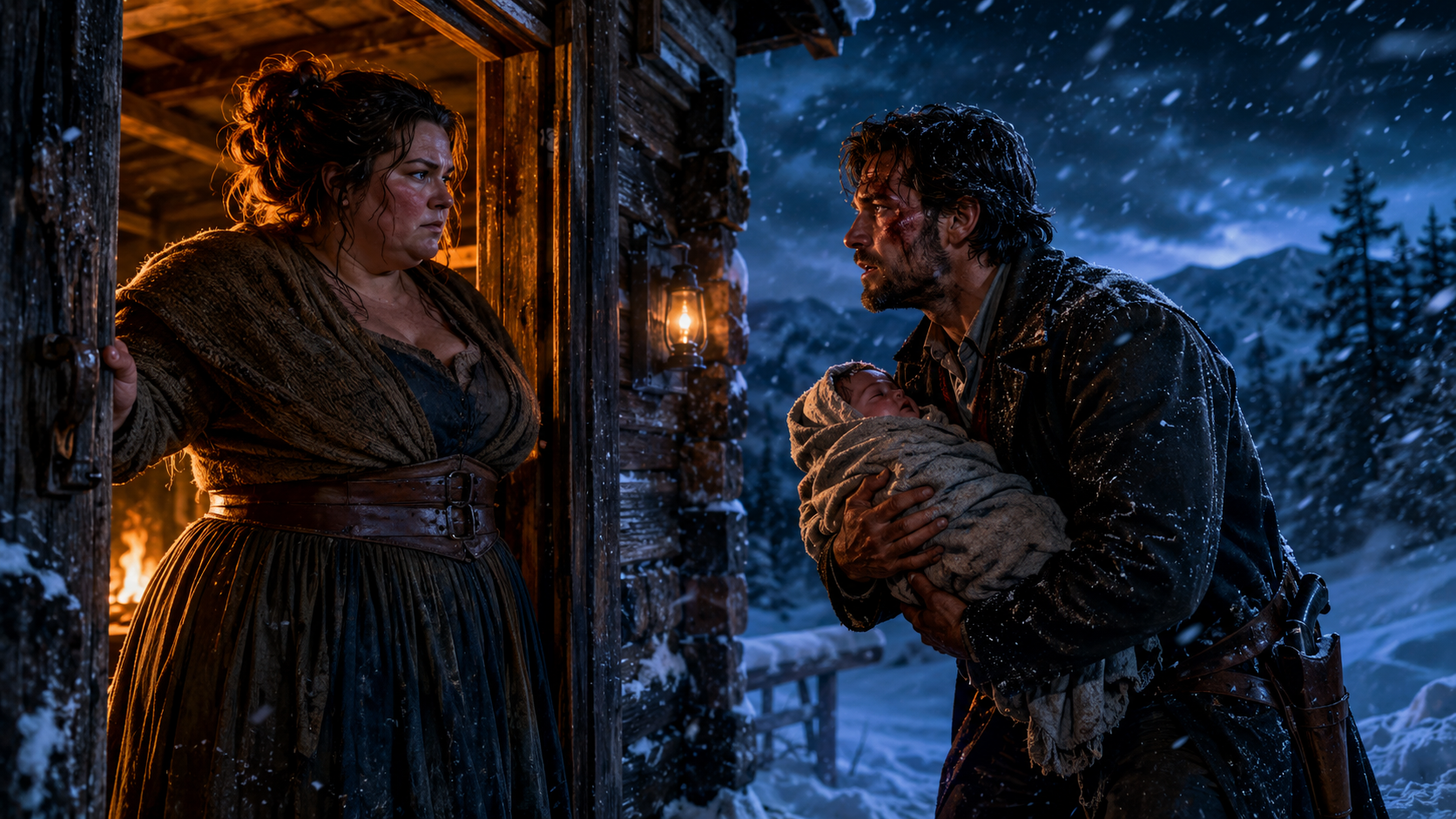
He obeyed at once.
Most men did not. Most men heard a woman’s command and needed a moment to wrestle with their pride before common sense won.
This man simply moved.
Iris shut and barred the door, then dropped to her knees beside the baby.
“How old?”
“Four months.”
“Name?”
“June.”
The baby made a thin, catching sound. Not quite a cry. Not enough air for that.
Iris unwrapped the blanket, touched the child’s cheek, then her chest, then the hollow of her throat. Heat burned beneath the skin, but her hands and feet were chilled dangerously cold.
“How long has she been sick?”
“Since yesterday morning. Fever. Cough. I was trying to get her to the doctor in Alder Creek, but the road washed out near the pass. Then the storm hit. Then—”
He stopped.
Iris looked up.
“Then what?”
Callum’s jaw tightened. “Then my horse went down.”
“That cut on your head wasn’t made by a horse.”
He said nothing.
Iris held the baby upright against her chest and listened to the wet rattle in her breathing. Pneumonia, maybe. Or close enough that the difference did not matter tonight.
“Boil water,” she said.
The man blinked. “What?”
“Pot. Water. Stove. Move.”
He moved.
Iris carried the baby closer to the warmth, not enough to shock her cold limbs, and began rubbing her back in small firm circles. The child’s breath shuddered. Iris tilted her carefully, supporting the tiny head.
“Come on, little bird,” Iris whispered. “You don’t leave the sky yet.”
Callum turned from the stove.
“Can you save her?”
The question was raw.
Iris hated questions like that. They asked a person to become God for a moment, and God had never answered Iris when she needed him most.
“I can help her breathe,” she said. “That is what I can do.”
Callum swallowed hard.
“What else?”
“You can stop asking questions and bring me that kettle when it sings.”
He nodded.
Iris crushed dried mint and pine needles into a bowl, added hot water, and made a tent with a blanket so the steam could rise around the baby without burning her. She worked from memory. Her father had taught her mountain remedies. Her mother had taught her how to sit with sickness without flinching. Her own son had taught her that fear could make a woman’s hands steadier, not weaker.
Callum knelt across from her, watching every breath his daughter took.
Only then did Iris notice his clothes.
Even ruined by storm, they were expensive. His boots were custom-made. His coat, though torn, had been cut by a tailor who expected payment in large bills. His gloves were fine leather, one missing, one soaked through.
She knew his name now.
Callum Reid.
Everyone in Briar County knew that name.
The Reids owned Blackthorn Ridge, the largest cattle spread west of Denver, with land that rolled from foothills to high pasture and a house made of stone, glass, and old money. Callum Reid had been on the front page of the state paper three months ago when his father died. He was the millionaire cowboy, the man who inherited cattle, mineral rights, rail contracts, and half the valley’s gossip.
Iris had once heard two women in Harlan’s store sigh over his photograph.
A man like that, they said, could marry anybody.
A man like that would never look twice at a woman like Iris Marlowe.
Now he was kneeling on her floor, bleeding into his collar, helpless as any poor man in a storm.
June coughed.
It was a small, horrible sound.
Then she drew a deeper breath.
Callum leaned forward.
Iris lifted one hand. “Slow.”
He froze.
The baby’s lips lost a little of their blue.
Iris exhaled.
“There she is.”
Callum covered his mouth with his hand. His shoulders shook once, violently, before he forced himself still.
“Thank you,” he whispered.
“Don’t thank me. Not yet.”
He looked at her.
“She’s alive.”
“She’s fighting. There’s a difference.”
His face changed at that. Not anger. Understanding. The kind that had already been punished.
Iris glanced at his wound.
“Sit.”
“I’m fine.”
“Men say that right before they fall on my floor.”
“I won’t.”
“If you fall on my floor, I’ll leave you there until morning.”
That startled a faint laugh out of him. It vanished almost immediately, as if he had forgotten laughter was allowed.
He sat.
Iris set June carefully in a padded basket near the stove, still upright and wrapped in warmth, then took a clean cloth from the shelf. When she touched Callum’s forehead, he flinched.
“That wasn’t your horse,” she said.
“No.”
“Tree branch?”
“No.”
“Then we’re done pretending.”
His eyes met hers.
For the first time, Iris saw the full force of them. Gray, tired, fevered with worry, but steady. He did not glance away from her face to her body the way men often did, as if checking whether the rumors were accurate.
He looked at her like she was the only solid thing left in the storm.
“My brother,” he said.