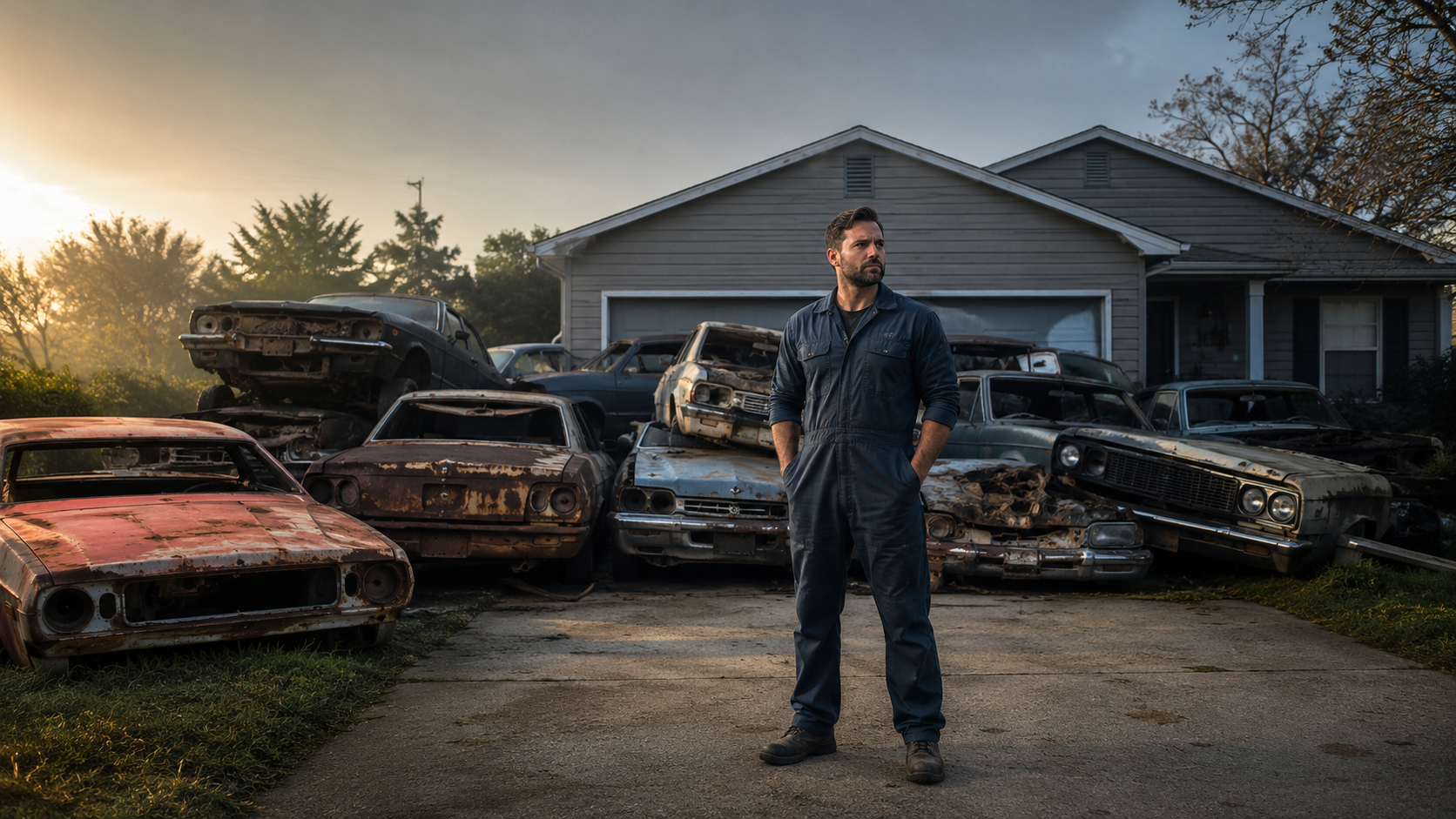
“I want people to understand that quiet people are not empty,” he said. “Sometimes they are just finished explaining themselves to people who refused to listen.”
That clip traveled farther than anything else.
Not because Micah was dramatic.
Because he was not.
The investigations lasted months. Harrow Automotive’s problems spread like rust under fresh paint. Regulators found title irregularities, improper disclosures, and patterns of misrepresentation. Customers filed claims. Two managers cooperated. Leah turned over the original records and resigned before Celeste could fire her. Later, she testified that Celeste had personally ordered the Alder Road delivery.
Celeste tried blaming subordinates.
It failed.
Her fourth dealership collapsed first. Then one lender withdrew. Then another. Inventory financing tightened. Customers avoided Harrow lots. Sales dropped. The empire did not explode in a single fireball. It lost oxygen slowly, one room at a time.
Meanwhile, Micah did something nobody expected.
He fixed the cars.
Not all of them. Some were too damaged and became evidence, then scrap. But six had enough value to become something else. With Theo, volunteers from the garage, and June supervising from a folding chair with a clipboard, Micah turned the junkers into training projects.
The red pickup became the first rebuild.
A former Army mechanic named Darius learned brake systems on it. A young mother named Lena learned diagnostics. A laid-off factory worker named Paul learned emissions repair. June labeled parts with masking tape and corrected grown adults when they misplaced sockets.
“What is she, the boss?” Darius asked one Saturday.
Micah glanced at June, who was frowning at a torque wrench.
“Assistant boss.”
June looked up.
“Temporary.”
By spring, the old warehouse near Alder Road had become the Vale Repair and Diagnostics Center. Not because Celeste agreed willingly, but because settlement became her only realistic alternative after regulators closed in. Her insurers pushed. Her lenders pushed harder. Her attorney finally told her the truth nobody in her company had dared say.
“You are not negotiating from strength anymore.”
The final settlement amount remained confidential, but everyone in Briar Glen knew the visible terms.
Celeste issued a public apology.
She stood behind a podium, dressed in black, with cameras in front of her and Micah standing off to the side beside Vivian. Her voice was controlled, but not victorious.
“Harrow Automotive acted improperly in delivering vehicles to Mr. Micah Vale’s property without consent. The action was unacceptable. I apologize to Mr. Vale, his daughter, and the Briar Glen community.”
It was not heartfelt.
Micah did not require heartfelt.
He required public.
The training center received funding. Affected customers received compensation. Harrow Automotive entered independent monitoring using updated ValeTrace technology. Celeste stepped down as chief executive and remained only a minority owner after restructuring.
Her name stayed on a few signs for a while.
Her control did not.
The day the first class began at the Vale Repair and Diagnostics Center, June insisted on cutting the ribbon. Micah tried explaining that adults usually handled ribbon cuttings. June said adults had caused most of the trouble, so maybe they should stand back.
Nobody argued.
She cut the ribbon with oversized scissors and a serious expression.
The crowd applauded.
Micah stood behind her with his hands in his pockets, overwhelmed in the quiet way grief sometimes changes into purpose when no one is watching. The building smelled of fresh paint, rubber mats, coffee, machine oil, and second chances. Along one wall hung a framed photograph of Elise Vale, smiling beside the original diagnostic prototype in their first garage.
Below the photo was a plaque.
For Elise, who believed repair was a form of truth.
Micah stood in front of it long after everyone left.
Theo found him there.
“She would have liked this,” Theo said.
Micah nodded, unable to speak for a moment.
Then he said, “She would ask why it took me so long.”
Theo laughed softly.
“Also true.”
The center grew faster than anyone expected. Local schools sent students. Veterans’ groups sent applicants. Community colleges asked for partnerships. Insurance companies sponsored diagnostic modules. Small dealerships signed up for compliance training because nobody wanted to become the next Harrow Automotive.
Micah taught the first course himself.
What a Vehicle Tells You Before It Fails.
His teaching style was exactly like his parenting style: quiet, precise, and allergic to nonsense.
“Cars do not lie,” he told the first class. “People lie about cars. Learn the difference.”
June sat in the back doing homework and raising her hand whenever she felt adults were missing the obvious.
Micah always called on her.