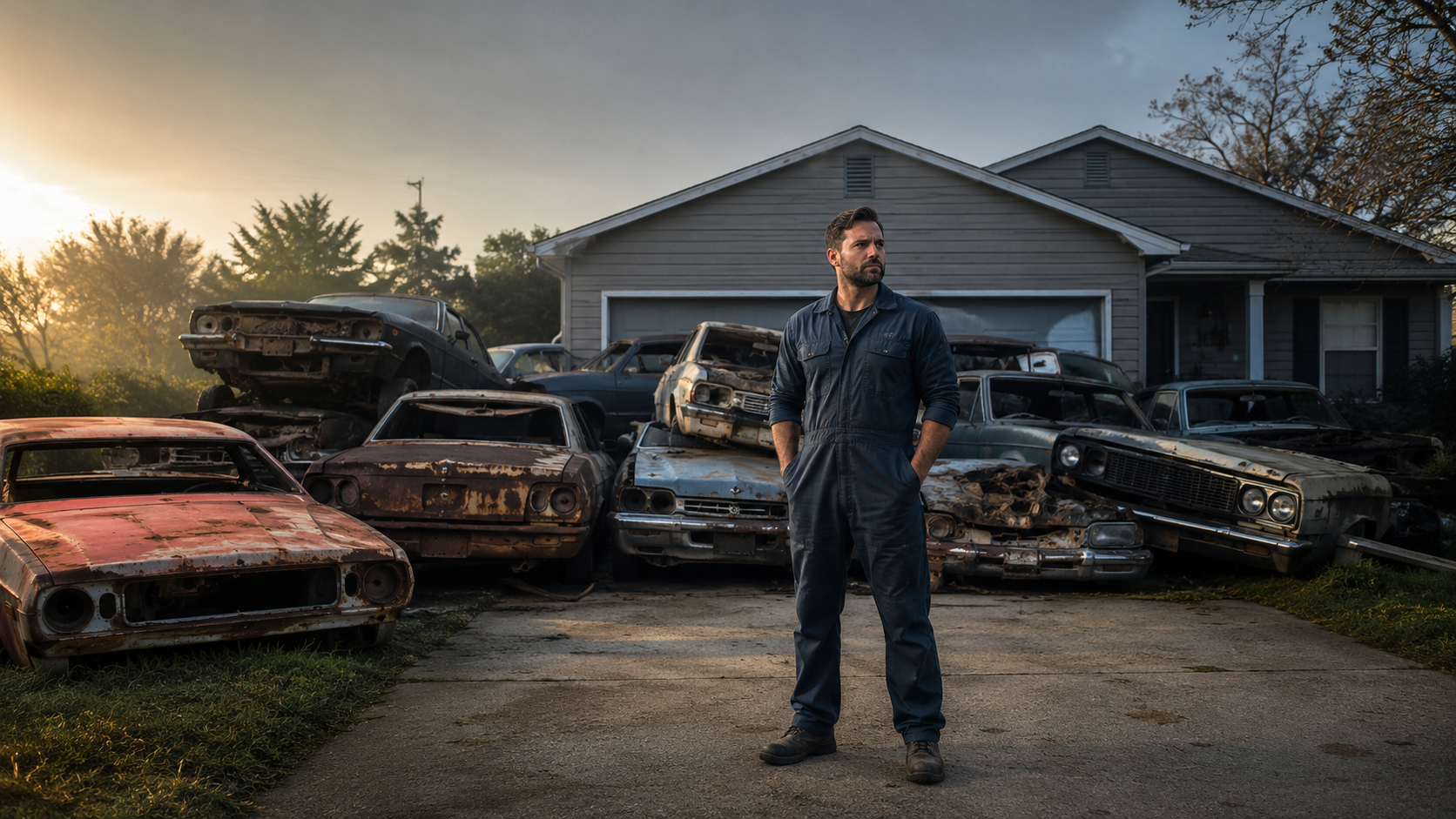
By the end of the first year, the center had placed dozens of graduates in jobs. By the second, it had expanded into compliance auditing and consumer protection training. Micah did not become flashy. He still woke early. He still packed June’s lunch. He still worked with his hands. He still lived in the gray house on Alder Road.
But the town changed around him.
People stopped calling him ordinary as if it meant small.
Celeste watched from a distance.
She had sold two of her three dealerships. Her glass office now belonged to someone else. Leah, once the silent assistant, became operations manager at the Vale center after Micah hired her with one condition.
“No hiding.”
Leah accepted.
Nearly two years after the junk cars appeared, Celeste walked into the training center.
The room went quiet.
Micah was under the hood of a rebuilt truck, explaining sensor data to two students. He looked up, wiped his hands on a rag, and waited.
Celeste looked different. Still elegant. Still controlled. But the polish around her had thinned.
“I wanted to see it,” she said.
Micah said nothing.
She glanced at the tool stations, the students, the repaired cars, the photograph of Elise on the wall.
“You turned my mistake into a monument.”
Micah shook his head.
“No. We turned your cruelty into something useful.”
Celeste flinched slightly.
Leah, watching from across the room, did not look away.
Celeste moved toward Elise’s photograph.
“Your wife?”
“Yes.”
“She was part of ValeTrace?”
Micah’s voice softened.
“She was ValeTrace. I built tools. She built the future around them.”
Celeste nodded slowly.
“I underestimated you.”
“You underestimated everyone who did not look profitable.”
That landed harder.
For once, Celeste did not answer immediately.
Then she reached into her purse and removed an envelope. Leah stiffened, but Celeste placed it on the workbench and stepped back.
“It is a donation,” Celeste said. “Personal. Not Harrow. No press.”
Micah did not touch it.
“Why?”
Celeste looked toward a student helping Lena rotate tires.
“My father started with one garage,” she said. “Then money came, and he forgot what the garage was for. I followed him farther than I should have.”
It was the closest thing to honesty Micah had ever heard from her.
He picked up the envelope and handed it to Leah.
“Put it in the scholarship fund.”
Celeste nodded.
As she turned to leave, June came out of the classroom carrying a stack of papers. She was older now, taller, still serious.
“You are Celeste Harrow,” June said.
Celeste stopped.
“Yes.”
“You made my dad angry.”
“I did.”
“He does not get angry often,” June said. “So that was inefficient.”
Theo coughed near the tool chest to hide a laugh.
Celeste blinked, then gave a small, surprised smile.
“You are probably right.”
“I usually am,” June said, and walked away.
Celeste left quietly.
Micah watched her go and felt no triumph. Triumph was too loud, too brief, too dependent on the person who had tried to hurt you.
What he felt was better.
Distance.
The kind that meant someone no longer controlled the weather inside your life.
Years passed.
The twelve junk cars became legend in Briar Glen. People still pointed at Micah’s driveway when telling visitors the story. The black muscle car, once decorated with a silver ribbon, was restored by the center’s first graduating classes and placed in the lobby. Its paint was deep midnight blue now. Its engine was rebuilt. Its interior was clean. A small plaque stood beside it.
Delivered as an insult. Rebuilt as evidence. Finished as proof.
June hated the plaque at first because she said it sounded dramatic.
Then she turned thirteen and decided drama was acceptable if properly edited.
Micah stayed Micah. He did not buy a mansion, though he could have. He did not buy a luxury truck, though Theo sent him listings every month. He repaired the porch, painted the garage, and replaced the damaged driveway after the legal case ended.
In the wet cement near the edge, June pressed a small wrench.
Beside it, Micah wrote Elise’s initials.
The ValeTrace patents eventually became part of a larger safety compliance platform used across the country. Micah licensed them broadly, but refused to sell outright. He had learned that ownership mattered, not for pride, but for protection. Celeste had reminded him of that in the ugliest way possible.
When June turned sixteen, Micah gave her the keys to the rebuilt muscle car.
She stared at him as if he had lost his mind.
“This is the evidence car,” she said.
“It is also very safe now.”
“It has too much history.”
“So do we.”
June ran one hand across the hood.
“Mom would have liked it?”
Micah smiled.
“Your mom would have driven it too fast just to scare me.”
June laughed, then cried, then hugged him with the sudden force of a child who was not fully a child anymore.