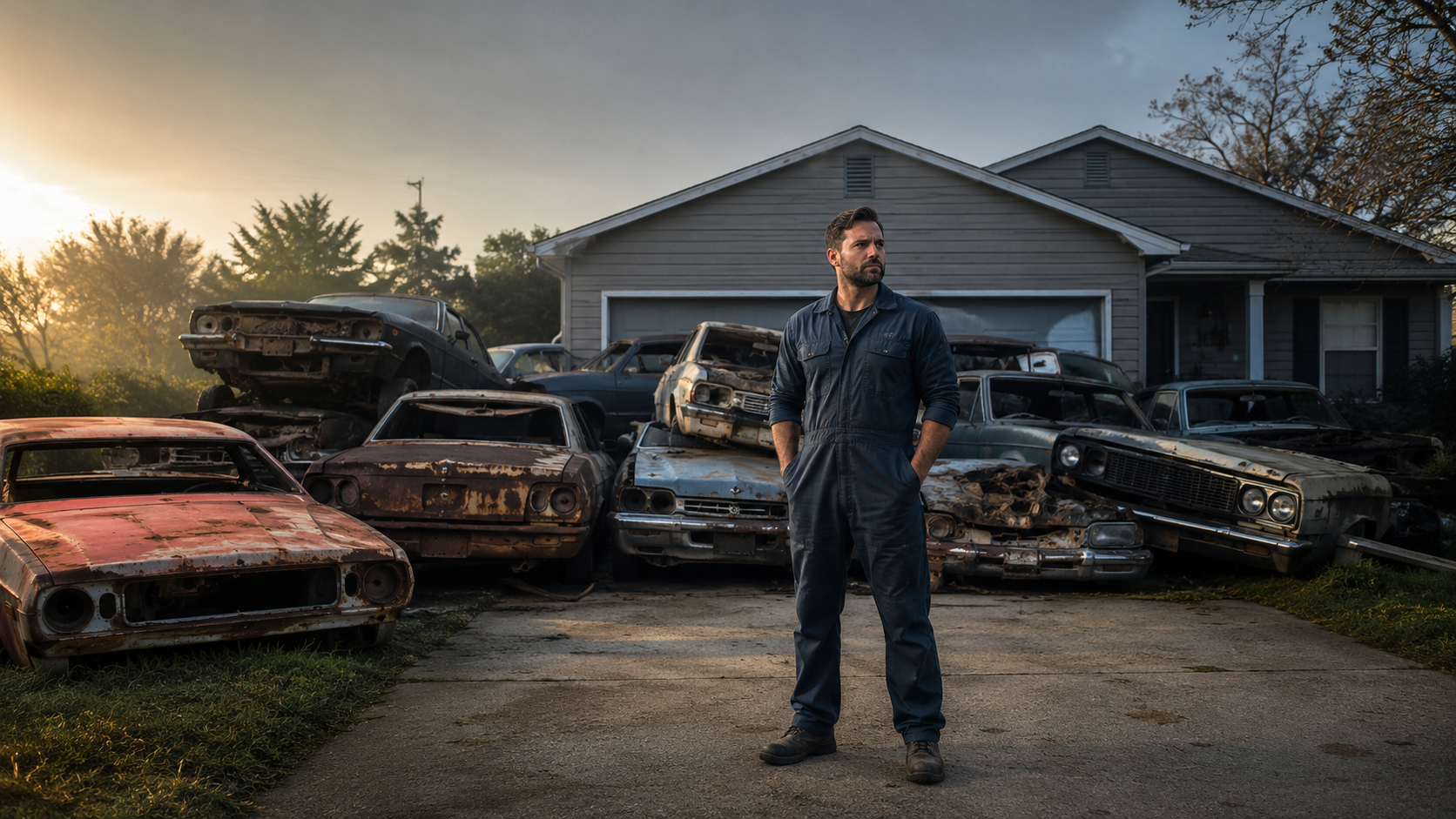
He had built the first prototype in a rented garage.
His wife, Elise, had turned it into a company.
Elise had been the one who understood that a broken machine could still tell the truth if someone knew how to listen. She built contracts, licensing agreements, investor decks, legal protections, and the future Micah had never been brave enough to imagine for himself.
Then she died in a highway crash when June was still a baby, returning from a patent mediation meeting that should never have taken place in bad weather.
After that, Micah walked away from the company.
Not completely. He kept the patents in a trust. He kept control of the core diagnostic framework. He allowed license payments to pass quietly through lawyers and accountants. But he left the boardrooms, the interviews, the conferences, and the industry that had swallowed the last years of his wife’s life.
He moved to Briar Glen and became ordinary on purpose.
People misunderstood quiet men.
They thought quiet meant weak.
They thought grief meant finished.
They thought a small house meant a small life.
Celeste Harrow had made all three mistakes.
The next morning, June found her father at the kitchen table surrounded by printed reports, vehicle records, photographs, and legal pads covered in notes. His eyes were tired, but his hands were steady.
“Did you fix them?” she asked.
“Not yet.”
“Can you?”
“Some.”
“Should you?”
Micah looked at her and smiled.
“That,” he said, “is the best question anyone has asked.”
June poured cereal into a bowl with serious concentration.
“If someone gives you garbage to be mean, is it still garbage?”
Micah looked out the window at the twelve vehicles.
“Depends who opens the hood.”
At nine fifteen, Micah walked into the office of Vivian Cross, a former state prosecutor who now worked above a pharmacy downtown. Vivian was in her sixties, wore red glasses, and had the kind of calm that made louder people nervous.
“You are the man with the cars,” she said.
“Yes, ma’am.”
“Harrow Automotive?”
“Yes.”
Vivian sighed. “Of course.”
Micah placed a folder on her desk.
“I need to protect my property. I also need these vehicles preserved before anyone moves them.”
Vivian opened the folder.
For five minutes, she said nothing.
Then ten.
At fifteen, she removed her glasses and looked at him.
“Mr. Vale, why does a garage mechanic have documentation that looks like a national compliance audit?”
Micah sat quietly.
Vivian waited.
Finally, he said, “Because I used to be ValeTrace Systems.”
Vivian’s expression changed.
The name meant something to her.
It did not mean much to most people in Briar Glen, but Vivian had prosecuted enough fraud cases to know the platform. ValeTrace was the technology behind several vehicle-history, salvage-verification, and compliance-tracking systems used across the industry.
“You are that Vale?” she asked.
Micah nodded once.
“I thought ValeTrace was sold.”
“Licensed,” Micah said. “Not sold.”
“To whom?”
“Several companies. Including one vendor that supplies Harrow Automotive’s inventory and compliance software.”
Vivian leaned back slowly.
“Celeste Harrow dumped twelve questionable vehicles on the property of the man who owns the diagnostic patent behind the system she uses to legitimize her inventory?”
“Yes.”
Vivian smiled.
It was not a friendly smile.
It was the smile of a lawyer who had just found a locked door with the key already in her hand.
“Well,” she said. “That was generous of her.”
By that afternoon, Vivian had filed a police report, contacted code enforcement before Celeste could weaponize it, issued preservation notices to Harrow Automotive, and arranged for an independent examiner to inspect the vehicles. She also demanded every record connected to the twelve cars: title histories, customer complaints, inspection reports, repair orders, auction transfers, emissions certificates, internal emails, and delivery instructions.
Celeste received the letter at 4:37 p.m.
Leah watched her read it.
The smile disappeared from Celeste’s face one line at a time.
“Who is Vivian Cross?” Celeste asked.
“A local attorney,” Leah said.
“Why is she asking for vehicle histories?”
Leah swallowed.
“Because you delivered the vehicles to Mr. Vale.”
Celeste looked up slowly. “Be careful with your tone.”
Leah lowered her eyes.
For the first time in two years, she heard uncertainty enter Celeste Harrow’s voice when Celeste called the company’s general counsel.
By Friday, Micah’s driveway had become the most famous place in Briar Glen.
At first, people came to stare. Some still laughed. Then they saw Micah working. He documented each vehicle with the patience of a surgeon and the suspicion of a detective. He tagged components, photographed hidden damage, logged corrosion, checked VINs against records, and built a timeline that grew uglier by the hour.