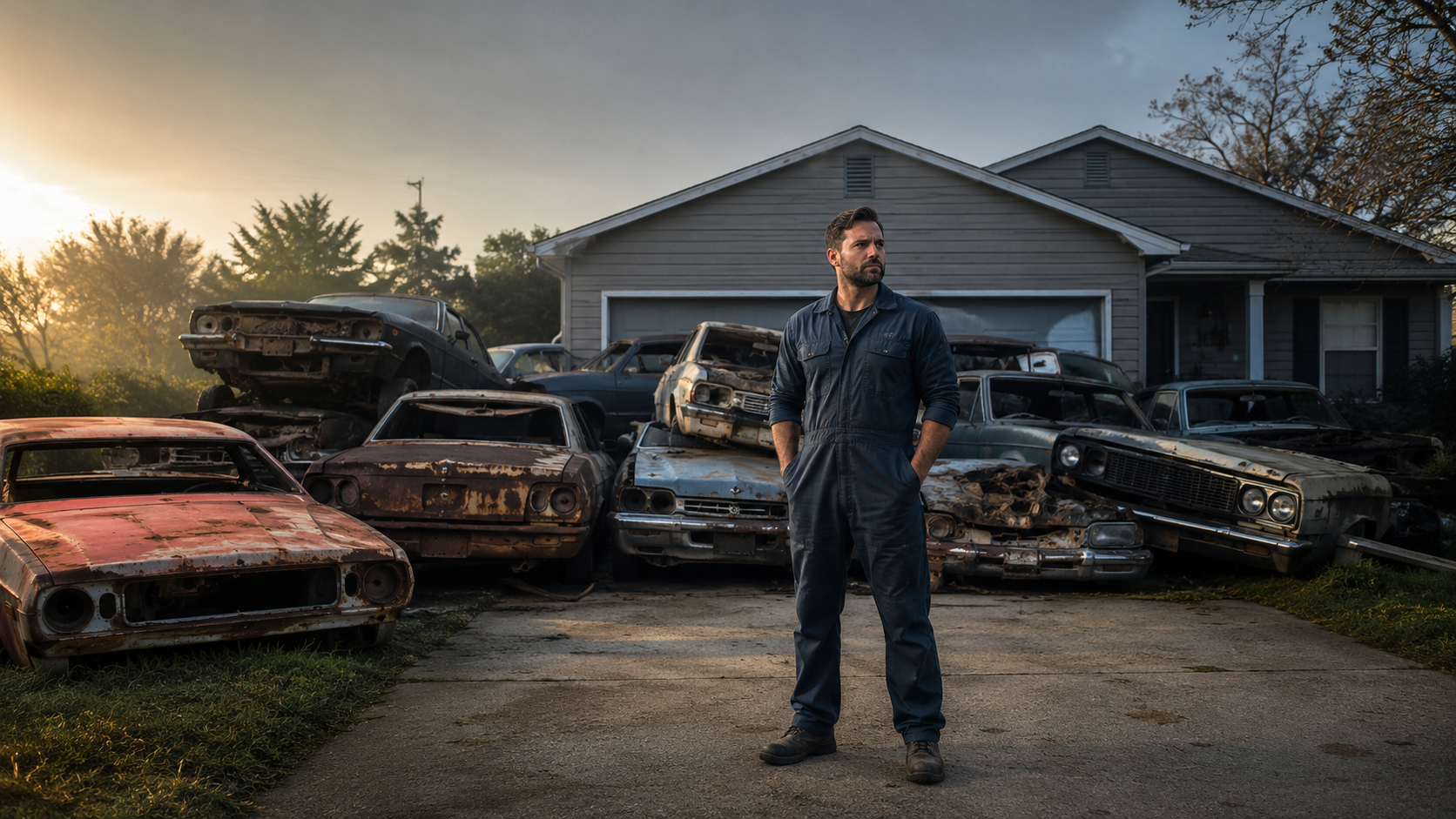
June saw them first.
She had come downstairs with one sock on and one sock in her hand, heading toward the kitchen where Micah was making scrambled eggs. She stopped at the window.
“Dad?”
Micah turned from the stove. “What is it, Bug?”
June did not answer. She pointed outside.
Micah walked to the window with the spatula still in his hand.
For several seconds, he said nothing.
There were cars everywhere.
A red pickup with no doors. A green minivan with duct tape over the rear window. A silver sedan sitting crooked on a spare tire. Two SUVs with mud lines still visible inside the cabin. A white delivery van with cracked glass. The black muscle car shell with the silver ribbon shining on it like a joke told by someone who had mistaken cruelty for wit.
Their neighbor, Theo Bennett, came jogging across the street before Micah had even opened the front door.
“Micah,” Theo said, stopping near the curb. “What in God’s name happened?”
June stepped onto the porch behind her father, wearing her backpack and holding a piece of toast.
“Are those ours?” she asked.
Micah looked at the cars, then at the ribbon, then down the street where a woman had already lifted her phone to record.
“No,” he said. “Not yet.”
Theo stared at him. “What does that mean?”
Micah did not answer.
A cream-colored envelope had been taped to the windshield of the black muscle car. Micah walked over, pulled it free, and opened it. Inside was a typed note on Harrow Automotive letterhead.
Complimentary salvage opportunity. Since Mr. Vale seems so attached to old property, we thought he might enjoy more of it. Storage responsibility transfers upon delivery. Best wishes.
There was no signature.
There did not need to be.
Theo swore under his breath. “Celeste Harrow did this.”
June looked up at her father. “Is this because you told her no?”
Micah folded the letter carefully and slid it into his jacket pocket.
“Most likely.”
“Are we in trouble?”
He looked down at her, and the hardness in his eyes softened.
“No, Bug. We are inconvenient.”
June thought about that. “Is inconvenient bad?”
“For some people,” Micah said. “It is terrifying.”
By eight o’clock, half of Alder Road had come outside. Some people looked sorry for him. Some looked entertained. A teenager filmed the mess and uploaded it before breakfast with a laughing comment about Micah opening a junkyard overnight.
By noon, the video had spread through Briar Glen.
By three in the afternoon, Celeste Harrow watched it from her office, smiling as the comments rolled in.
Guess he should have sold.
Harrow always gets what she wants.
That mechanic is finished.
Celeste set the phone down.
“Give him a few days,” she told one of her managers. “Pride becomes expensive when everyone can see it.”
Leah stood near the door and felt sick.
But Micah did not give Celeste a few days.
He gave her one night.
After June fell asleep, Micah opened the garage and switched on the fluorescent lights. Theo came over with coffee, expecting to find rage or panic or a plan involving the sheriff. Instead, he found Micah kneeling beside the black muscle car, shining a flashlight into the empty engine bay.
“You need a lawyer,” Theo said.
“I know.”
“You also need every tow company in the county.”
“Maybe.”
Theo frowned. “Maybe? Micah, they dumped twelve dead cars on your property.”
Micah ran one hand along the rusted frame of the muscle car, then smiled without humor.
“No,” he said. “They delivered twelve pieces of evidence to my front door.”
Theo blinked. “Evidence of what?”
Micah stood slowly.
“That depends on how stupid they were.”
He started with the flood-damaged SUVs. By midnight, he had photographed VIN plates, title stickers, odometer readings, airbag modules, corrosion marks, cracked seals, repair labels, and hidden wiring damage. By two in the morning, he had matched one SUV to a customer complaint buried in a public arbitration record. By three, he found a second vehicle that had been sold as certified despite signs of flood exposure. By four, he found a pickup whose emissions components had been modified in a way that should never have passed inspection.
Theo watched him move from car to car with calm precision.
“How do you know where to look?” Theo asked.
Micah looked up from beneath the hood of the minivan.
“Because I designed the system they are pretending to follow.”
Theo lowered his coffee cup.
“What system?”
Micah did not answer right away.
For fifteen years, Micah Vale had allowed Briar Glen to believe he was simply a mechanic. It was not a lie exactly. He was a mechanic. But it was not the whole truth.
Before Briar Glen, before the gray house on Alder Road, before school lunches and quiet mornings and the small garage where he worked for hourly pay, Micah had been the founder of ValeTrace Systems, a vehicle diagnostics and salvage-chain verification platform used by insurers, auction houses, lenders, and compliance auditors across the country.