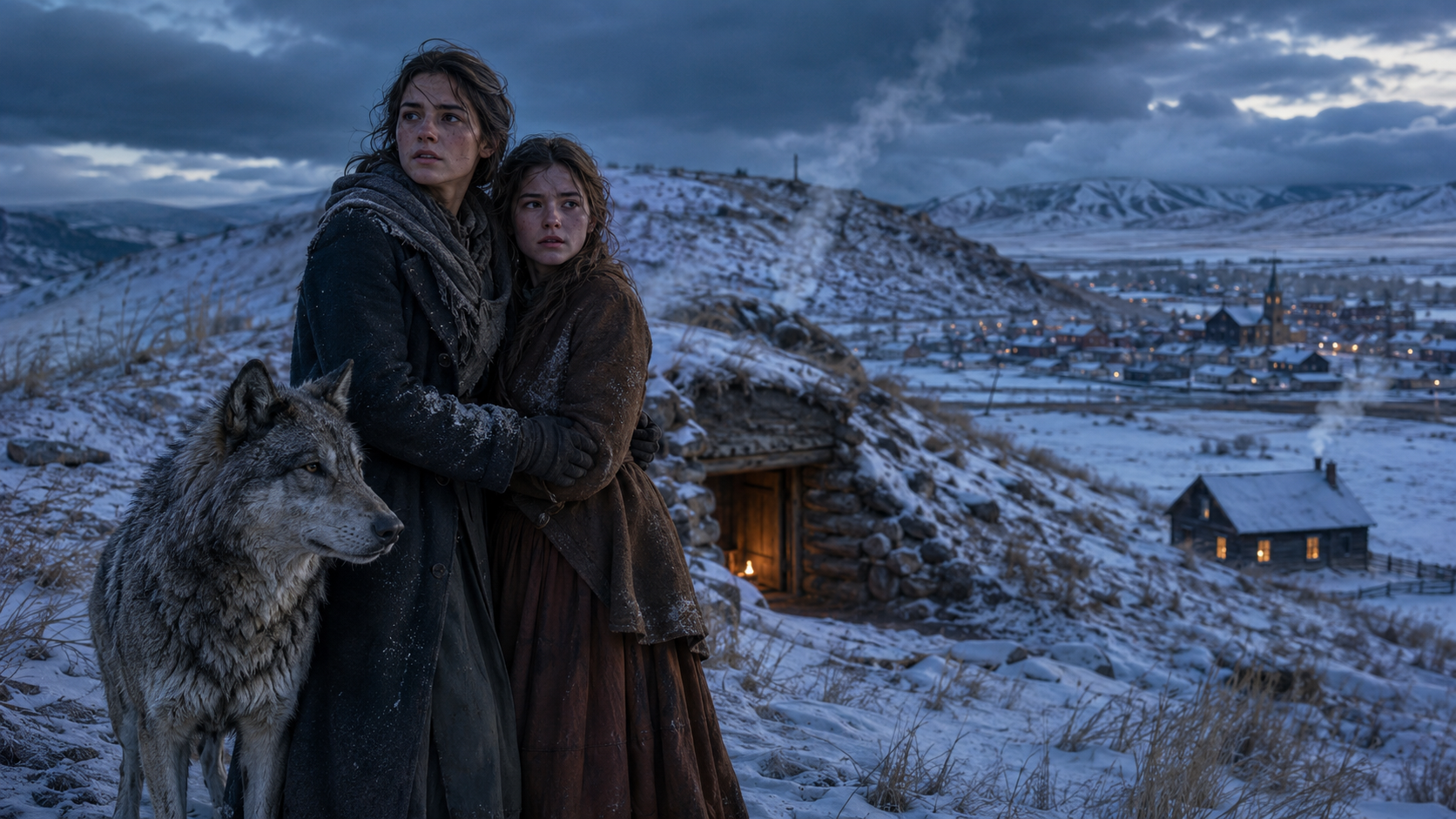
That reached where anger could not.
Lottie wiped her face with her sleeve, cursed, and lifted the bar.
They opened the door.
Snow exploded inward.
Jonah and Maren dragged Cora first. She collapsed over the threshold, lips blue, hair frozen white at the edges. Lottie hauled Reverend Morrow by his coat. Dr. Reed shoved Thatcher Bell through next. Hiram Pike crawled in on his hands and knees. Owen Bell came after, crying from pain, one ear white with frostbite.
More arrived.
Not all.
But enough.
By midnight, thirty people crowded the earth house they had mocked.
By morning, Maren and Jonah had tied ropes around their waists and gone into the storm to pull in anyone close enough to save. Bram found two children under an overturned wagon board and barked until Lottie dug them free with bleeding hands. Dr. Reed worked without sleeping. Tamsin Rook, found half-buried near the creek road, took over boiling water the moment her fingers could bend.
For eight days, the blizzard held Coldwater Crossing prisoner.
The earth house was too small for dignity. That was the first thing the town lost.
Men who had laughed at Maren slept on her floor. Women who had whispered against Lottie took broth from her hands. Children huddled under the sisters’ blankets while Bram moved among them like a gray guardian.
Maren organized everything because no one else could think clearly.
Children nearest the stove. Elderly along the back wall. The sick where Dr. Reed could reach them. Able-bodied adults in shifts: melt snow, feed fire, clear tunnel, ration food, check frostbite, hold the rope line.
No one ate enough.
Everyone ate.
The chimney drew. The walls held. The roof did not break.
On the fourth night, little Nell Pike began crying because her hands hurt as they thawed. Bram lowered his huge head into her lap.
“Is he a wolf?” she whispered.
Lottie handed the child a cup of broth.
“Only when necessary.”
Several adults looked away.
On the sixth night, Clerk Pritchard’s fever rose.
Fever has a strange loyalty to truth. It digs under manners. It opens locked drawers in the mind.
Maren was sitting beside Abram when she heard her father’s name.
Pritchard tossed beneath a blanket near the stove.
“Elias wouldn’t sign,” he muttered. “Wouldn’t do it. Said the girls kept the house. Said Cora had enough.”
Maren turned slowly.
The room quieted.
Pritchard’s eyes were open but seeing another place.
“She pressed his hand to the pen. I guided it. He was nearly gone. Maybe already gone. Morrow signed because Thatcher said it was settled. Thatcher said land troubles scare buyers. Clean papers. Clean town.”
Cora pushed herself upright against the wall.
“He’s fevered.”
Pritchard began to cry.
“You paid me.”
Cora’s face went white.
“You lying coward.”
“You paid me with Elias’s money. Said if the south hill ever proved useful, I’d have a share for keeping quiet.”
A gasp moved through the shelter.
Maren looked at Cora.
“You knew about Mother’s land.”
Cora’s mouth trembled, then hardened.
“Your father was going to leave me scraps.”
Abram’s voice came weak but sharp from the bed.
“He was going to leave you a widow’s portion. Not their lives.”
Cora’s eyes burned.
“I married into a house haunted by a dead woman. Her dishes. Her quilts. Her daughters staring at me like I was dirt on the floor. I worked. I smiled. I waited. And when Elias died, I chose not to be cast aside.”
Maren stared at her.
“So you cast us out first.”
“I survived.”
Lottie stood so fast Jonah caught her arm.
“You call this surviving?”
Cora looked around the packed room: the townspeople she had gathered to witness the sisters’ humiliation, now witnessing hers.
The truth did not explode.
It settled.
That was worse.
Cora had forged the paper. Pritchard had filed it. Thatcher Bell had known enough to keep quiet because a railroad man had once asked questions about the south ridge. Reverend Morrow had signed without seeing Elias alive because rules were easier than doubt. Others had suspected and chosen silence because two orphan girls were a small price for peace.
Coldwater Crossing had not merely failed the Vale sisters.
It had spent them.
Thatcher Bell stood slowly. Frostbite had made his face gray and old.
“I knew the paper was wrong,” he said.
No one moved.
“I told myself it was not my affair. I told myself girls need authority. I told myself Cora would keep the farm working and the town steady. Truth is, I kept quiet because a clean document kept business simple.”
Maren said nothing.
Thatcher removed his hat though there was no room for ceremony.
“If I live through this, I will testify.”
Lottie’s voice was cold.
“And that makes you noble?”
“No,” Thatcher said. “It makes me late.”
Reverend Morrow covered his face.
Jonah looked at his father. “You signed it.”
The reverend’s voice broke.