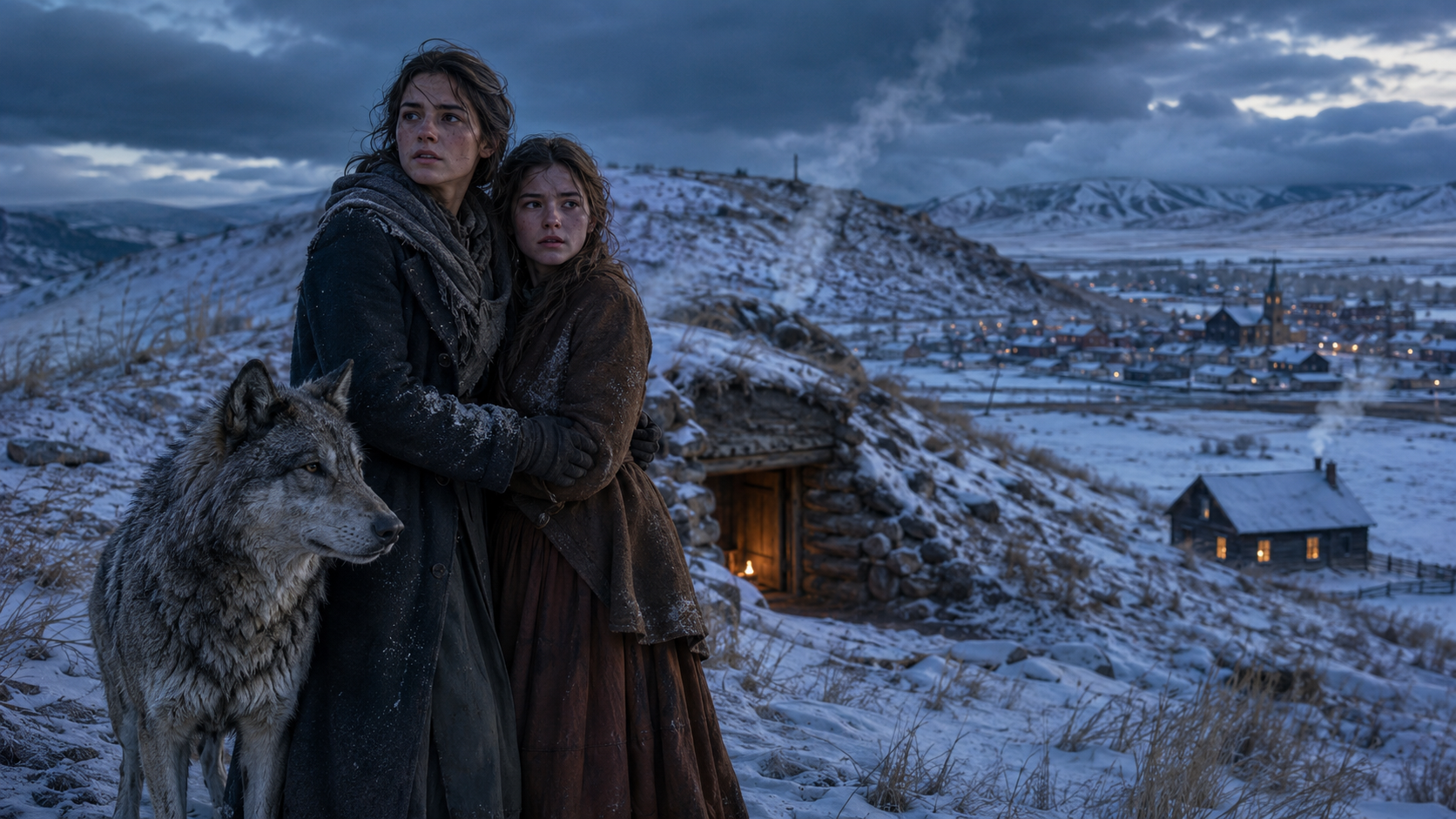
His nephew, Owen Bell, leaned against the pickle barrel and grinned.
“Maybe the dog can dig them a den.”
Bram growled.
Owen’s grin died.
Maren kept her voice level. “We are asking for work.”
Thatcher tapped ash from his pipe. “What you’re asking for is trouble. Cora Whitlock showed me that paper this morning. Proper seal. Proper witness. You start calling folk forgers, and next time you won’t be asking for work. You’ll be asking a judge for mercy.”
A woman buying needles would not meet Maren’s eyes. A ranch hand stared at the floor. The clerk pretended to count nails.
By sundown, all of Coldwater Crossing knew the Vale girls had been put out.
By nightfall, all of Coldwater Crossing had decided that knowing was enough.
Their last hope lived beyond the east creek.
Grandfather Abram Keene had been born in Pennsylvania coal country and carried the mines in his lungs. Every breath whistled faintly. His back had a permanent bend from years of low tunnels and lower wages. He owned little: a narrow cabin, a rusted stove, a mule too stubborn to die, and thirty acres of rough hillside south of town that no farmer had ever wanted.
But he opened his door before Maren knocked.
“Took longer than I expected,” he said, looking past them into the snow. “That woman finally showed her teeth?”
Lottie ran into him first.
Abram held her with one arm and reached for Maren with the other.
For one night, he asked no questions.
He fed them beans and coffee. He gave Bram scraps. He let Lottie cry into a quilt that smelled of cedar smoke. Maren sat by the stove and watched the fire until her eyes burned dry.
In the morning, Abram spread old papers across the table.
“This was your mother’s,” he said.
Maren leaned closer.
A deed. Yellowed at the edges. Written in ink faded brown with years.
“South slope of Broken Antler Hill,” Abram said. “Thirty acres. Your mother’s land before she married Elias. He never worked it because stone eats the plow up there. Cora likely doesn’t know about it. Pritchard might, but he won’t care unless there’s profit in it.”
Lottie rubbed her swollen cheek. “What are we supposed to do with a hill?”
Abram’s eyes warmed with the faintest humor.
“Burrow into it.”
The sisters stared.
“A house?” Maren asked.
“A good one,” Abram said. “Better than most board houses in a Montana winter, if you build it right.”
He took a charred stick from the stove and drew on the tabletop: a slope, a cut beneath it, a door turned south, a smoke pipe hidden among stones, drainage lines, timber bracing, packed clay, sod roof.
“When I was young,” he said, “miners knew the earth better than preachers know scripture. Down deep, weather loses its temper. Cold can rage above you, but earth keeps its own mind. You dig in, brace well, keep water out, and you can live where the wind can’t find your bones.”
Lottie’s eyes sharpened.
“Could people see it?”
“Not if we choose the fold carefully.”
Maren understood then. “You mean hide.”
Abram’s face grew serious.
“I mean survive. Hiding is what you do when you have no plan. Surviving is what you do until the truth has teeth.”
They began two days later.
Broken Antler Hill looked useless from the road. Dry grass, scattered stones, sagebrush, and a crease in the slope where spring runoff had cut a shallow scar. But Abram walked it like he was reading a book. He marked a spot between two ribs of rock where the land folded inward and the entrance could be hidden by shadow.
“Fourteen feet wide,” he told them. “Twenty-three deep. Seven high. Don’t cheat height. A girl who has been pushed low by people ought to stand straight in her own home.”
So they dug.
The work was brutal.
Maren swung the pick until her hands blistered, split, bled, hardened, and split again. Lottie hauled dirt in a sled. Bram learned to pull a rope tied to a wooden drag, though sometimes he forgot the purpose and tried to chase jackrabbits while still harnessed. Abram sat wrapped in blankets on a stump, coughing into a cloth, correcting them whenever the angle was wrong.
“Drainage first,” he said. “A dry shelter is a living shelter.”
“Beam thicker,” he said. “Snow is quiet until it becomes heavy.”
“Door lower than pride, higher than flood.”
At night, the sisters returned to Abram’s cabin too tired to hate anyone.
That became a kind of mercy.
Hatred needed energy. Digging took all of it.
By late November, the hole had become a chamber. By the first week of December, it had a timbered roof. By the second, it had clay-packed walls and a narrow stove salvaged from an abandoned line camp. Abram showed them how to set the stovepipe through stone so smoke would emerge thin and broken, mistaken for ground mist if a person was not watching closely.
Coldwater Crossing heard about them anyway.
A cattleman named Hiram Pike saw fresh dirt near the hill and carried the story back to Thatcher Bell’s store.