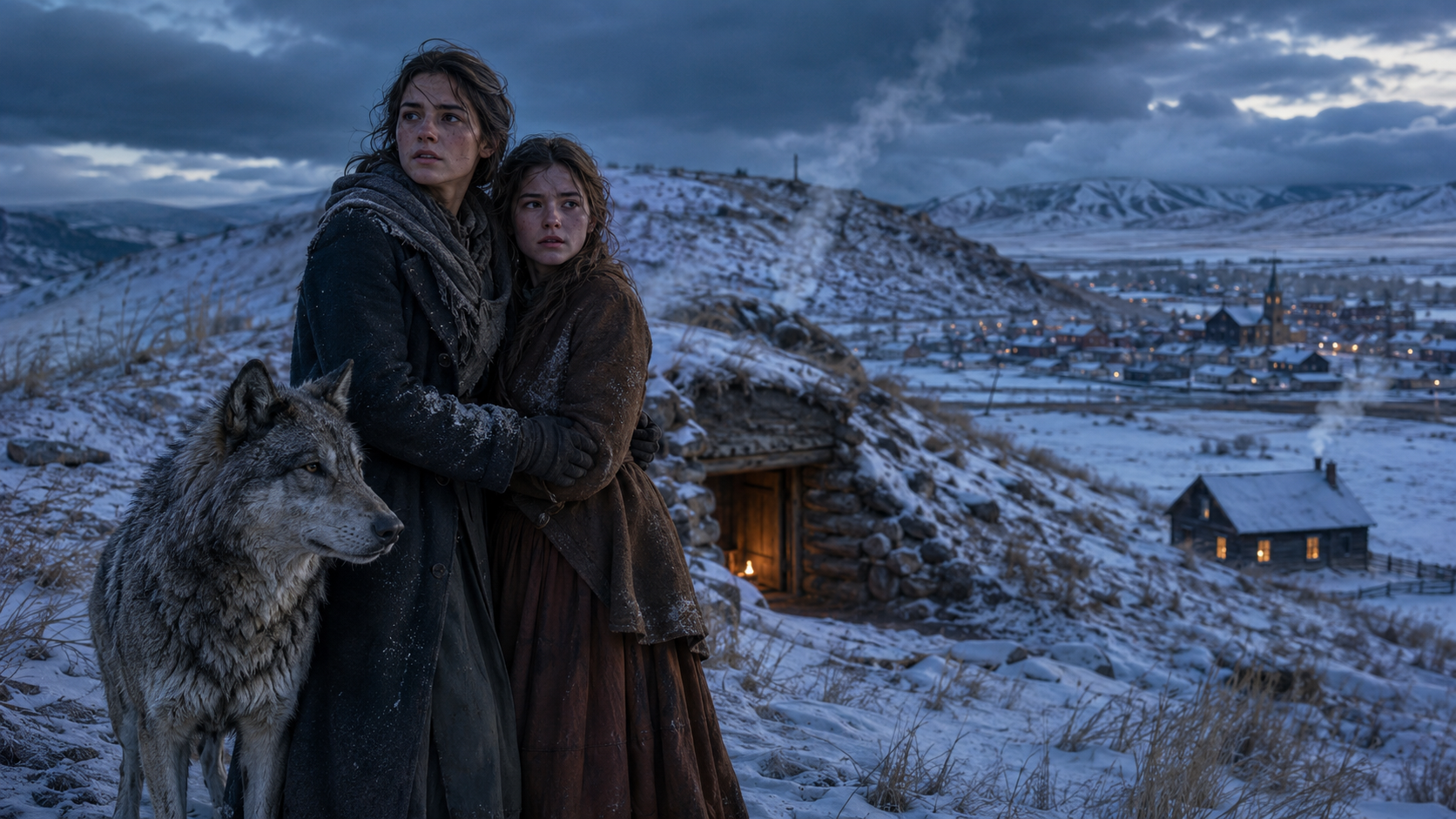
“Those Vale girls are living like foxes,” he announced. “Dug themselves into a bank like animals.”
Owen Bell laughed. “They’ll be dead by Christmas.”
Men laughed because it was easier than wondering whether two girls had built something they could not.
Then the smoke appeared.
The first morning it rose, Maren was boiling coffee inside the earth house. The stove breathed softly. The clay walls held warmth. A square of oiled muslin over the small window glowed amber with sunrise.
Outside, thin gray smoke slipped from between stones above the roof and vanished into the cold.
A boy driving cattle saw it.
By noon, the town had a story.
By evening, it had a name.
Ghost smoke.
Thatcher Bell rode out with two men to find the entrance. They walked over the hillside for an hour and found nothing but grass, stone, and Bram’s paw prints leading in circles because Lottie had trained him well.
The next morning, smoke rose again.
That irritated the town more than silence ever could.
Because every gray thread climbing from Broken Antler Hill said the same thing:
The Vale girls had not died.
Not only had they not died — they were warm.
The first person to find the hidden entrance came in the form of a young man Maren did not trust.
Jonah Morrow, the reverend’s son, appeared at dusk with his hands raised and a bundle beneath one arm.
Maren had been carrying kindling when he stepped from behind the rocks.
“Don’t scream,” he said.
She drew the knife.
Bram appeared beside her like a storm with teeth.
Jonah swallowed. “I deserved that.”
“What do you want?”
“I brought glass.”
Maren did not lower the knife.
“For what?”
“For a proper window.”
“We don’t have one.”
“You could.”
He laid the bundle on the ground and backed away. Inside were three panes wrapped in burlap, chipped but whole.
Maren stared at them.
“Your father told us to crawl back to Cora.”
“I know.”
“Your father called us rebellious.”
“I know that too.”
“Then why are you here?”
Jonah looked toward town, where faint yellow lights trembled in the dark.
“Because my father knows rules better than mercy. Because I watched you and Lottie haul beams in sleet while men twice your size mocked you from a stove. Because when I saw the smoke, I thought I’d find desperation. Instead, I found a home built with more sense than anything in Coldwater Crossing.”
Maren did not know what to do with kindness when it arrived wearing the face of someone who had stood by while she suffered.
So she said, “Leave it there.”
Jonah nodded.
“I won’t tell.”
“Why should I believe you?”
“Don’t,” he said. “Just watch what I do.”
He left.
The glass stayed.
That was how help began: not as a parade, not as apology, but as small things left near the entrance at dusk.
A sack of beans from someone who did not sign her name.
Lamp oil.
A spool of wire.
A coil of rope.
A jar of goose fat to seal cracks.
Mrs. Tamsin Rook, the midwife, came openly one morning and ducked through the hidden door with a satisfied grunt.
“Well,” she said, looking around the warm room, the shelves, the stove, the table made from scrap planks, “I’ll be damned.”
Lottie raised an eyebrow.
“Ma’am?”
“I said what I said.” Tamsin tapped the packed wall. “My grandmother slept in a dugout in Kansas. Summer cool, winter steady. Folks get a few glass windows and think old ways are stupidity. Then weather comes and teaches school.”
She stayed for tea and left three blankets.
Dr. Ansel Reed came next under the excuse of looking for grouse. He listened to Abram’s chest, frowned, and stepped outside with Maren.
“He’s worse than he admits,” the doctor said.
Maren looked back through the doorway. Abram was showing Lottie how to carve wooden pegs.
“How long?”
Dr. Reed’s face softened.
“Long enough to see what you built. Not long enough for what he deserves.”
In January, Abram moved into the earth house for good.
They brought him by sled after Maren found him on his cabin floor, one hand against his chest, the fire nearly out. He was lighter than she expected. That frightened her more than the cough.
They placed him near the warmest wall. For two days he drifted in and out of fever, calling names from mines and wars and marriages long buried. On the third morning, he woke clear.
He studied the room.
The stove. The window. The walls. The shelves of dried beans, cornmeal, rabbit jerky, onions, potatoes, candles, and spare kindling. The braided rug Lottie had made from old shirts. Bram sleeping at the foot of his bed.
“This is fine work,” Abram whispered.
Maren sat beside him. “Don’t talk like goodbye.”
Abram smiled faintly.
“Girl, everything old men say is part goodbye.”
Lottie turned away.
Abram reached for her hand.
“Don’t spend your whole life sharpening grief,” he said. “A knife is useful. But not if you sleep holding the blade.”