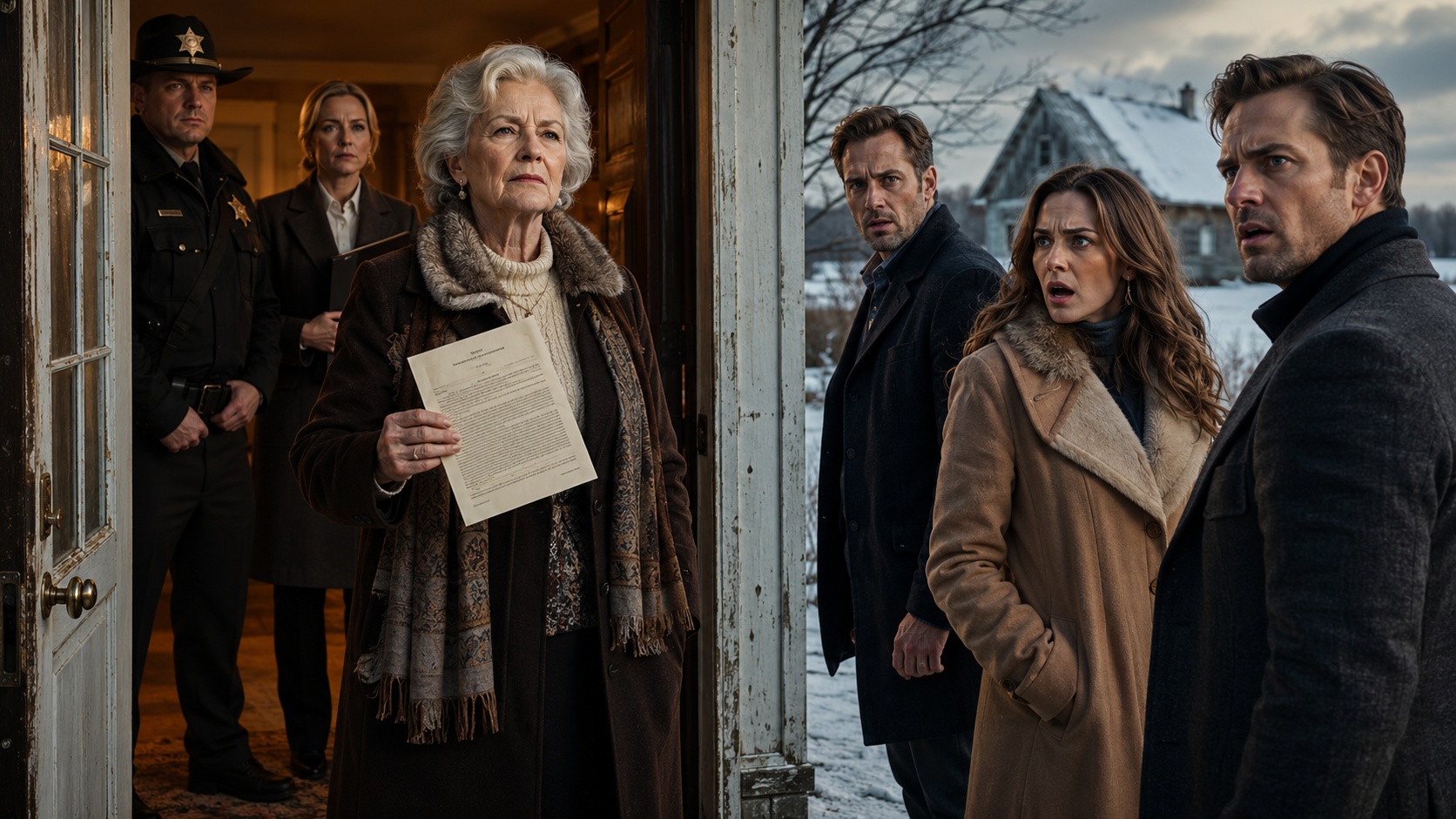
“This is a misunderstanding.”
Attorney Crowe nodded once.
“Good. Then you can explain why the signature was submitted electronically from your office IP address.”
Derek’s face lost color.
Natalie turned toward him fully now.
“Derek?”
He ignored her.
Attorney Crowe continued.
“And why the notary listed on the document has provided a sworn statement that she never witnessed Mrs. Graves sign anything.”
Owen covered his mouth with one hand.
Derek took a step back.
Eleanor had seen him afraid only a few times in his life.
Once when he was twelve and fell through the ice near the pond.
Once when his father collapsed in the barn.
Once at the funeral, when he realized grief could not be delegated.
This fear was different.
This was not fear of loss.
It was fear of consequence.
Derek looked at the sheriff.
“Are you accusing me of something?”
Sheriff Price’s voice was even.
“I’m listening.”
That was worse than an accusation.
It gave Derek space to ruin himself.
Natalie pointed at the document.
“I didn’t know about that.”
Eleanor looked at her.
“No?”
Natalie’s eyes widened. “No.”
Eleanor reached into the box again.
Natalie sat down slowly.
The next page was an email printout.
Eleanor did not read it immediately.
She let Natalie recognize the shape of her own words.
Then she spoke.
“Two weeks ago, you wrote to Derek: If Mom refuses, we may need to establish diminished capacity. Owen can handle the emotional part.”
Owen looked at Natalie as if she had struck him.
“You said I could handle the emotional part?”
Natalie’s face flushed. “That was taken out of context.”
Eleanor gave a small, tired smile.
“Everything cruel is taken out of context once someone reads it aloud.”
Attorney Crowe placed another paper beside it.
“This is a draft petition for guardianship prepared but not filed. It claims Mrs. Graves is confused, financially irresponsible, and vulnerable to outside influence.”
Eleanor leaned back in Henry’s chair.
“Outside influence,” she said. “That means anyone who told me I had the right to say no.”
Derek’s eyes moved rapidly now, searching for the weakest person in the room.
He chose Owen.
“Owen, tell her. Tell her we never meant to hurt her.”
Owen stared at him.
For the first time that morning, he did not obey.
Derek’s voice sharpened.
“Owen.”
Owen looked at his mother.
Eleanor could see the boy he had been, trapped inside the man who had learned to hide behind everyone else’s decisions.
“I’m sorry,” Owen whispered.
Derek exhaled with relief, thinking apology was the beginning of escape.
Then Owen said, “I knew parts of it.”
Natalie closed her eyes.
Derek turned slowly.
“What did you just say?”
Owen’s voice shook, but he kept going.
“I knew Derek was pushing too hard. I knew the deadline wasn’t real. I knew the capacity thing was wrong.”
Eleanor’s chest hurt.
Not because she was surprised.
Because hearing the truth still hurts, even when you have prepared for it.
“Why?” she asked.
Owen looked down.
“Because I owed him money.”
Derek snapped, “Shut up.”
Sheriff Price took one quiet step forward.
Derek stopped.
Owen wiped his face with both hands.
“I owed him money, and he said if the land sold, everything would be fixed. He said Mom would be fine. He said she’d get a condo near town, and we’d all visit more.”
Eleanor laughed softly.
It was not a happy sound.
“You would visit more after selling the only place where you could have visited me for free?”
No one answered.
Because some truths leave no room for defense.
Natalie tried again, but her voice had lost its sharpness.
“Mom, this is ugly, but it can still stay private.”
There it was.
The family’s favorite religion.
Privacy.
Keep the pain private.
Keep the lies private.
Keep the loneliness private.
Protect the family name, which usually meant protect the people who had harmed the family.
Eleanor looked toward the window.
Beyond the glass, the white fields stretched all the way to the tree line. In spring, wildflowers would come up near the fence. In summer, the grass would turn gold and high. In autumn, the maples would burn red behind the barn.
Henry had died in the upstairs bedroom, facing those fields.
Not because the hospital couldn’t keep him longer.
Because he wanted to see home at the end.
Derek wanted to call that land dead money.
Natalie wanted to call it a burden.
Owen wanted to call it a solution.
But Eleanor knew what it was.
It was witness.
It had watched her become a wife, mother, widow, and finally, herself again.
“No,” she said. “It will not stay private.”
Derek’s face tightened.
“You don’t want to do that.”
“I know exactly what I want.”
“No, you don’t. You’re angry.”
“Yes.”
He blinked.
Eleanor stood slowly.