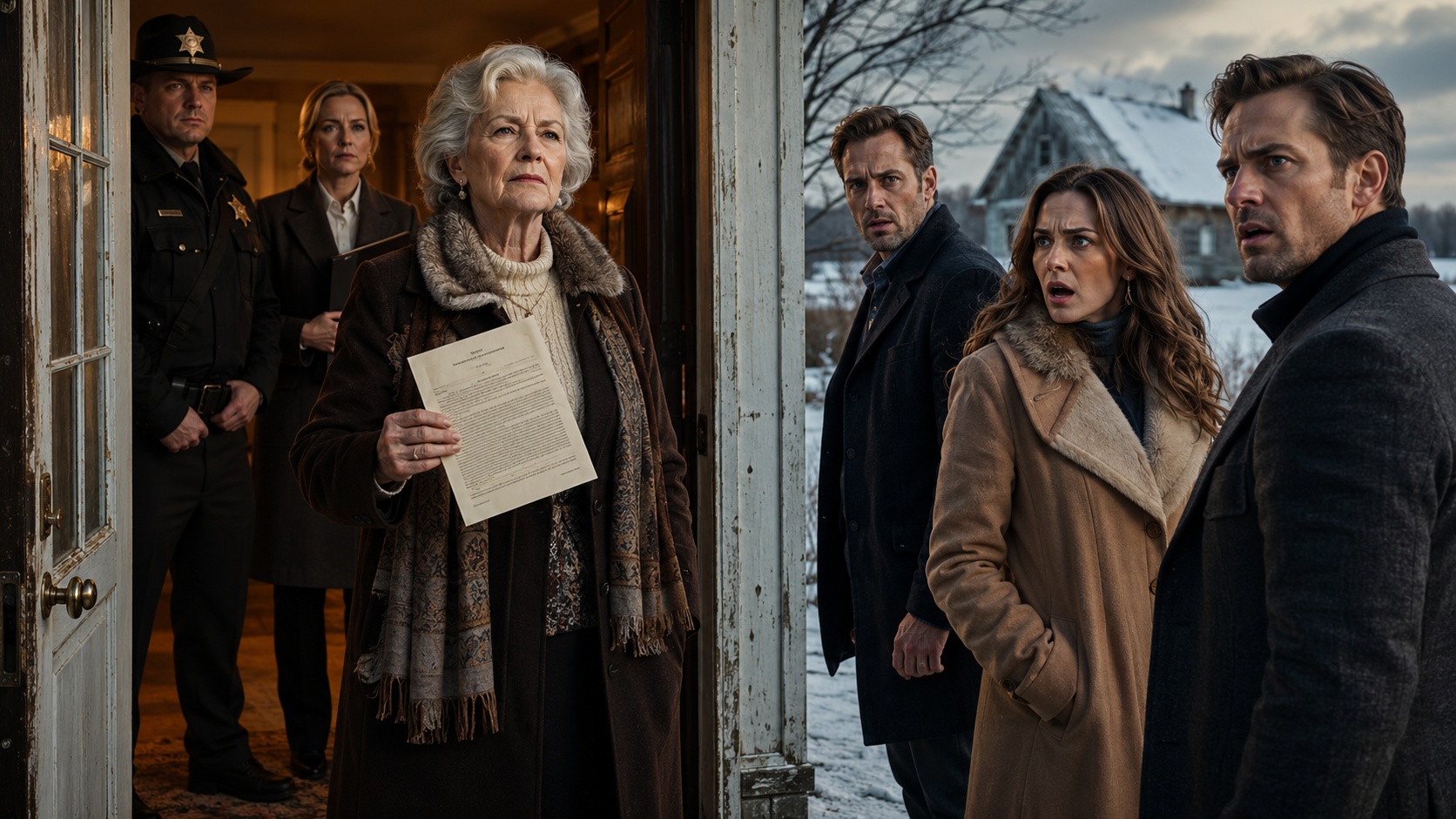
At seventy-one, standing too fast made her hip ache. She stood anyway.
“I am angry because I earned the right to be angry. I am angry because every one of you learned how to sound loving while reaching into my pockets. I am angry because you used your father’s name like a crowbar. I am angry because you mistook my loneliness for stupidity.”
Owen began to cry silently.
Natalie stared at the table.
Derek’s face hardened again because guilt had never been a language he spoke fluently.
“You’re going to destroy your children over paperwork?”
Eleanor looked at the forged signature.
“No. You nearly destroyed your mother over land.”
That sentence did what no accusation had done.
It made Natalie flinch.
Attorney Crowe reached into her folder.
“There is still one remaining matter.”
Derek watched her hand.
He was no longer pretending not to be afraid.
Eleanor lifted a cream-colored envelope from the wooden box.
It was not thick.
It was not dramatic.
Just one envelope.
One document.
Four notarized pages.
A blue ribbon seal.
And the date from three days earlier.
Derek stared at it.
“What is that?”
Eleanor held it for a moment before answering.
She wanted to remember this second.
Not because she enjoyed their fear.
She did not.
That was the terrible part. Even now, part of her still wanted to save them from the consequences of being themselves.
But another part of her, the part Henry had loved most, knew that mercy without boundaries becomes permission.
She placed the document on the table.
“This is the deed restriction and irrevocable land trust agreement for Briar Hill Farm.”
Natalie frowned.
“What does that mean?”
Attorney Crowe answered.
“It means Mrs. Graves has transferred the land into a protected trust. It cannot be sold to HarborStone Development. It cannot be used as collateral for your debts. It cannot be transferred by power of attorney. It cannot be inherited by any beneficiary named in the prior will.”
The words moved through the room like a slow blade.
Derek stared at his mother.
“You did what?”
Eleanor’s voice did not tremble.
“I protected my home.”
Natalie’s face went white.
“You can’t just remove us from everything.”
“I did not remove you from everything,” Eleanor said.
Derek let out a bitter laugh.
“Oh? That’s generous.”
Eleanor looked at him.
“I removed you from anything that required trust.”
That silenced him.
Attorney Crowe continued.
“Upon Mrs. Graves’s death, the farmhouse will become the residence of the Briar Hill Senior Advocacy Foundation. The land will support housing, legal aid, and emergency relocation for elderly people facing financial abuse.”
Owen looked up.
“Foundation?”
Eleanor nodded.
“In your father’s name.”
Derek’s expression changed from fear to rage.
“Dad would never agree to this.”
For the first time that morning, Eleanor’s eyes flashed.
“You do not get to borrow your father’s voice to defend what you did.”
Derek stepped back as if she had slapped him.
She took one step toward him.
“Your father spent forty years building this place. He fixed fences with cracked hands. He drove tractors before sunrise. He came home so tired some nights that he fell asleep at the kitchen table. And do you know what he said to me the last winter he was alive?”
Derek said nothing.
Eleanor’s voice softened, but that made it stronger.
“He said, ‘Promise me you won’t let them turn this place into money before you are done living in it.’”
Natalie looked away.
Owen sobbed once.
Derek’s mouth tightened.
“You’re lying.”
Eleanor smiled sadly.
“I used to wish you were better at it.”
Attorney Crowe placed one more paper beside the trust agreement.
“This is also notice that Mrs. Graves has revoked all previous powers of attorney and medical authorizations naming any of you. She has executed new documents naming an independent fiduciary.”
Natalie gripped the edge of the table.
“An outsider?”
Eleanor looked at her daughter.
“A professional.”
“That’s cold.”
“No,” Eleanor said. “Cold is discussing how to prove your mother incompetent while asking what her land is worth.”
Natalie’s lips trembled.
For the first time, she looked less polished.
Less certain.
Almost young.
And because Eleanor was still a mother, part of her wanted to cross the room and hold her.
But then she remembered Natalie stepping over her loneliness year after year, calling only when there was a crisis, turning every holiday into a negotiation, every favor into an obligation.
Eleanor stayed where she was.
Derek pointed toward the document.
“I’ll contest it.”
Attorney Crowe did not blink.
“You can try.”
“I’ll say she was pressured.”
Sheriff Price looked at him.
“By whom?”
Derek’s jaw worked.