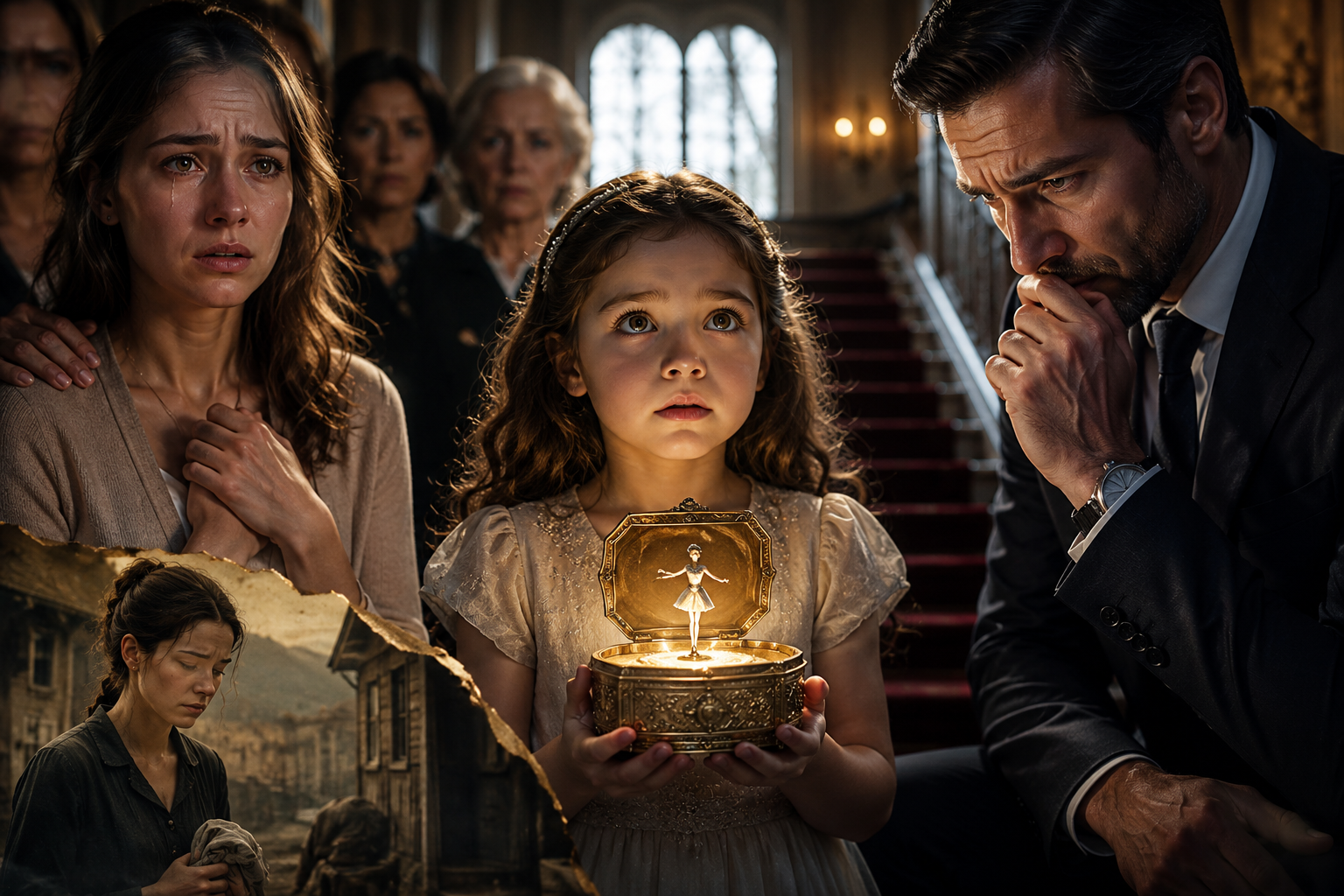
A portion of every sale went to a foundation in Clara’s honor, helping children who had lost parents receive birthday gifts, school supplies, and grief counseling.
Julian asked Lily to choose the foundation’s logo.
She drew a blue flower under a moon.
Thomas cried when he saw it.
On opening day, the line outside the store wrapped around the block.
Parents came with children.
Former employees came with flowers.
Women who had once worked with Clara came to tell stories Thomas had never heard.
One said Clara always kept candy in her drawer for interns.
Another said Clara fixed a broken toy for her son during a bring-your-child-to-work day.
Another admitted she had believed Victor because it was easier.
Thomas thanked the first two.
He walked away from the third.
Forgiveness, he had learned, was not a public service.
Inside the store, Lily stood beside a display of Blue Moon dolls.
She wore a small name tag Julian had made for her.
It said:
Lily Vale — Keeper of the Song.
She took the job seriously.
When children came near the display, she turned the handle and let the melody play.
Then she told them, “My mommy made this song.”
Not once did she lower her voice.
Not once did she look ashamed.
That was the ending Thomas wanted more than money.
Near closing time, he noticed a woman standing by the entrance.
The former saleswoman.
She looked smaller without the red uniform.
Less certain.
Thomas almost turned away, but Lily saw her.
“That’s the mean lady,” she whispered.
“Yes.”
The woman approached slowly.
Julian moved as if to stop her, but Thomas lifted a hand.
Let her come.
She stopped a few feet away.
“I’m sorry,” she said.
No excuse.
No speech about stress or policy.
Just sorry.
Thomas studied her face.
She looked at Lily.
“I was cruel to you. You didn’t deserve that.”
Lily hid partly behind Thomas’s coat.
The woman’s eyes filled.
“I had no right to make you feel small.”
Lily looked up at Thomas.
He did not tell her what to say.
Adults had forced enough feelings onto children.
After a moment, Lily said, “You hurt my feelings.”
The woman nodded.
“I know.”
“My mommy said people who make kids cry should have to sit alone and think about it.”
A surprised laugh escaped someone nearby.
The woman nodded again, crying now.
“Your mommy was right.”
Lily considered this.
Then she said, “Okay.”
Not forgiveness.
Not friendship.
Just okay.
For an eight-year-old, that was plenty.
That night, Thomas and Lily walked home under Christmas lights.
Snow began falling, soft and silver, dusting her hair and the shoulders of his old coat.
He had money now.
He could have called a car.
He could have bought a warmer coat that same day.
But Lily wanted to walk, and Thomas had spent too many years rushing through grief to refuse a peaceful moment.
She carried a Blue Moon doll in one arm and held his hand with the other.
“Grandpa,” she asked, “was Mommy famous?”
Thomas thought about it.
Famous was not the right word.
Fame was cameras, headlines, names printed on boxes.
Clara had deserved those things.
But they were not what made her matter.
“Your mommy was loved,” he said.
Lily frowned.
“That’s not what I asked.”
Thomas chuckled softly.
“No, it isn’t.”
He looked at the snow falling beneath the streetlights.
“Yes,” he said. “She’s famous now.”
Lily smiled.
“Good.”
Then she added, “But she was always famous to me.”
Thomas stopped walking.
The world blurred again.
Lily tugged his hand.
“Grandpa?”
He knelt in the snow and hugged her carefully, so carefully, because she was still the last fragile piece of his heart.
But maybe not the last.
Maybe his heart had more pieces than he thought.
Maybe some pieces were hidden like letters in music boxes, waiting for the right song to open them.
One year later, Wonderlight Toys held a public memorial for Clara.
Not in a boardroom.
Not at a corporate banquet.
In the first store.
The one Eleanor built.
The one Thomas helped build.
The one where it all began.
Children filled the aisles, each holding a small blue paper moon.
Julian spoke briefly.
Then he handed the microphone to Thomas.
For a long moment, Thomas only looked at the crowd.
He saw parents.
Employees.
Reporters.
Old friends.
Children who knew nothing about fraud, courtrooms, or family betrayal.
They only knew the dolls played a beautiful song.
That was enough.
“My daughter used to say toys were not about fabric or paint,” Thomas began. “She said they were about giving children something soft to hold when the world became too hard.”
His voice shook.
“She understood that because the world was often hard on her.”
Lily stood beside him, one hand wrapped around his coat.
Thomas continued.