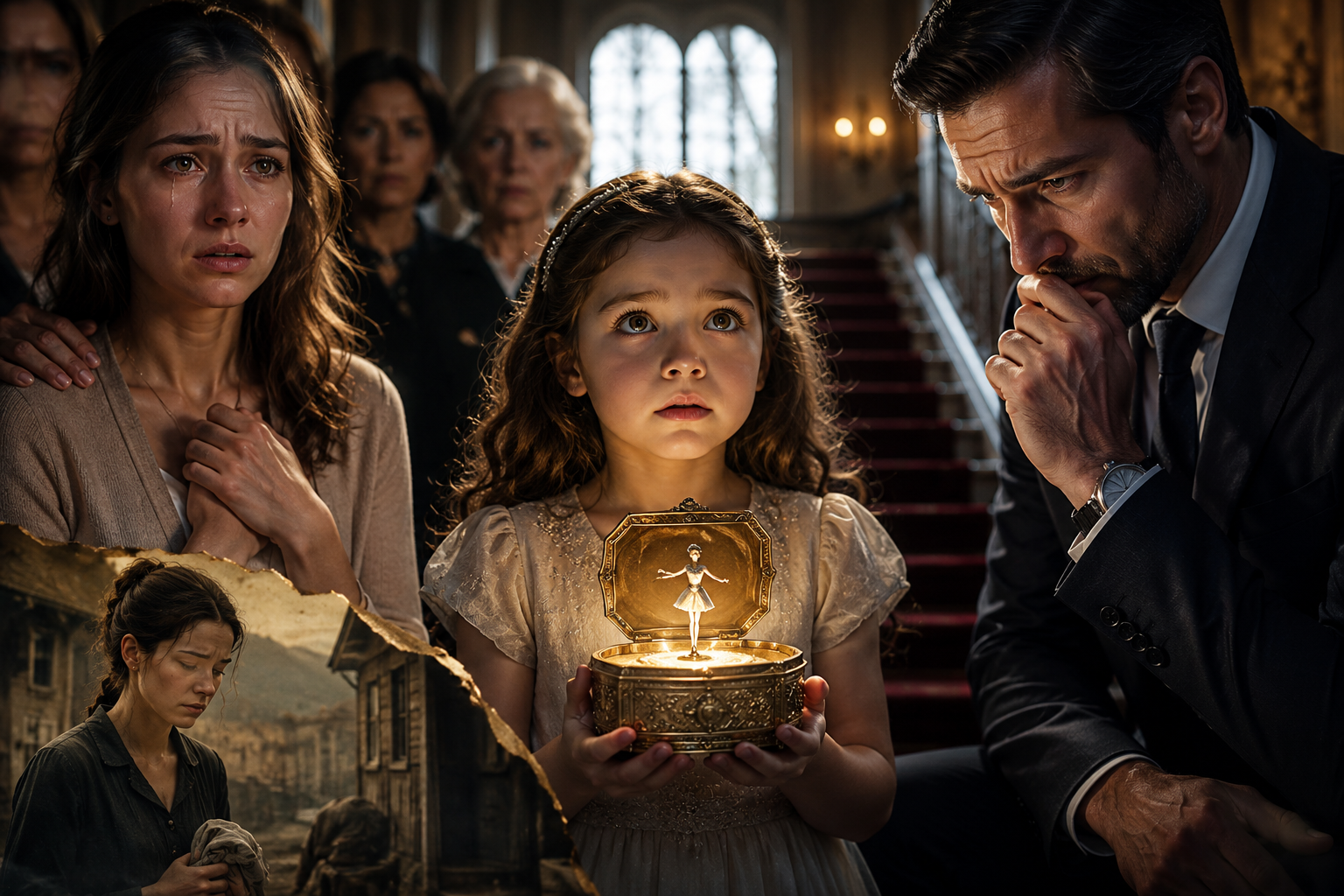
“For twenty-two years, people called Clara Vale a thief. Today, in the store that sold her dreams without her name, I ask you to remember her correctly.”
The room was silent.
“She was a daughter. A mother. An artist. A woman who protected what was hers even when powerful people tried to scare her into silence.”
He looked down at Lily.
“And she was loved by the child she left behind.”
Lily lifted her blue paper moon.
Then one by one, every child in the store lifted theirs.
A hundred tiny moons rose into the air.
Thomas could not speak after that.
He did not need to.
The song began to play over the speakers.
Not the commercial version.
Clara’s original recording.
Her voice, soft and young, sang the words Lily had remembered.
Under the moon, beneath the snow, find the truth where blue flowers grow.
People cried openly.
Julian covered his face.
Thomas closed his eyes and listened to his daughter sing inside the store that had tried to erase her.
And for once, the walls did not feel stolen.
They felt returned.
Later, after the crowd left, Lily placed her paper moon beneath Clara’s photo.
“Mommy,” she whispered, “we did it.”
Thomas stood behind her, one hand on her shoulder.
“Yes,” he said. “We did.”
But deep down, he knew the truth.
Clara had done it.
She had hidden the letter.
She had taught Lily the song.
She had trusted Thomas with the key before anyone knew it was a key.
She had built a truth small enough to fit inside a doll and strong enough to bring a toy empire to its knees.
As they walked out of the store that evening, Julian stopped Thomas near the door.
“Mr. Vale,” he said, “the board wants to offer you an honorary chair position.”
Thomas looked at him.
Then he laughed.
A real laugh this time.
“I’m too old for chairs that don’t rock.”
Julian smiled.
“Then what do you want?”
Thomas looked across the store.
At the children.
At Lily.
At the wall where Clara’s name finally belonged.
“I want a shelf,” he said.
“A shelf?”
“One shelf in every Wonderlight store. Low enough for children to reach. Toys no child is told they can’t touch just because their pockets are empty.”
Julian’s face softened.
“We can do that.”
“And no child gets chased out for looking.”
Julian lowered his eyes.
“Never again.”
Six months later, every Wonderlight Toys had a Clara Shelf.
Children could choose one toy from it for free on their birthday.
No proof of income.
No humiliating questions.
No cold employee deciding who looked worthy.
Just a shelf low enough for small hands and kind enough for tired families.
Lily visited the first one with Thomas.
She watched a little boy choose a stuffed bear, then hug it so tightly his mother started crying.
Lily leaned against her grandfather’s side.
“Grandpa,” she said, “Mommy would like this.”
Thomas looked at the shelf.
At the toys waiting to be held.
At the children walking out with something soft in their arms.
“Yes,” he said. “She would.”
That night, Thomas placed Lily’s Blue Moon doll on her dresser.
The original stayed in the store display, safe behind glass.
But Julian had made Lily a perfect copy.
Inside it, Thomas placed a tiny note written in his own shaky hand.
Your mother was not a thief. She was the song.
Lily would find it years later.
But that night, she only turned the silver handle and climbed into bed as the melody filled her room.
Thomas stood in the doorway listening.
For the first time in twenty-two years, the song did not feel like grief.
It felt like proof.
Proof that cruelty can be loud, but truth is patient.
Proof that poor hands can carry royal keys.
Proof that a child’s memory can outlast a corporation’s lie.
And proof that sometimes, the person a store tries to throw out is the one holding the key to everything it stole.
Lily’s eyes grew heavy.
“Grandpa?” she murmured.
“Yes, sweetheart?”
“Can we go back to the toy store tomorrow?”
Thomas smiled.
“Of course.”
She hugged the doll closer.
“But this time, can we stand as long as we want?”
His throat tightened.
He looked at the little girl who had once lowered her eyes because a stranger told her she did not belong.
Then he looked at the music-box doll, its blue dress glowing softly in the night-light.
“Yes,” he said.
“As long as we want.”
And that was the real victory.
Not the money.
Not the headlines.
Not Victor Whitmore in a courtroom.
The victory was a little girl walking into a toy store with her head high, touching the doll her mother made, and knowing no one had the right to move her along.
Because her mother’s name was on the wall now.
Her grandfather’s hands were in the foundation.
And the key that once unlocked a hidden letter had finally opened something much bigger.
A future where Lily Vale would never again have to beg with her eyes.
She would look straight ahead.
She would remember the song.
And she would know exactly where she belonged.