Because truth has gravity.
Partners withdrew. Donations were returned. A government contract was suspended when investigators found irregular payments tied to permits.
Once one locked room opens, people start checking other doors.
Octavio blamed me, of course.
One day outside court, he stepped too close while Julian was buying water.
“You have destroyed a family,” he said.
I looked at him.
“No,” I said. “I exposed one.”
His face twisted.
“My son’s life is over.”
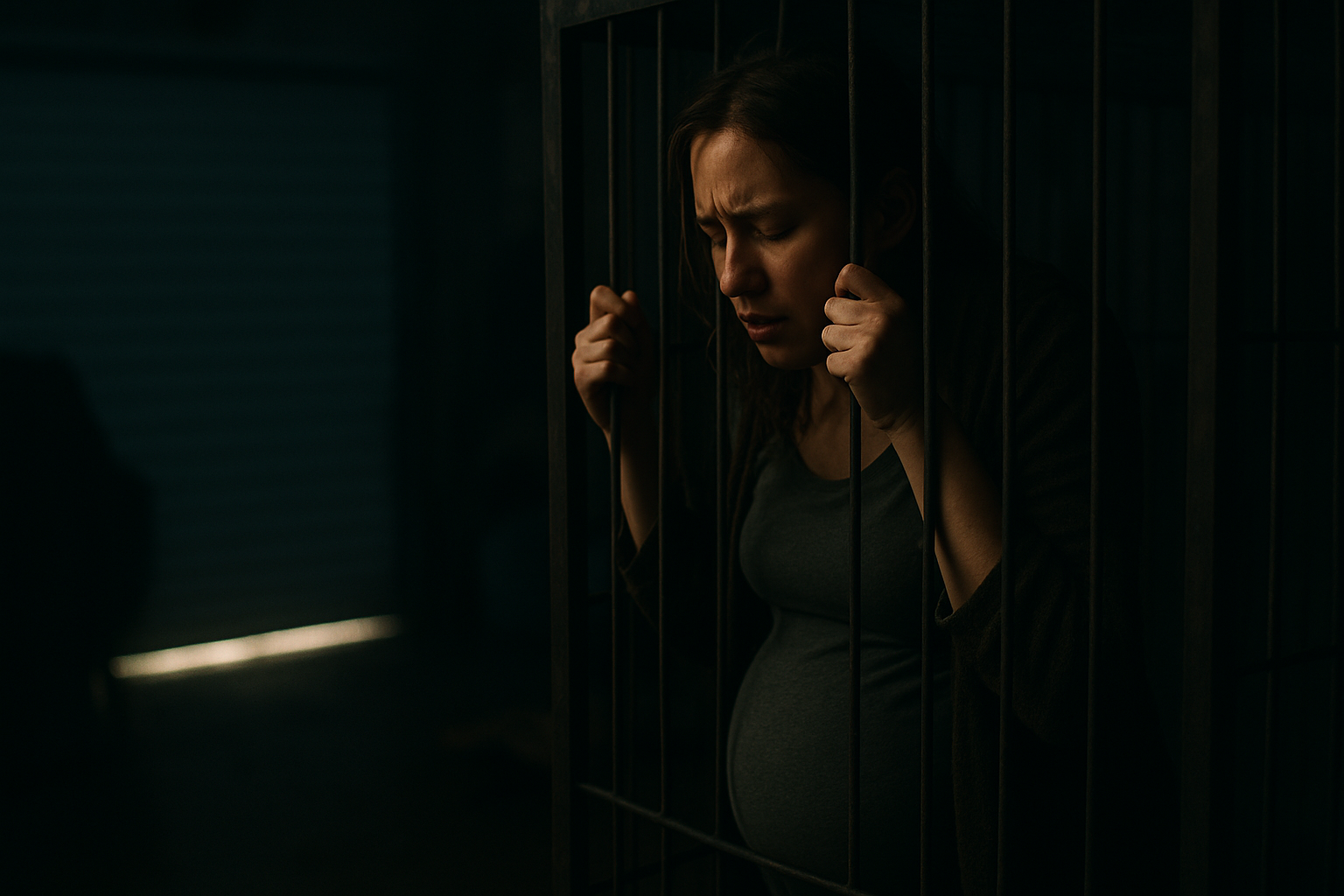
I thought of the garage. The dark. The cage. My baby coming into the world under terror.
“Your son still has a life,” I said. “That is more mercy than he gave me.”
Octavio raised his hand.
Not fully.
Just enough.
A voice behind him said, “I would not.”
Julian stood there with two water bottles, calm in the way storms are calm before they choose a direction.
Octavio lowered his hand.
He never approached me again.
Dante eventually accepted a plea agreement after Bianca agreed to testify.
Not because she found a conscience.
Because she found self-preservation.
She told the court about the messages, the plan to call me unstable, the custody discussions, and the pressure from Dante’s parents to protect the family image at any cost.
Celeste cried when Bianca testified.
I did not.
Bianca looked at me once across the courtroom.
“I didn’t think he would go that far,” she said.
That sentence followed me home like a bad smell.
People say that when they helped build the road but do not want responsibility for where it ended.
Dante was sentenced.
Bianca faced charges tied to conspiracy, intimidation, and obstruction. Octavio’s business investigations continued. Celeste lost her committees, which hurt her more than she admitted.
The Alvarado name did not disappear.
But it changed.
Money can polish a name.
It cannot make cruelty clean.
And me?
I moved into Julian’s house for six months.
He turned the guest room into a nursery with military precision. Diapers stacked by size. Bottles labeled. Emergency numbers laminated.
He installed a camera above the crib and proudly called it “for safety.”
I stared at him.
He removed it immediately.
“Right,” he said. “No cameras.”
We laughed for the first time in weeks.
Healing was not beautiful.
It was messy.
Some days I felt strong. Other days I cried because a garage door closed across the street. Some nights I woke convinced I was back in the cage. Sometimes Mateo’s crying made my body panic, because my body remembered crying as something dangerous.
Therapy helped.
Time helped.
Julian helped.
Mrs. Nela helped with soup, gossip, and her firm belief that babies should wear socks even in warm weather.
But most of all, returning to myself helped.
I began teaching again.
Not full-time. Not at first.
One morning a week at a community center. Then two. Then three.
I taught children to read. To write. To hold pencils. To raise their hands without fear.
I had forgotten how much I loved a classroom. The chaos. The questions. The tiny dramas over crayons and missing erasers.
One little girl asked why I wore my wedding ring on a chain around my neck.
I looked down.
I had not worn it as a promise since the garage. I wore it because it had carved the message that helped prove the truth.
It was no longer Dante’s ring.
It was evidence that I had refused to vanish.
“It helped me remember I was stronger than I thought,” I told her.
She nodded seriously.
“Like armor?”
I smiled.
“Yes. Like armor.”
Later, I had the diamond made into a small star pendant. The band itself I kept in a box with Mateo’s hospital bracelet, my court statement, Mrs. Nela’s note, and the first picture of my son after birth.
Not because I wanted to live in the past.
Because memory protects the truth when shame tries to rewrite it.
A year after Mateo was born, we held his birthday party in Mrs. Nela’s garden.
Not in a fancy hall.
Not in the Alvarado house.
In a garden full of clay pots, paper banners, folding chairs, homemade tamales, and children chasing balloons through wet grass because, of course, it rained again.
Julian burned the meat and argued with the smoke.
Irene brought cupcakes.
Officer Salas came after her shift and gave Mateo a toy police car.
Mrs. Nela wore a purple dress and told everyone she was the baby’s “strategic intelligence department.”
I laughed until I cried.
When it was time for cake, Mateo smashed both hands into the frosting before anyone could stop him.
Everyone cheered.
I watched my son, healthy and loud and sticky with vanilla icing, and felt a strange peace.
Not because the past was gone.
Because it had not won.
Julian stood beside me.
“Do you ever think about leaving Santa Lucía?” he asked.
I looked at the garden wall. The same wall where my note had crossed from danger into hope.
“No,” I said. “Not anymore.”
“I thought this city would feel haunted.”
“It does,” I said. “But not all ghosts are enemies.”
I looked at Mrs. Nela laughing with Mateo.
“This is where she helped save us. This is where you came. This is where he survived. I don’t want Dante to own the map of my life.”