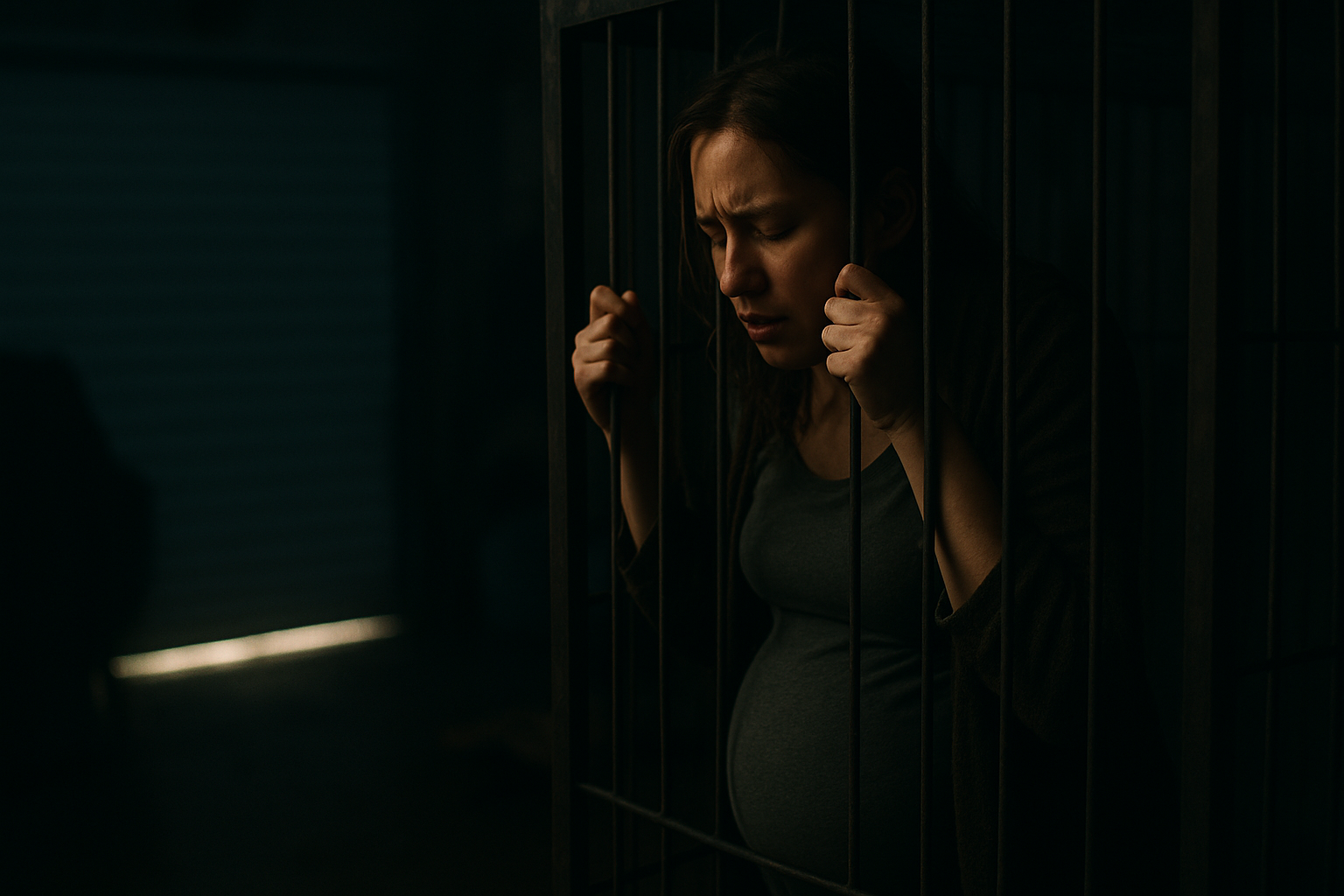
“Marisol Vega and her newborn son are safe. The matter involves documented evidence, police reports, and an ongoing criminal process. Any attempt to defame Ms. Vega or intimidate witnesses will be treated as further evidence.”
She did not say cage.
She did not say labor.
She did not have to.
A city may love gossip.
But it respects proof.
Meanwhile, I was learning to hold my son without shaking.
That sounds simple.
It was not.
For weeks, every sudden sound froze my body. A door closing. A phone buzzing. A man laughing too loudly down the hall.
People told me I was safe.
But safety is not a switch someone else can flip.
It is a room you rebuild inside yourself, nail by nail.
One night Julian found me sitting upright, exhausted, staring into Mateo’s crib.
“He’s breathing,” he said softly.
“I know.”
“You need sleep.”
“I can’t.”
He pulled a chair beside me.
“Then I’ll watch him while you close your eyes for ten minutes.”
“I can’t.”
“Mari.”
My name sounded like childhood in his mouth.
I began to cry.
“I picked him,” I whispered. “Dante. I married him. I brought my baby into that house.”
Julian knelt in front of me.
“No.”
“Yes.”
“No,” he said again. “You picked the man he pretended to be. He chose the monster he became.”
“I should have known sooner.”
“You knew as soon as you could safely know. Then you made a plan. You got a note to Mrs. Nela. You saved yourself and your son before any of us even arrived.”
I looked at him.
His voice broke.
“I jumped a wall, Mari. You built the bridge.”
That stayed with me.
You built the bridge.
The first hearing was packed.
Not just with reporters. With Alvarado relatives. Business partners. Church acquaintances. Women who had smiled at me at charity dinners. Men who had shaken Dante’s hand as if he were the future of the family.
Dante entered in a dark suit.
No cologne this time.
No smirk.
He looked thinner. Paler.
But still offended.
Some men do not look guilty when they are caught.
They look inconvenienced.
His mother sat behind him with a rosary. His father sat beside her, face carved from stone.
Bianca was not there yet.
She had tried to leave the city after Dante’s arrest. Police found her two days later at a cousin’s apartment with a new phone and a suitcase full of cash. Her messages tied her to the plan to make me look unstable.
She claimed she thought Dante was “only scaring” me.
Only scaring.
As if terror is not a crime when it stops short of death.
When the prosecutor described the evidence, the courtroom changed.
The cage.
The footage.
The messages.
The photos sent to Bianca.
The note to Mrs. Nela.
The words carved into the floor with my wedding ring.
At that, Dante looked down for the first time.
Not in shame.
In calculation.
My statement came later.
I stood behind a screen so I would not have to see him while I spoke. I wanted my voice to reach the judge without Dante’s eyes dragging me back into silence.
“My name is Marisol Vega,” I began. “I was a teacher before I was a wife. I was a sister before I was a victim. I was a mother before my son took his first breath, because I fought for him when his father decided we did not deserve help.”
The courtroom went still.
“Dante did not lose control,” I said. “He used control. He isolated me, took my phone, watched my movements, cut me off from people who loved me, and when I was most vulnerable, he locked me in a cage and photographed me.”
My voice shook.
I paused.
Then I thought of Mateo.
Born furious.
Ready to argue with everybody.
I kept going.
“He told his lover I was learning my place. He was wrong. That night, I learned my place was not under him. Not behind him. Not inside any cage he built. My place is beside my son, in my own life, with my own name.”
Someone behind me sobbed.
I did not turn.
“I am not here because I want revenge. I am here because men like Dante count on women disappearing quietly. I did not disappear.”
When I finished, the judge called a recess.
Outside the courtroom, Julian stood with Mateo strapped against his chest. My son slept with his mouth open, completely unimpressed by justice.
“How did I do?” I whispered.
Julian looked at me as if I were the bravest person he had ever seen.
“You sounded free.”
The case did not end in one day.
Real justice rarely moves at the speed of pain.
There were delays. Expert reports. Attempts to challenge evidence. Attempts to paint me as unstable. Attempts to make Julian seem violent. Attempts to make Mrs. Nela look confused because of her age.
That last one was a mistake.
When the defense attorney asked if she might have misunderstood what she heard that night, Mrs. Nela adjusted her glasses.
“Young man,” she said, “I have been ignoring foolish men since before your mother learned to walk. I know the difference between a woman crying and a television drama.”
The courtroom laughed.
Even the judge looked down to hide a smile.
Mrs. Nela became a legend by accident.
Then the Alvarado business began to suffer.
Not because I campaigned against them.