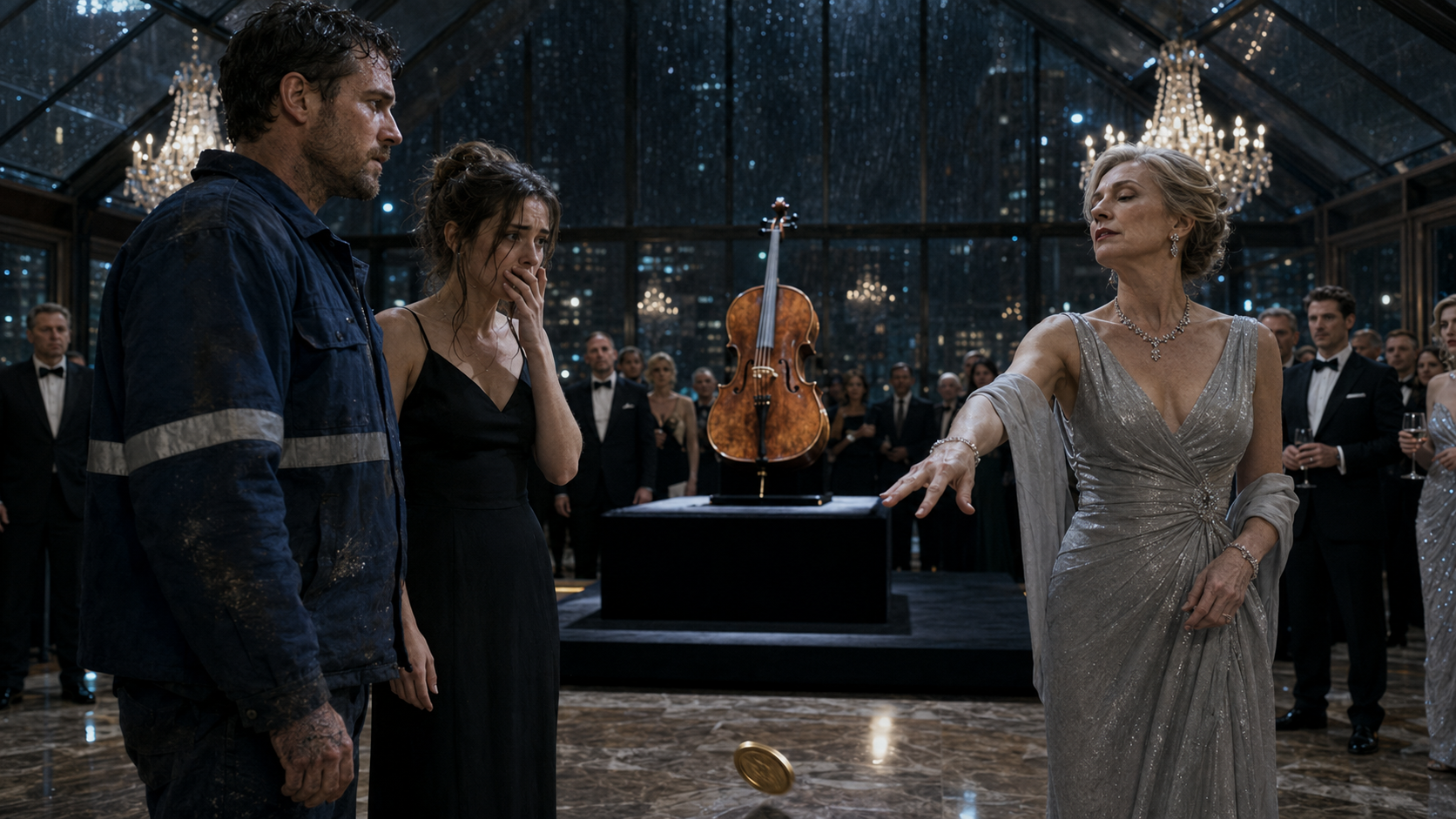
“Which collection?”
“That information is confidential.”
“Was its ownership history independently verified?”
A nervous murmur passed through the crowd.
Vivienne gave a short laugh.
“You repair railway cables, Mr…?”
“Reed.”
“Mr. Reed. I doubt you understand the complexities of international art ownership.”
“I understand shipping records.”
“That is hardly the same thing.”
“Sometimes it is exactly the same thing.”
The ballroom doors opened.
A tall man wearing a dark suit entered with two uniformed officers. Behind them came a woman carrying a silver evidence case.
The guests turned.
Vivienne’s smile disappeared.
The man in the suit approached Elias first.
“Mr. Reed,” he said. “We recovered the final ledger.”
Vivienne stared at him.
The man continued.
“It matches the warehouse manifests, the insurance claims, and the foundation’s private acquisition records.”
One of the guests lowered his champagne glass.
Another stopped recording.
Vivienne spoke sharply.
“Who allowed these people inside?”
The man showed his identification.
“Financial Crimes Division.”
For the first time that evening, the confidence left Vivienne’s eyes.
Elias bent down and picked up the golden token.
He examined it under the chandelier.
On one side was the Aurelia Foundation’s emblem.
On the other was a serial number.
“Interesting,” he said.
“What?” Mara asked.
“This isn’t a cloakroom token.”
The investigator took it from him and placed it in a transparent evidence pouch.
“It belongs to the foundation’s private storage facility,” he explained. “These tokens are issued to authorized warehouse visitors.”
Vivienne’s face became pale.
The young woman with emerald earrings quietly stepped away from her.
Mara looked from the evidence pouch to the cello.
“What is happening?”
Elias faced her.
“Your father’s instrument wasn’t sold to pay his debts.”
Mara stopped breathing.
“It was removed from his workshop before the legal inventory began,” Elias continued. “The auction documents were forged later.”
“Who took it?”
He looked at Vivienne.
No one laughed now.
Mara shook her head.
“You knew?”
“I suspected.”
“For how long?”
“Since I saw the photograph in the auction announcement.”
“And you didn’t tell me?”
“I needed proof before I gave you hope.”
Vivienne recovered enough composure to straighten her shoulders.
“This is absurd. The foundation has handled thousands of donations. I cannot personally verify every object that passes through our facilities.”
The investigator opened the silver case.
Inside were several folders, two encrypted drives, and a stack of photographs.
“You personally approved the transfers,” he said. “You also received payments through three consulting companies.”
Vivienne turned toward the ballroom.
“My attorneys will address this misunderstanding.”
“They’re welcome to try.”
She looked at Elias again.
“You arranged this?”
“Part of it.”
“Who are you?”
A distant mechanical sound came from above them.
The glass roof began to open.
Rain-cooled air swept into the ballroom as the panels separated. Guests looked upward. Beyond the roof, a black rescue helicopter descended toward the private landing platform.
Its rotors sent water streaming across the glass.
Vivienne watched it in disbelief.
The helicopter bore the emblem of Northline Emergency Systems, the company responsible for medical transport, disaster communications, and rail safety networks across six countries.
Its founder had never appeared in interviews.
He had never attended award ceremonies.
Newspapers used an outdated university photograph whenever they mentioned him.
Mara slowly turned toward Elias.
“No,” she whispered.
He looked almost embarrassed.
A woman in a flight jacket entered through the rooftop corridor.
“Elias, the board is connected,” she said. “Oslo, Montreal, and Singapore are waiting. The transport ministry also wants your report before midnight.”
Mara stared at him.
“You own Northline?”
“I started it.”
“You told me you repaired train systems.”
“I do repair train systems.”
“You let me believe you were a maintenance worker.”
“I am a maintenance worker.”
“You are also a billionaire.”
Elias glanced around the ballroom.
“That part has never been particularly useful.”
Despite everything, Mara gave a breathless, disbelieving laugh.
Vivienne took a step backward.
“You came here disguised.”
“No,” Elias said. “I came here directly from my job.”
The answer landed harder than an accusation.
He walked to the auction platform and stopped beside the cello.
“The Aurelia Foundation sold stolen instruments through charity auctions,” he said. “The buyers received impressive tax documents. The foundation received clean money. Families like Mara’s were told their property had disappeared into bankruptcy sales.”